Ecosystem — DPP 3

20 NEET questions from Ecosystem, with answers and explanations. Attempt it as a timed test to get scoring, accuracy breakdown and mistake tracking.

Attempt this test free 20 questions · 30 minutes · +80 marks
1
Which of the following is an example of a primary consumer in a terrestrial ecosystem?
  1. A Grasshopper
  2. B Zooplankton's
  3. C Snake
  4. D Lion
Show answer

Correct answer: C

2
Photosynthetically active radiation (PAR) represents the following range of wave length.
  1. A $400 - 700 \mathrm {~nm}$
  2. B $500 - 600 \mathrm {~nm}$
  3. C $450 - 950 \mathrm {~nm}$
  4. D $340 - 450 \mathrm {~nm}$
Show answer

Correct answer: A

3
Under certain conditions soil nutrients get tied up with the biomass of microbes and becomes temporarily unavailable to other organism such incorporation of nutrients is called -
  1. A Nutrient immobilisation
  2. B Acclimatisation
  3. C Mineralisation
  4. D Leaching
Show answer

Correct answer: A

4
Choose the incorrect one regarding ecological pyramids :-
  1. A No place for decomposers
  2. B Represent unidirectional flow of energy
  3. C Can represent food web
  4. D Is erect for number of organisms in grassland ecosystem.
Show answer

Correct answer: C

5
Vultures in an ecosystem are :
  1. A Predators
  2. B Scavangers
  3. C Consumers
  4. D Top carnivores
Show answer

Correct answer: B

6
Assertion :- Detritus food chain may be connected with grazing food chain at some levels.
Reason :- Some of the organisms of DFC are prey to the GFC animals and some of the organisms are of omnivorous nature.
  1. A Both Assertion and Reason are true but Reason is not the correct explanation of Assertion.
  2. B Assertion is true but Reason is false.
  3. C Assertion is false but Reason is true.
  4. D Both Assertion and Reason are true and Reason is the correct explanation of Assertion.
Show answer

Correct answer: D

7
How much amount of incident solar radiation (ISR) is used in the photosynthesis process by plants :-
  1. A $1 - 5 \%$
  2. B $5 - 10 \%$
  3. C $20 - 40 \%$
  4. D $50 - 70 \%$
Show answer

Correct answer: A

8
Percentage energy transferred to higher trophic level in food chain is :-
  1. A $1\%$
  2. B $10 \%$
  3. C $90 \%$
  4. D $100\%$
Show answer

Correct answer: B

9
Concentration of DDT is highest in :-
  1. A Primary consumer
  2. B Producers
  3. C Top consumer
  4. D Decomposers
Show answer

Correct answer: C

10
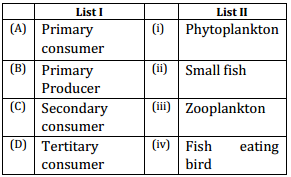
Match list-I with list-II and select correct answer:
Ecosystem – NEET-3638
  1. A A-ii & B-iii & C-i & D-iv
  2. B A-iii & B-i & C-ii & D-iv
  3. C A-i & B-ii & C-iii & D-v
  4. D A-iii & B-ii & C-i & D-iv
Show answer

Correct answer: B

11
Consider the following statements concerning food chains :-
(a) Removal of $80 \%$ tigers from an area resulted in greatly increased growth of vegetation.
(b) Removal of most of the carnivores resulted in an increased population of deers.
(c) The length of food chains is generally limited to 3-4 trophic levels due to energy loss.
(d) The length of food chains may very from 2 to 8 trophic levels. Which two of the above statements are correct?
  1. A a, d
  2. B a, b
  3. C b, c
  4. D c, d
Show answer

Correct answer: C

12
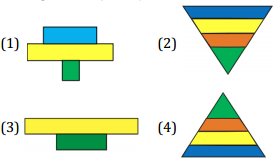
For the given food chain choose the correct pyramid for biomass:
Phytoplankton → Zooplankton → Small fishes → Large fishes (Shark)
Ecosystem – NEET-3582

  1. A
  2. B
  3. C
  4. D BES293
Show answer

Correct answer: B

13
Plant → Insect → P → Snake → Hawk In above given food chain identify P :-
  1. A Frog
  2. B Cobra
  3. C Fox
  4. D Lion
Show answer

Correct answer: A

14
Large ecosystems are called -
  1. A Biomes
  2. B Ecotone
  3. C Ecads
  4. D Biocoenosis
Show answer

Correct answer: A

15
The rate of formation of new organic matter by rabbit in a grassland, is called :-
  1. A Net primary productivity
  2. B Gross primary productivity
  3. C Net productivity
  4. D Secondary productivity
Show answer

Correct answer: D

16
Given below are two statements:
Statement-I: Trophic level represents a functional level, not a species as such.
Statement-II: A given species may occupy more than one trophic level in the same ecosystem at the same time.
In the light of the above statements, choose the correct answer from the options given below:
  1. A Statement I is true, but Statement II is false.
  2. B Statement I is false, but Statement II is true.
  3. C Both Statement I Statement II is true.
  4. D Both Statement I Statement II is false.
Show answer

Correct answer: B

17
The detritus food chain (DFC) begins with :-
  1. A Producers
  2. B Grasses
  3. C Dead organic matter
  4. D Humus
Show answer

Correct answer: C

18
Trophic levels are formed by :-
  1. A Only plants
  2. B Only carnivores
  3. C Only animals
  4. D Organisms linked in food chain
Show answer

Correct answer: D

19
Which of the following option correctly represent functions of an ecosystem?
(A) Energy flow
(B) Decomposition
(C) Productivity
(D) Nutrient cycling
  1. A A and D
  2. B A, C and D
  3. C B, C and D
  4. D A, B, C and D
Show answer

Correct answer: D

20
Nepenthes (Insectivorous pitcher plant) is:
  1. A Producer
  2. B Consumer
  3. C Both (A) & (B)
  4. D None
Show answer

Correct answer: C

Attempt this as a timed test

Reading answers is not the same as sitting the paper. Attempt it timed and you get your score, per-question timing, and the mistakes tracked for revision.

Start free

More Ecosystem tests

All Ecosystem tests →