Neural Control And Coordination — DPP 2

20 NEET questions from Neural Control And Coordination, with answers and explanations. Attempt it as a timed test to get scoring, accuracy breakdown and mistake tracking.

Attempt this test free 20 questions · 30 minutes · +80 marks
1
Which part of the brain has centres for controlling respiration, cardiovascular reflexes and gastric secretions
  1. A Cerebrum
  2. B Cerebellum
  3. C Medulla
  4. D Pons
Show answer & explanation

Correct answer: C

Respiratory rhythm centre, cardiac centre are present in medulla oblongata. Taste, smell or thought of food or tactile sensations of food in the mouth stimulate medulla oblongata that influences gastric secretions.
2
Which of the following act as auditory receptors in the ear?
  1. A Semicircular canals
  2. B Cristae
  3. C Hair cells of oragn of corti
  4. D Saccule and utricle
Show answer & explanation

Correct answer: C

Hair cells are part of sensory structure i.e. organ of corti.
3
The stereo cilia are projected from which part of the hair cell?
  1. A Basal part
  2. B Apical part
  3. C Lateral part
  4. D Front part
Show answer & explanation

Correct answer: B

Stereo cilia are projected from apical part of the hair cells.
4
The lower membrane of the scala vestibuli is the
  1. A Tympanic membrane
  2. B Reissner's membrane
  3. C Basilar's membrane
  4. D Tectorial membrane
Show answer & explanation

Correct answer: B

Tectorial membrane covers the tips of the hair cells.
Basilar's membrane is the lower membrane of cochlea.
5
The eustachian tube connects _______ with the _______.
  1. A External auditory canal, middle ear cavity
  2. B Middle ear cavity, pharynx
  3. C External auditory canal, labyrinth
  4. D Cochlea, larynx
Show answer & explanation

Correct answer: B

Eustachian tube connects middle ear to the pharynx
6
The receptors of neurotransmitters are present on/in the
  1. A Pre-synaptic membrane
  2. B Synaptic cleft
  3. C Post-synaptic membrane
  4. D Ion channels
Show answer & explanation

Correct answer: C

The neurotransmitters that are released by pre-synaptic membrane and attaches to the receptors that are present on the post-synaptic membrane.
7
The ionic gradients across the resting membrane are maintained by the
  1. A Ion channels
  2. B Sodium-potassium pumps
  3. C Electrical synapses
  4. D Chemical synapses
Show answer & explanation

Correct answer: B

The ionic gradients across the resting membrane is due to opening of $\mathrm{K}^{+}$leaky channels but is maintained because of $\mathrm{Na}^{+} \mathrm{K}^{+}$pump which continuously pump $3 \mathrm{Na}^{+}$ions outwards in exchange of $2 \mathrm{~K}^{+}$inwards at the expense of energy.
8
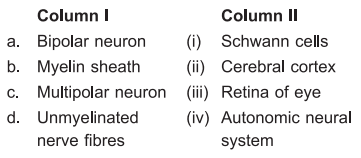
Match the columns.
Neural Control And Coordination – NEET-8759
  1. A a(i), b(iii), c(ii), d(iv)
  2. B a(iii), b(i), c(ii), d(iv)
  3. C a(iv), b(ii), c(i), d(iii)
  4. D a(i), b(ii), c(iii), d(iv)
Show answer & explanation

Correct answer: B

Bipolar neuron is found in retina of eye. Myelin sheath is formed by Schwann cells, and multipolar neurons are found in cerebral cortex. Unmyelinated nerve fibres are commonly found is autonomic and somatic neural system.
9
The eye receives retinal blood vessels at the
  1. A Yellow spot
  2. B Fovea
  3. C Ciliary body
  4. D Blind spot
Show answer & explanation

Correct answer: D

Fovea is present on the macula lutea lateral to blind spot.
10
The hair cells present on the crista ampullaris receive the stimuli of
  1. A Audition
  2. B Change in the body posture
  3. C Vision
  4. D Olfaction
Show answer & explanation

Correct answer: B

The hair cells present on the cristae ampullaris receives stimuli of the change of body posture.
11
Above the rows of hair cells in cochlea is a thin elastic membrane called
  1. A Tectorial membrane
  2. B Reissner's membrane
  3. C Tympanic membrane
  4. D Sclera
Show answer & explanation

Correct answer: A

Reissner's membrane forms the roof of scala media.
12
Cytoplasm with typical cell organelles and Nissl's granule is present in the
  1. A Axon Hillock
  2. B Cell body
  3. C Axon
  4. D Synaptic vesicles
Show answer & explanation

Correct answer: B

Cytoplasm with cell organelles and Nissl’s granule is a characteristic of cyton/cell body part of axoplasm but absent in the axon
13
Which of the following is the function of ear ossicles?
  1. A To collect the vibrations in the air
  2. B To equalise the pressures on either sides of the ear drum
  3. C To secrete ear wax
  4. D To increase the efficiency of transmission of sound waves to the inner ear
Show answer & explanation

Correct answer: D

Ear ossicles are responsible for amplification of signal due to leverage system of ossicle. Thus, they increase the efficiency of transmission of sound waves.
14
Equal stimulation of all three types of cones will result in sensation of
  1. A Green light
  2. B White light
  3. C Red light
  4. D Blue light
Show answer & explanation

Correct answer: B

The sensations of different colors are produced by various combinations of the three different types of cones and their photopigments. When these cones are stimulated equally, a sensation of white light is produced.
15
The scala vestibuli ends at the _______ while the scala tympani terminates at the ______. Find the correct option.
  1. A Scala media, temporal bone
  2. B Oval window, round window
  3. C Pinna, tympanic membrane
  4. D Eustachian tube, external auditory meatus
Show answer & explanation

Correct answer: B

The scala vestibuli ends at the oval window while the scala tympani ends at the round window.
16
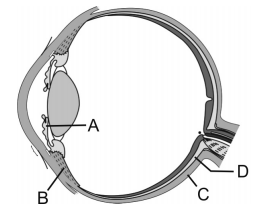
Part A, B, C and D of human eye are shown in the diagram. Choose the option which provides the correct identification of these alphabets.
Neural Control And Coordination – NEET-8762
  1. A A: Iris, B: Retina, C: Choroid, D: Sclera
  2. B A: Iris, B: Ciliary body, C: Sclera, D: Choroid
  3. C A: Ciliary body, B: Iris, C: Choroid, D: Sclera
  4. D A: Cornea, B: Iris, C: Sclera, D: Retina
Show answer & explanation

Correct answer: B

A = Iris
B = Ciliary body
C = Sclera
D = Choroid
17
Which layer of the wall of eyeball looks bluish in colour?
  1. A Sclera
  2. B Cornea
  3. C Choroid
  4. D Retina
Show answer & explanation

Correct answer: C

Choroid, that is present in between the retina and sclera, is the highly vascular layer of eye and the choroid is heavily pigmented because of excess of melanin. This is to prevent the internal reflection in the eyes, to ensure the image received is not blurred.
18
The retinal blood vessels enter the eye at
  1. A Fovea
  2. B Blind spot
  3. C Macula lutea
  4. D Crista
Show answer & explanation

Correct answer: B

The retinal blood vessels enter the eye and the optic nerve leave the eye at blind spot Photoreceptor cells are absent at the blind spot, hence this spot is known as blind spot.
19
Which of the following results in the generation of potential differences in the photoreceptor cells of eyes?
  1. A Conversion of retinal into opsin
  2. B Conversion of opsin into retinal
  3. C Dissociation of the retinal from opsin
  4. D Dissociation of the opsin from retinol
Show answer & explanation

Correct answer: C

Dissociation of retinal from opsin results in the generation of potential difference. When light is absorbed by rhodopsin, retinal is split from protein and the rod becomes partially bleached. At the same time nerve impulse is generated
20
Select the incorrectly matched pair w.r.t. structure of ear and its function/feature.
  1. A Cochlea - Main hearing organ of inner ear
  2. B Eustachian tube - Equalises pressure on either side of the ear drum
  3. C External auditory - Wax secreting meatus glands present
  4. D Tympanic - Covered with mucous membrane membrane on the outside and connective tissue on the inside
Show answer & explanation

Correct answer: D

The outer surface of tympanic membrane is composed of connective tissue covered with skin while inner surface has mucous membrane.

Attempt this as a timed test

Reading answers is not the same as sitting the paper. Attempt it timed and you get your score, per-question timing, and the mistakes tracked for revision.

Start free

More Neural Control And Coordination tests

All Neural Control And Coordination tests →