Photosynthesis In Higher Plants — DPP 3

20 NEET questions from Photosynthesis In Higher Plants, with answers and explanations. Attempt it as a timed test to get scoring, accuracy breakdown and mistake tracking.

Attempt this test free 20 questions · 30 minutes · +80 marks
1
Thomas Engelmann illuminated a filament of algae with light that passed through a prism, thus exposing different segments of the algal filament to different wavelength of light. He added aerobic bacteria and found that these bacteria congregated in the areas illuminated by red and blue light. If you run the same experiment without passing light through a prism, what would you predict?
  1. A There would be no difference in results
  2. B The number of bacteria would decrease along the entire length of the filament
  3. C The bacteria would be relatively evenly distributed along the length of the filament
  4. D The number of bacteria would increase along the entire length of the filament
Show answer

Correct answer: C
2
Identify the mismatched pair.
  1. A Light saturation - 10 percent of full sunlight
  2. B Blackman - Law of Limiting Factors
  3. C Joseph Priestley - First action spectrum of photosynthesis
  4. D Julius von Sachs - Evidence for production of glucose
Show answer

Correct answer: C

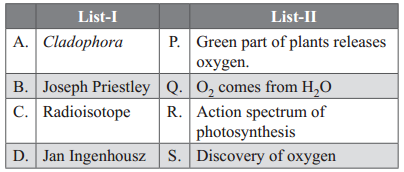
3
Match the List-I with List-II to find out the correct option.
Photosynthesis In Higher Plants – NEET-6344
  1. A A-S; B-P; C-T; D-Q; E-R
  2. B A-S; B-T; C-P; D-R; E-Q
  3. C A-P; B-S; C-T; D-Q; E-R
  4. D A-S; B-P; C-Q; D-R; E-T
Show answer

Correct answer: A

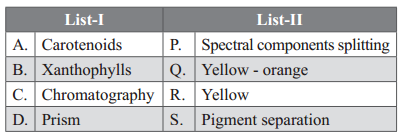
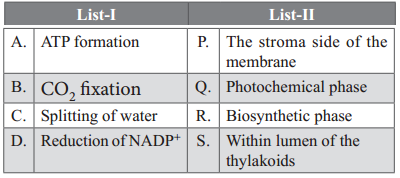
4
Match the List-I with List-II to find out the correct option.
Photosynthesis In Higher Plants – NEET-6342
  1. A A-Q; B-P; C-S; D-R
  2. B A-R; B-Q; C-S; D-P
  3. C A-P; B-S; C-Q; D-R
  4. D A-Q; B-R; C-S; D-P
Show answer

Correct answer: D

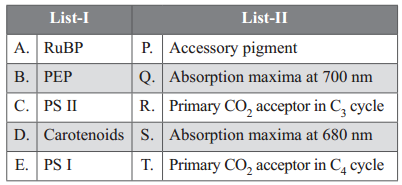
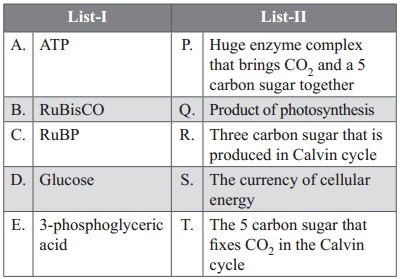
5
Match the List-I with List-II to find out the correct option.
Photosynthesis In Higher Plants – NEET-6327
  1. A A-Q; B-S; C-P; D-R; E-T
  2. B A-T; B-P; C-S; D-Q; E-R
  3. C A-R; B-P; C-Q; D-T; E-S
  4. D A-R; B-T; C-S; D-P; E-Q
Show answer

Correct answer: D

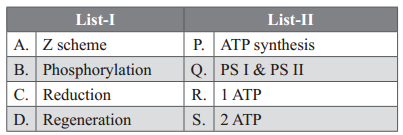
6
Choose the option which shows correct matchings amongst A, B, C and D.
Photosynthesis In Higher Plants – NEET-6345
  1. A B and C
  2. B A and C
  3. C B and D
  4. D A and B
Show answer

Correct answer: D

7
Assertion (A): Oxidative phosphorylation requires oxygen.
Reason (R): Photophosphorylation occurs in chloroplast.
  1. A Both Assertion (A) and Reason (R) are true and Reason (R) is the correct explanation of Assertion (A)
  2. B Both Assertion (A) and Reason (R) are true, but Reason (R) is not the correct explanation of Assertion (A)
  3. C Assertion (A) is true, but Reason (R) is false
  4. D Assertion (A) is false, but Reason (R) is true
Show answer

Correct answer: B

8
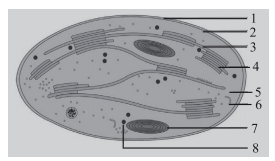
Identify the mismatched pair.
  1. A Maximum absorption by chlorophyll $a$ - Blue and red spectral regions
  2. B Lipid droplet - Within the thylakoid lumen
  3. C Plastoquinone - Proton carrier
  4. D Final acceptor of electron $-\mathrm{NADP}^{+}$
Show answer

Correct answer: B

9
Identify the correctly matched pair.
  1. A Both photosystem - Same reaction centre
  2. B Splitting of water $-\mathrm{P}_{700}$
  3. C Grana lamellae - Cyclic photophosphorylation only
  4. D First stable product PGA - $\mathrm{C}_{3}$ pathway
Show answer

Correct answer: D

10
Match the List-I with List-II to find out the correct option.
Photosynthesis In Higher Plants – NEET-6341
  1. A A-Q; B-P; C-S; D-R
  2. B A-P; B-S; C-Q; D-R
  3. C A-R; B-S; C-Q; D-P
  4. D A-S; B-P; C-R; D-Q
Show answer

Correct answer: A

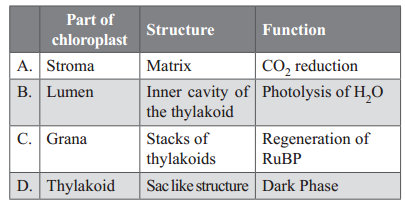
11
Which of the following is correctly matched with its function?
Photosynthesis In Higher Plants – NEET-6314

  1. A
  2. B
  3. C
  4. D
Show answer

Correct answer: C

12
Identify the mismatched pair.
  1. A World War II - beneficial use of radioisotope
  2. B Primary acceptor of $\mathrm{CO}_{2}$ in Calvin cycle - 2 carbon compound
  3. C Kranz anatomy - Found in sorghum
  4. D RuBisCO - Greater affinity for $\mathrm{CO}_{2}$
Show answer

Correct answer: B

13
Which one is NOT a mismatched pair?
  1. A Green parts release oxygen - Julius von Sachs
  2. B Alignment of chloroplast - Quantity of incident light
  3. C Stroma - Evolution of $\mathrm{O}_{2}$
  4. D Photochemical phase - Reduction of $\mathrm{CO}_{2}$
Show answer

Correct answer: B

14
Match the List-I with List-II to find out the correct option.
Photosynthesis In Higher Plants – NEET-6339
  1. A A-Q; B-P; C-S; D-R
  2. B A-Q; B-R; C-S; D-P
  3. C A-P; B-S; C-Q; D-R
  4. D A-R; B-S; C-Q; D-P
Show answer

Correct answer: D

15
The reactions of Calvin cycle are not directly dependent on light, but they usually do not occur at night. Why?
  1. A Night is often too cold for these reactions to occur.
  2. B $\mathrm{CO}_{2}$ concentration in night is too high for these reactions to occur.
  3. C Plants usually open their stomata at night.
  4. D Calvin cycle is dependent on the products of light reaction.
Show answer

Correct answer: D

16
Splitting of water is associated with:
  1. A photosystem I
  2. B lumen of thylakoid
  3. C both photosystem I and II
  4. D inner surface of thylakoid membrane.
Show answer

Correct answer: D

17
Which one of the following is NOT a correct statement?
  1. A Cyclic photophosphorylation also occurs when only light of wavelengths beyond 680 nm are available for excitation.
  2. B The LHC is made up of hundreds of pigment molecules bound to proteins.
  3. C The temperature optimum for photosynthesis of different plants does not depend on their adapted habitat.
  4. D Though chlorophyll is the major pigment responsible for trapping light, other thylakoid pigments also absorb
Show answer

Correct answer: C

18
Identify the mismatched pair.
  1. A The reaction centre - Many molecules of chlorophyll $a$
  2. B Downhill movement of electron - In ETS
  3. C Uphill movement of electron - Reaction centre to electron acceptor
  4. D Plants in shade or in dense forests - Light is a limiting factor
Show answer

Correct answer: A

19
Match the List-I with List-II to find out the correct option.
Photosynthesis In Higher Plants – NEET-6338
  1. A A-Q; B-P; C-S; D-R
  2. B A-Q; B-R; C-S; D-P
  3. C A-P; B-S; C-Q; D-R
  4. D A-S; B-R; C-P; D-Q
Show answer

Correct answer: B

20
Immediately after light becomes unavailable, the biosynthetic process of photosynthesis continues for some time, and then stops. If then, light is made available, the synthesis start again. Which of the following can be the relevant conclusion, based on the statement, given above?
  1. A Being physical and light driven, electron transport reactions are comparatively fast.
  2. B Membrane or lamellae of the grana have both PS-I and PS-II, the stroma lamellae membranes lack PS-II as well as NADP reductase enzyme.
  3. C Biosynthetic phase of photosynthesis does not directly depend on the presence of light but is dependent on the products of the light reaction
  4. D Consumption of ATP and $\mathrm{NADPH}_{2}$ is comparatively slow process.
Show answer

Correct answer: C

Attempt this as a timed test

Reading answers is not the same as sitting the paper. Attempt it timed and you get your score, per-question timing, and the mistakes tracked for revision.

Start free

More Photosynthesis In Higher Plants tests

All Photosynthesis In Higher Plants tests →