Structural Organisation In Animals — DPP 3

20 NEET questions from Structural Organisation In Animals, with answers and explanations. Attempt it as a timed test to get scoring, accuracy breakdown and mistake tracking.

Attempt this test free 20 questions · 30 minutes · +80 marks
1
Excess of nutrients which are not used immediately are converted into fats and stored in;
  1. A Areolar tissue
  2. B Adipose tissue
  3. C Dense regular connective tissue
  4. D Dense irregular connective tissue
Show answer

Correct answer: B
2
Which of the following statements is incorrect regarding epithelial tissue?
  1. A It does not have a free surface.
  2. B Provides a covering for some parts of the body.
  3. C Cells are compactly packed.
  4. D It is of two types.
Show answer

Correct answer: A

3
Select the incorrect match.
  1. A Smooth muscles - Uninucleated cells
  2. B Columnar epithelium - Nuclei are located in the center of the cells
  3. C Red blood cells - Anucleated
  4. D Skeletal muscles - Multinucleated cells
Show answer

Correct answer: B

4
What will happen if ligaments are cut or broken?
  1. A Bones will move freely at joints.
  2. B No movement at joints.
  3. C Bone will become unfix.
  4. D Bone will become fixed.
Show answer

Correct answer: C

5
Select the incorrect match.
  1. A Dense regular connective tissue-Tendons and ligaments
  2. B Simple squamous epithelium - Walls of blood vessels and alveoli
  3. C Compound epithelium - Moist surface of buccal cavity and pharynx
  4. D Squamous epithelium - Inner lining of ducts of salivary glands.
Show answer

Correct answer: D

6
Select the incorrect match.
  1. A Adipocytes - Fat storing cells
  2. B Chondrocytes - Secrete matrix which is organised into lamellae
  3. C Osteocytes - Present in spaces called lacunae
  4. D Erythrocytes - Cells carrying oxygen transporting pigment in blood
Show answer

Correct answer: B

7
Animal tissues are broadly classified into four types as;
  1. A Squamous, columnar, cuboidal and ciliated
  2. B Simple, compound, special and glandular
  3. C Epithelial, connective, neural and skeletal
  4. D Neural, connective, epithelial and muscular
Show answer

Correct answer: D

8
Function of adhering junction is to;
  1. A perform cementing.
  2. B facilitate communication.
  3. C stop substances from leaking.
  4. D secretion of hormones.
Show answer

Correct answer: A

9
Arrange the following in decreasing order on the basis of their complexity.
  1. A Organ system → Tissues → Organ
  2. B Organ system → Organ → Tissues
  3. C Organ → Organ system → Tissues
  4. D Tissues → Organ → Organ system
Show answer

Correct answer: B

10
Choose correct option which have all right statement for bones.
(A) Bones have a hard and non-pliable ground substance.
(B) Matrix of bone is rich in calcium salt and free from collagen fibres.
(C) Bone marrow in some bones is the site of production of blood cells.
(D) Bone is a type of specialised connective tissue.
  1. A A, B and C
  2. B A, C and D
  3. C A and D only
  4. D All of these
Show answer

Correct answer: B

11
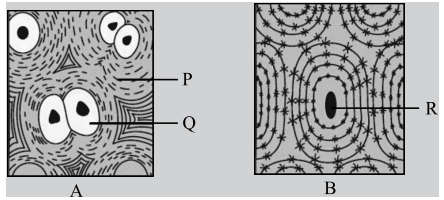
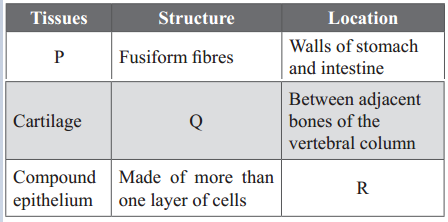
Find $\mathrm{P}, \mathrm{Q}$ and R.
Structural Organisation In Animals – NEET-7078
  1. A P = Skeletal muscles, Q = Solid and pliable, R = Moist surface of buccal cavity
  2. B P = Smooth muscles, Q = Solid and pliable, R = Blood vessels
  3. C P = Skeletal muscles, Q = Solid and non-pliable, R = Proximal convoluted tubules
  4. D P = Smooth muscles, Q = Solid and pliable, R = Dry surface of the skin
Show answer

Correct answer: D

12
Which of the following is correct. pairing of a body part and the kind of muscle tissue that moves it?
  1. A Wall of blood vessels - Involuntary smooth muscle
  2. B Heart wall - Involuntary unstriated muscle
  3. C Biceps of upper arm - Smooth muscle fibres
  4. D Abdominal wall - Skeletal muscle
Show answer

Correct answer: A

13
Identify the correct matching.
Structural Organisation In Animals – NEET-7113
  1. A A-Cartilage, P-Elastic fibres
  2. B A-Bone, Q-Osteocyte
  3. C B-Cartilage, R-Chondrocyte
  4. D B-Bone, R-Haversian canal
Show answer

Correct answer: D

14
The organisation of tissue to form organs and then to form organ system is essential;
  1. A for better coordinated activities
  2. B to look organism better
  3. C Both (1) and (2)
  4. D None of these
Show answer

Correct answer: A

15
Which of the following statements is correct w.r.t. neuroglial cells?
  1. A They are excitable cells which conduct the impulse generated in response to a suitable stimulus.
  2. B They are always endodermal in origin.
  3. C They make up less than half of the neural tissue of the body.
  4. D They form the blood brain barrier and support the neurons.
Show answer

Correct answer: D

16
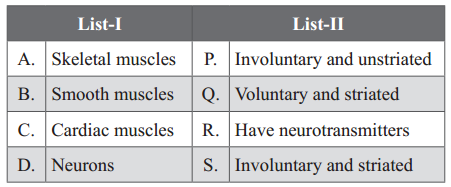
Match the List-I and List-II to find out the correct combination.
Structural Organisation In Animals – NEET-7116
  1. A $\mathrm{A}-(\mathrm{Q}) ; \mathrm{B}-(\mathrm{R}) ; \mathrm{C}-(\mathrm{P}) ; \mathrm{D}-(\mathrm{S})$
  2. B $\mathrm{A}-(\mathrm{Q}) ; \mathrm{B}-(\mathrm{P}) ; \mathrm{C}-(\mathrm{S}) ; \mathrm{D}-(\mathrm{R})$
  3. C $\mathrm{A}-(\mathrm{Q}) ; \mathrm{B}-(\mathrm{S}) ; \mathrm{C}-(\mathrm{P}) ; \mathrm{D}-(\mathrm{R})$
  4. D $\mathrm{A}-(\mathrm{S}) ; \mathrm{B}-(\mathrm{R}) ; \mathrm{C}-(\mathrm{P}) ; \mathrm{D}-(\mathrm{Q})$
Show answer

Correct answer: B

17
Select the incorrect match.
  1. A Fibroblasts - Cells that secrete and produce fibres
  2. B Osteocytes - Present in the spaces called lacunae
  3. C Blood - Contain RBC, WBC and platelets only
  4. D Chondrocytes - Cells of cartilage
Show answer

Correct answer: C

18
Out of the given tissues, how many are types of connective tissue: Adipose, bones, skeletal muscle, ligaments, simple squamous, areolar.
  1. A Two
  2. B Four
  3. C Six
  4. D Five
Show answer

Correct answer: B

19
The large amoeboid cells found in areolar tissue and are also part of our innate immune system are known as;
  1. A Mast cells
  2. B Macrophages
  3. C Adipocytes
  4. D Fibroblasts
Show answer

Correct answer: B

20
Which of the following is not true for muscle fibres associated with biceps?
  1. A Multinucleated in appearance
  2. B Striated in nature
  3. C Extensively branched in appearance
  4. D Voluntary in nature
Show answer

Correct answer: C

Attempt this as a timed test

Reading answers is not the same as sitting the paper. Attempt it timed and you get your score, per-question timing, and the mistakes tracked for revision.

Start free

More Structural Organisation In Animals tests

All Structural Organisation In Animals tests →