Alcohols Phenols And Ethers — DPP 2

20 NEET questions from Alcohols Phenols and Ethers, with answers and explanations. Attempt it as a timed test to get scoring, accuracy breakdown and mistake tracking.

Attempt this test free 20 questions · 30 minutes · +80 marks
1
Methanol can be distinguished from ethanol by the following except
  1. A Reaction with iodine and alkali
  2. B Reaction with salicylic acid and $\mathrm { H } _ { 2 } \mathrm { SO } _ { 4 }$
  3. C Reaction with Lucas reagent
  4. D Boiling point
Show answer & explanation

Correct answer: C

$\begin{array}{l}\mathrm{CH}_{3}-\mathrm{OH} \longrightarrow \boldsymbol{x} \\ \mathrm{CH}_{3}-\mathrm{CH}_{2}-\mathrm{OH} \longrightarrow \boldsymbol{x}\end{array}$
(Turbidity only on heating after long time i.e. 30 min.)
2
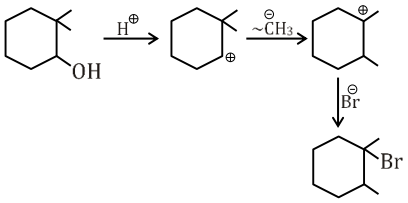
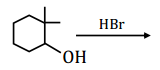
Alcohols Phenols And Ethers – NEET-5481 Major product?
  1. A
  2. B
  3. C
  4. D
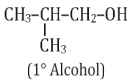
Show answer & explanation

Correct answer: B

Alcohols Phenols And Ethers – NEET-5481
3
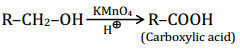
Which of the following reactions does not give aldehyde as major product?

  1. A
  2. B $\mathrm{RCH}_{2} \mathrm{OH} \xrightarrow{\text { anhy. } \mathrm{CrO}_{3}}$
  3. C $\mathrm{RCH}_{2} \mathrm{OH} \xrightarrow{\mathrm{Cu} / 573 \mathrm{~K}}$
  4. D $\mathrm{RCH}_{2} \mathrm{OH} \xrightarrow{\mathrm{KMnO}_{4}, \mathrm{H}^{+}}$
Show answer & explanation

Correct answer: D

Alcohols Phenols And Ethers – NEET-5473

4
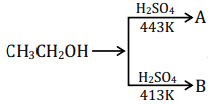
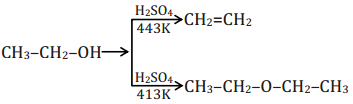
Alcohols Phenols And Ethers – NEET-5409 A and B are (respectively)
  1. A $\mathrm { CH } _ { 2 } = \mathrm { CH } _ { 2 }$
  2. B 0
  3. C $\mathrm{CH}_{2}=\mathrm{CH}_{2}, \mathrm{CH}_{2}=\mathrm{CH}_{2}$
  4. D
Show answer & explanation

Correct answer: D

Alcohols Phenols And Ethers – NEET-5409
5
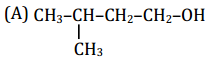
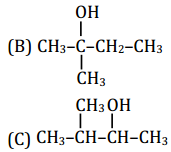
Arrange the following alkanols $\mathrm { A } , \mathrm { B }$ and $\mathrm { C }$ in order of their reactivity towards acid catalysed dehydration:-
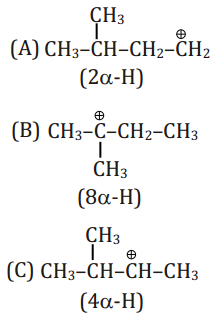
Alcohols Phenols And Ethers – NEET-5485 Alcohols Phenols And Ethers – NEET-5485

  1. A A > B > C
  2. B B > A > C
  3. C B > C > A
  4. D C > B > A
Show answer & explanation

Correct answer: C

Alcohols Phenols And Ethers – NEET-5485 B > C > A
6
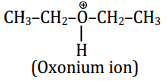
Oxonium ion of ether has the structure :-
  1. A
  2. B
  3. C $\left( \mathrm { C } _ { 2 } \mathrm { H } _ { 5 } \right) _ { 2 } \mathrm { O }$
  4. D
Show answer & explanation

Correct answer: B

Alcohols Phenols And Ethers – NEET-5411
7
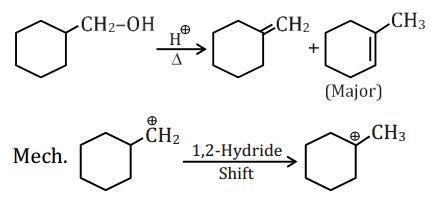
The major product in the following reaction is
  1. A
  2. B
  3. C
  4. D
Show answer & explanation

Correct answer: C

Alcohols Phenols And Ethers – NEET-5486
8
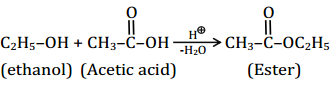
Ethanol on heating with acetic acid in the presence of a few drops of sulphuric acid gives the smell of
  1. A Oil of wintergreen
  2. B Oil of mustard
  3. C An ester
  4. D Oil of bitter almonds
Show answer & explanation

Correct answer: C

Alcohols Phenols And Ethers – NEET-5475

9
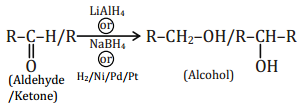
For the reduction of aldehydes and ketones into alcohol the reagent which can be used is/are :
  1. A $\mathrm { H } _ { 2 }$ in presence of $\mathrm { Ni } , \mathrm { Pt }$ or $\mathrm {Pd}$
  2. B $\mathrm { NaBH } _ { 4 }$
  3. C $\mathrm { LiAlH } _ { 4 }$
  4. D All
Show answer & explanation

Correct answer: D

Alcohols Phenols And Ethers – NEET-5384
10
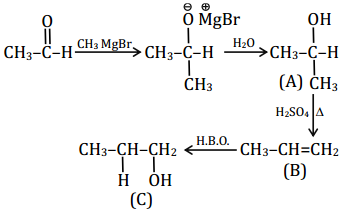
Compound A and C in the following reaction are Hydroboration
$\mathrm { CH } _ { 3 } \mathrm { CHO } \xrightarrow [ \text { (ii) } \mathrm { H } _ { 2 } \mathrm { O } ] { \text { (i) } \mathrm { CH } _ { 3 } \mathrm { MgBr } } ( \mathrm {~A} ) \xrightarrow [ \Delta ] { \mathrm { H } _ { 2 } \mathrm { SO } _ { 4 } } ( \mathrm {~B} ) \xrightarrow { \text { oxidation } }$ $\mathrm { (C) }$
  1. A Identical
  2. B Functional isomer
  3. C Positional isomer
  4. D Optical isomer
Show answer & explanation

Correct answer: C

Alcohols Phenols And Ethers – NEET-5471 A is Propan-2-ol
B is Propan-1-ol
Both are P.I.
11
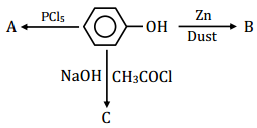
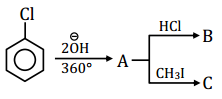
Alcohols Phenols And Ethers – NEET-5489 The compounds $\mathrm { A } , \mathrm { B }$ and $\mathrm {C}$ in the above reaction sequence are :-
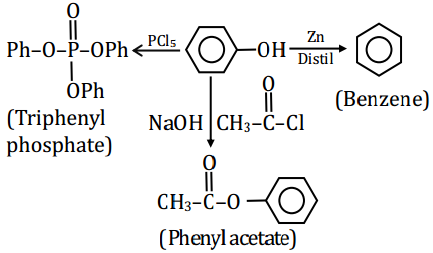
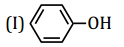
  1. A Chlorobenzene, benzene, methyl benzoate
  2. B Chlorobenzene, benzene, phenyl acetate
  3. C Benzyl chloride, benzene, phenyl acetate
  4. D Benzyl chloride, benzene, phenylacetyl chloride
Show answer & explanation

Correct answer: B

Alcohols Phenols And Ethers – NEET-5489
12
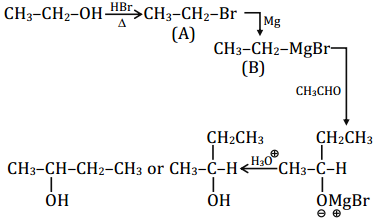
The compounds $\mathrm { A } , \mathrm { B }$ and $\mathrm { C }$ in the reaction sequence are given by the set :-
$\mathrm{CH}_{3} \mathrm{CH}_{2} \mathrm{OH} \xrightarrow[\Delta]{\mathrm{HBr}} \mathrm{A} \xrightarrow{\mathrm{Mg}} \mathrm{B} \xrightarrow[\text { (ii) } \mathrm{H}_{3} \mathrm{O}^{\oplus}]{\text { (i) } \mathrm{CH}_{3} \mathrm{CHO}} \mathrm{C}$
  1. A $\mathrm { CH } _ { 3 } \mathrm { CH } _ { 2 } \mathrm { Br } , \mathrm { CH } _ { 3 } \mathrm { CH } _ { 2 } \mathrm { MgBr } , \left( \mathrm { CH } _ { 3 } \right) _ { 3 } \mathrm { C } - \mathrm { OH }$
  2. B $\mathrm { CH } _ { 3 } \mathrm { CH } _ { 2 } \mathrm { Br } , \left( \mathrm { CH } _ { 3 } \mathrm { CH } _ { 2 } \right) _ { 2 } \mathrm { Mg } , \left( \mathrm { CH } _ { 3 } \right) _ { 2 } \mathrm { CHCH } _ { 2 } \mathrm { OH }$
  3. C $\mathrm { CH } _ { 3 } \mathrm { CH } _ { 2 } \mathrm { Br } , \mathrm { CH } _ { 3 } \mathrm { CH } _ { 2 } \mathrm { MgBr } , \mathrm { CH } _ { 3 } \mathrm { CH } ( \mathrm { OH } ) \mathrm { CH } _ { 2 } \mathrm { CH } _ { 3 }$
  4. D $\mathrm { CH } _ { 3 } \mathrm { CHBr } _ { 2 } , \mathrm { CH } _ { 3 } \mathrm { CH } ( \mathrm { MgBr } ) _ { 2 } , \mathrm { CH } _ { 3 } \mathrm { CH } ( \mathrm { OH } ) \mathrm { CH } _ { 3 }$
Show answer & explanation

Correct answer: C

Alcohols Phenols And Ethers – NEET-5476
13
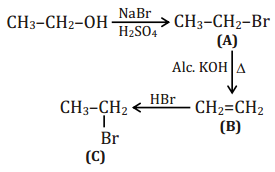
$\mathrm { CH } _ { 3 } - \mathrm { CH } _ { 2 } - \mathrm { OH } \underset { \mathrm { H } _ { 2 } \mathrm { SO } _ { 4 } } { \mathrm { NaBr } } ( \mathrm { A } ) \xrightarrow [ \Delta ] { \text { Alc.KOH } } ( \mathrm { B } ) \xrightarrow { \mathrm { HBr } }$ $\mathrm { C }$
$\mathrm { A } , \mathrm { B }$ and $\mathrm { C }$ are respectively -
  1. A $\mathrm { CH } _ { 3 } \mathrm { CH } _ { 2 } \mathrm { HSO } _ { 4 } , \mathrm { CH } _ { 2 } = \mathrm { CH } _ { 2 } , \mathrm { BrCH } _ { 2 } - \mathrm { CH } _ { 2 } - \mathrm { Br }$
  2. B $\mathrm { CH } _ { 3 } - \mathrm { CH } _ { 2 } - \mathrm { Br } , \mathrm { CH } _ { 2 } = \mathrm { CH } _ { 2 } , \mathrm { CH } _ { 3 } - \mathrm { CH } _ { 2 } - \mathrm { Br }$
  3. C $\mathrm { CH } _ { 3 } - \mathrm { CH } _ { 2 } - \mathrm { OCH } _ { 2 } - \mathrm { CH } _ { 3 } , \mathrm { CH } _ { 2 } = \mathrm { CH } _ { 2 }$,
  4. D $\mathrm { CH } _ { 2 } = \mathrm { CH } _ { 2 } , \mathrm { CH } _ { 3 } - \mathrm { CH } _ { 2 } - \mathrm { OH } , \mathrm { CH } _ { 3 } - \mathrm { CH } _ { 2 } - \mathrm { Br }$
Show answer & explanation

Correct answer: B

Alcohols Phenols And Ethers – NEET-5479
14
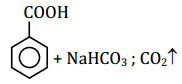
Phenol and benzoic acid are distinguished by:-
  1. A Lucas reagent
  2. B Victor Meyer test
  3. C Caustic soda
  4. D Sodium bicarbonate
Show answer & explanation

Correct answer: D

Alcohols Phenols And Ethers – NEET-5397 While phenol doesn’t react.
15
Best method to convert alcohol into alkyl chloride is -
  1. A $\mathrm { ROH } + \mathrm { SOCl } _ { 2 } \longrightarrow \mathrm { R } - \mathrm { Cl } + \mathrm { SO } _ { 2 } + \mathrm { HCl }$
  2. B $\mathrm { R } - \mathrm { OH } + \mathrm { PCl } _ { 3 } \longrightarrow \mathrm { R } - \mathrm { Cl }$
  3. C $\mathrm { R } - \mathrm { OH } + \mathrm { PCl } _ { 5 } \longrightarrow \mathrm { R } - \mathrm { Cl }$
  4. D $\mathrm { R } - \mathrm { OH } + \mathrm { HCl } \longrightarrow \mathrm { R } - \mathrm { Cl } + \mathrm { H } _ { 2 } \mathrm { O }$
Show answer & explanation

Correct answer: A

$\underset{\text { (Alcohol) }}{\mathrm{R}-\mathrm{OH}}+\mathrm{SOCl}_{2}\longrightarrow \underset{\text { (Alkyl chloride) }}{\mathrm{R}-\mathrm{Cl}+\mathrm{SO}_{2} \uparrow + \mathrm{HCl} \uparrow}$
Alcohols Phenols And Ethers – NEET-5480

16
Alcohols Phenols And Ethers – NEET-5488 The structures of the compounds/ions $\mathrm { A } , \mathrm { B }$ and $\mathrm { C }$ in the reaction sequence are given by the set:-
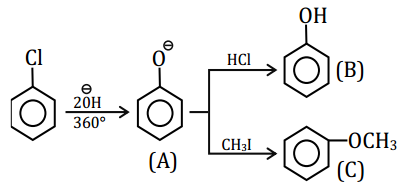
  1. A
  2. B
  3. C
  4. D
Show answer & explanation

Correct answer: B

Alcohols Phenols And Ethers – NEET-5488
17
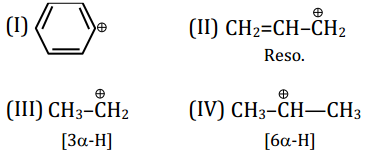
The correct reactivity order towards $\mathrm { H } - \mathrm { X }$ will be
Alcohols Phenols And Ethers – NEET-5483 (II) $\mathrm { CH } _ { 2 } = \mathrm { CH } - \mathrm { CH } _ { 2 } \mathrm { OH }$
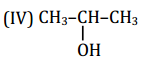
(III) $\mathrm { CH } _ { 3 } - \mathrm { CH } _ { 2 } - \mathrm { OH }$
Alcohols Phenols And Ethers – NEET-5483
  1. A II $>$ I $>$ III $>$ IV
  2. B IV $>$ III $>$ II $>$ I
  3. C II $>$ IV $>$ I $>$ III
  4. D II $>$ IV $>$ III $>$ I
Show answer & explanation

Correct answer: D

Alcohols Phenols And Ethers – NEET-5483 II > IV > III > I
18
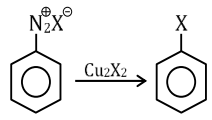
Identify incorrect match in the following -
  1. A
  2. B
  3. C
  4. D
Show answer & explanation

Correct answer: A

Alcohols Phenols And Ethers – NEET-5482 It is N.S.R.
19
Which alcohol produces turbidity with Lucas reagent most slowly
  1. A 2-Butanol
  2. B t-Butyl alcohol
  3. C Isobutyl alcohol
  4. D Diphenyl methanol
Show answer & explanation

Correct answer: C

Alcohols Phenols And Ethers – NEET-5478 {Reactivity towards Lucas Reagent ⇒ 3° > 2° > 1°}
20
For the reaction, $\mathrm { C } _ { 2 } \mathrm { H } _ { 5 } \mathrm { OH } + \mathrm { HX } \longrightarrow \mathrm { C } _ { 2 } \mathrm { H } _ { 5 } \mathrm { X }$, the order of reactivity is
  1. A $\mathrm { HI } > \mathrm { HCl } > \mathrm { HBr }$
  2. B $\mathrm { HI } > \mathrm { HBr } > \mathrm { HCl }$
  3. C $\mathrm { HCl } > \mathrm { HBr } > \mathrm { HI }$
  4. D $\mathrm { HBr } > \mathrm { HI } > \mathrm { HCl }$
Show answer & explanation

Correct answer: B

$\mathrm{C}_{2} \mathrm{H}_{5}-\mathrm{OH}+\mathrm{HX} \longrightarrow \mathrm{C}_{2} \mathrm{H}_{5}-\mathrm{X}$
The order of reactivity ⇒ $\mathrm{HI}>\mathrm{HBr}>\mathrm{HCl}$

Attempt this as a timed test

Reading answers is not the same as sitting the paper. Attempt it timed and you get your score, per-question timing, and the mistakes tracked for revision.

Start free

More Alcohols Phenols and Ethers tests

All Alcohols Phenols and Ethers tests →