Chemical Kinetics — DPP 2

20 NEET questions from Chemical Kinetics, with answers and explanations. Attempt it as a timed test to get scoring, accuracy breakdown and mistake tracking.

Attempt this test free 20 questions · 30 minutes · +80 marks
1
Which of the following about the rate constant of a reaction is incorrect?
  1. A It remains unchanged throughout the course of reaction
  2. B It provides a convenient measure of reaction rate
  3. C It is expressed in the same unit $( \mathrm { s } ) ^ { - 1 }$ for all reactions
  4. D The more rapid the reaction, the larger is the value of k , the slower the reaction, the smaller is its value
Show answer

Correct answer: C
2
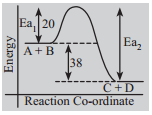
Reaction, $\mathrm { A } + \mathrm { B } \longrightarrow \mathrm { C } + \mathrm { D } + 38 \mathrm { kcal }$, has activation energy 20 kcal . What would be the activation energy of the reaction, $\mathrm { C } + \mathrm { D } \longrightarrow \mathrm { A } + \mathrm { B }$.
  1. A 20 kcal
  2. B - 20 kcal
  3. C 18 kcal
  4. D 58 kcal
Show answer & explanation

Correct answer: D

$\mathrm{E}_{\mathrm{a}_{2}}=$ = 58 k Cal
Chemical Kinetics – NEET-9906 Therefore, option (4) is correct answer.
3
Under a given set of experimental conditions with increase in the concentration of the reactants, the rate of chemical
reaction, except zero order reaction:
  1. A decreases
  2. B increases
  3. C remains constant
  4. D first decreases then increases
Show answer

Correct answer: B

4
The number of molecules of the reactants taking part in a single step of the reaction is indicative of:
  1. A order of a reaction
  2. B molecularity of a reaction
  3. C fast step of the mechanism of a reaction
  4. D half life of the reaction
Show answer

Correct answer: B

5
Directions: These questions consist of two statements each, printed as Assertion and Reason. While answering these questions, you are required to choose any one of the following four responses.
Assertion (A): Order of the reaction can be zero or fractional.
Reason (R): We cannot determine order from balanced chemical equation
  1. A Both Assertion and Reason are True and the Reason is a correct explanation of the Assertion.
  2. B Both Assertion and Reason are True but Reason is not a correct explanation of the Assertion
  3. C Assertion is True but the Reason is False.
  4. D Assertion is False but Reason is True.
Show answer

Correct answer: B

6
The rate for the reaction,
$\mathrm { RCl } + \mathrm { NaOH } ( \mathrm { aq } ) \longrightarrow \mathrm { ROH } + \mathrm { NaCl }$ is given by: rate $= \mathrm { k } [ \mathrm { RCl } ]$.
The rate of reaction is:
  1. A doubled on doubling the concentration of NaOH .
  2. B halved on reducing the concentration of RCl to half.
  3. C decreased on increasing the temperature of the reaction.
  4. D unaffected by increasing the temperature of the reacion.
Show answer & explanation

Correct answer: B

Rate ∝ [RCl]
So, when [RCl] is reduced to half, rate of reaction is also halved.
Therefore, option (2) is correct answer
7
A gaseous hypothetical chemical equation, $2 \mathrm {~A} \rightleftharpoons 4 \mathrm {~B} + \mathrm { C }$, is carried out in a closed vessel. The concentration of B is found to increase by $5 \times 10 ^ { - 3 } \mathrm {~mol} \mathrm {~L} ^ { - 1 }$ in 10 seconds. The rate of appearance of B is:
  1. A $5 \times 10 ^ { - 4 } \mathrm {~mol} \mathrm {~L} ^ { - 1 } \mathrm {~s} ^ { - 1 }$
  2. B $5 \times 10 ^ { - 5 } \mathrm {~mol} \mathrm {~L} ^ { - 1 } \mathrm {~s} ^ { - 1 }$
  3. C $6 \times 10 ^ { - 5 } \mathrm {~mol} \mathrm {~L} ^ { - 1 } \mathrm {~s} ^ { - 1 }$
  4. D $4 \times 10 ^ { - 4 } \mathrm {~mol} \mathrm {~L} ^ { - 1 } \mathrm {~s} ^ { - 1 }$
Show answer

Correct answer: A

8
In a reaction 2 X $\rightarrow$ Y, the concentration of X decreases from 3.0 moles/litre to 2.0 moles/litre in 5 minutes. The rate of reaction is:
  1. A $0.1 \mathrm {~mol} \mathrm {~L} ^ { - 1 } \mathrm {~min} ^ { - 1 }$
  2. B $5 \mathrm {~mol} \mathrm {~L} ^ { - 1 } \mathrm {~min} ^ { - 1 }$
  3. C $1 \mathrm {~mol} \mathrm {~L} ^ { - 1 } \mathrm {~min} ^ { - 1 }$
  4. D $0.5 \mathrm {~mol} \mathrm {~L} ^ { - 1 } \mathrm {~min} ^ { - 1 }$
Show answer

Correct answer: A

9
For which order half-life period is independent of initial concentration?
  1. A Zero order
  2. B First order
  3. C Second order
  4. D Third order
Show answer

Correct answer: B

10
Calculate the half-life of the first-order reaction:
$\mathrm { C } _ { 2 } \mathrm { H } _ { 4 } \mathrm { O } ( \mathrm {g} ) \rightarrow \mathrm { CH } _ { 4 } ( \mathrm {g} ) + \mathrm { CO } ( \mathrm {g} ) .$
If the initial pressure of $\mathrm { C } _ { 2 } \mathrm { H } _ { 4 } \mathrm { O } ( \mathrm { g } )$ is 80 mm Hg and the total pressure at the end of 20 minutes is 120 mm Hg .
  1. A 40 min
  2. B 120 min
  3. C 20 min
  4. D 80 min
Show answer

Correct answer: C

11
For the reaction:
$2 \mathrm { NH } _ { 3 } \rightarrow \mathrm {~N} _ { 2 } + 3 \mathrm { H } _ { 2 }$,
if $\frac { - \mathrm { d } \left[ \mathrm { NH } _ { 3 } \right] } { \mathrm { dt } } = \mathrm { k } _ { 1 } \left[ \mathrm { NH } _ { 3 } \right] , \frac { \mathrm { d } \left[ \mathrm { N } _ { 2 } \right] } { \mathrm { dt } } = \mathrm { k } _ { 2 } \left[ \mathrm { NH } _ { 3 } \right]$ and $\frac { \mathrm { d } \left[ \mathrm { H } _ { 2 } \right] } { \mathrm { dt } } = \mathrm { k } _ { 3 } \left[ \mathrm { NH } _ { 3 } \right]$, then the relation between k$_{1}$, k$_{2}$ and k$_{3}$ is:
  1. A $\mathrm{k}_{1}=\mathrm{k}_{2}=\mathrm{k}_{2}$
  2. B $\mathrm{k}_{1}=3 \mathrm{k}_{2}=2 \mathrm{k}_{3}$
  3. C $1.5 \mathrm{k}_{1}=3 \mathrm{k}_{2}=\mathrm{k}_{3}$
  4. D $2 \mathrm{k}_{1}=\mathrm{k}_{2}=3 \mathrm{k}_{3}$
Show answer

Correct answer: C

12
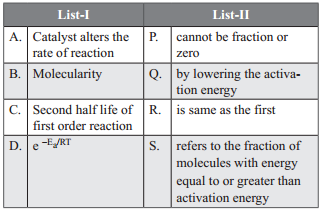
Match the List-I with the List-II to find the correct option.
Chemical Kinetics – NEET-9981
  1. A A-(Q); B-(P); C-(R); D-(S)
  2. B A-(S); B-(Q); C-(P); D-(R)
  3. C A-(R); B-(P); C-(S); D-(Q)
  4. D A-(Q); B-(R); C-(P); D-(S)
Show answer

Correct answer: A

13
Directions: These questions consist of two statements each, printed as Assertion and Reason. While answering these questions, you are required to choose any one of the following four responses.
Assertion (A): All collision of reactant molecules lead to product formation.
Reason (R): Only those collisions in which molecules have correct orientation and sufficient kinetic energy lead to product formation.
  1. A Both Assertion and Reason are True and the Reason is a correct explanation of the Assertion.
  2. B Both Assertion and Reason are True but Reason is not a correct explanation of the Assertion.
  3. C Assertion is True but the Reason is False.
  4. D Assertion is False but Reason is True.
Show answer

Correct answer: D

14
Which equation is correct for first-order reactions?
  1. A $t _ { 1 / 2 } \propto \mathrm { C } ^ { - 1 }$
  2. B $\mathrm { t } _ { 1 / 2 } \propto \mathrm { C }$
  3. C $t _ { 1 / 2 } \propto C ^ { 0 }$
  4. D $t _ { 1 / 2 } \propto \mathrm {C} ^ { 1 / 2 }$
Show answer & explanation

Correct answer: C

The relation between half-life period and initial concentration for a nth order reaction is given by
t$_{1/2}$ ∝ $\frac{1}{\mathrm{C}^{\mathrm{n}-1}}$ (for first-order reaction, n = 1.)
t$_{1/2}$ ∝ $\frac{1}{\mathrm{C}^{1-1}}$ or $\mathrm{t}_{1 / 2} \propto \mathrm{C}^{0}$
Therefore, option (3) is correct answer
15
The rate of chemical reaction depends on the nature of reactants because:
  1. A the number of bonds broken in the reactant molecules and the number of bonds formed in product molecules changes
  2. B some of the reactants are solids at the room temperature.
  3. C some of the reactants are coloured
  4. D some of reactants are liquids at room temperature
Show answer

Correct answer: A

16
Dimensions of rate of reaction involves
  1. A concentration only
  2. B time only
  3. C both concentration and time
  4. D neither time nor concentration
Show answer

Correct answer: C

17
The rate law for a reaction between the substances A and B is given by: rate $= \mathrm { k } [ \mathrm { A } ] ^ { \mathrm { n } } [ \mathrm { B } ] ^ { \mathrm { m } }$. On doubling the concentration of A and halving the concentration of B, the ratio of the new rate to the earlier rate of the reaction will be:
  1. A $m + n$.
  2. B $( n - m )$.
  3. C $2 ^ { ( n - m ) }$.
  4. D $\frac { 1 } { 2 ^ { ( m + n ) } }$.
Show answer & explanation

Correct answer: C

Earlier rate = k[A]$^{n}$ [B]$^{m}$
New rate = k[2A]$^{n}$[B/2]$^{m}$
$\frac{\text { New rate }}{\text { Earlier rate }}=\frac{k(2 A)^{n}\left[\frac{B}{2}\right]^{m}}{k A^{n} B^{m}}=2^{n-m}$
Therefore, option (3) is correct answer.
18
The decomposition of a substance follows first order kinetics. Its concentration is reduced to $1 / 8 ^ { \text {th } }$ of its initial value in 24 minutes. The rate constant of the decomposition process is:
  1. A $(1 / 24) \mathrm{min}^{-1}$
  2. B $(0.693 / 24) \mathrm{min}^{-1}$
  3. C $\frac{2.303}{24} \log \left(\frac{1}{8}\right) \mathrm{min}^{-1}$
  4. D $\frac{2.303}{24} \log \left(\frac{8}{1}\right) \mathrm{min}^{-1}$
Show answer

Correct answer: D

19
The rate constant of the reaction at temperature 200 K is 10 times less than the rate constant at 400 K. What is the activation energy of the reaction?
  1. A 1842.4 R
  2. B 921.2 R
  3. C 460.6 R
  4. D 230.3 R
Show answer

Correct answer: B

20
In reactions involving gaseous reactants and gaseous products the units of rate are:
  1. A atm
  2. B atm s
  3. C $\mathrm { atm } \mathrm {~s } ^ { - 1 }$
  4. D $a \mathrm {~atm} ^ { 2 } \mathrm {~s} ^ { 2 }$
Show answer

Correct answer: C

Attempt this as a timed test

Reading answers is not the same as sitting the paper. Attempt it timed and you get your score, per-question timing, and the mistakes tracked for revision.

Start free

More Chemical Kinetics tests

All Chemical Kinetics tests →