d- and f- Block Elements — DPP 3

20 NEET questions from d- and f- Block Elements, with answers and explanations. Attempt it as a timed test to get scoring, accuracy breakdown and mistake tracking.

Attempt this test free 20 questions · 30 minutes · +80 marks
1
An increase in both atomic and ionic radii with atomic number occurs in any group of the periodic table. In accordance of this the ionic radii of Ti (IV) and Zr (IV) ions are 0.68 $\mathrm { A } ^ { 0 }$ and $0.74 \mathrm {~A} ^ { 0 }$ respectively but for Hf (IV) ion the ionic radius is $0.75 \mathrm {~A} ^ { 0 }$, which is almost the same as that for $\operatorname { Zr }$ (IV) ion. This is due to :-
  1. A greater degree of covalency in compounds of $\mathrm { Hf } ^ { 4 + }$
  2. B Lanthanide contraction
  3. C Difference in the co-ordination number of $\mathrm { Zr } ^ { + 4 }$ and $\mathrm { Hf } ^ { + 4 }$ in their compounds
  4. D Actinide contraction
Show answer & explanation

Correct answer: B

Due to Lanthanoid contraction.
2
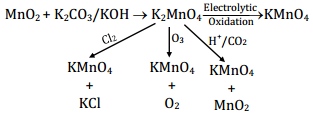
$\mathrm { MnO } _ { 4 } ^ { - 2 }$ can be converted to $\mathrm { MnO } _ { 4 } ^ { - }$
(A) By oxidation of $\mathrm { O } _ { 3 }$
(B) By electrolytic oxidation
(C) By the addition of dil. $\mathrm { H } _ { 2 } \mathrm { SO } _ { 4 }$
(D) By the addition of HCl
  1. A If A, B and C options are correct.
  2. B If A & B both options are correct.
  3. C If B & D both are options correct.
  4. D If A & C both are options correct.
Show answer & explanation

Correct answer: A

d- and f- Block Elements – NEET-11701
3
Given below are two statements; one is labelled as Assertion (A) and the other is labelled as Reason (R).
Assertion (A) : K$_{2}$Cr$_{2}$O$_{7}$ is used as a primary standard solution in Titration.
Reason (R) : It is not a hygroscopic in nature.
In the light of the above statements, choose the most appropriate answer from the options given below :
  1. A If (A) & (R) both are correct and (R) is the correct explanation of (A).
  2. B If (A) & (R) both are correct but (R) is not the correct explanation of (A).
  3. C (A) is not correct but (R) is incorrect.
  4. D (A) & (R) both are correct.
Show answer & explanation

Correct answer: A

K$_{2}$Cr$_{2}$O$_{7}$ is preferred over Na$_{2}$Cr$_{2}$O$_{7}$ because Na$_{2}$Cr$_{2}$O$_{7}$ is Hygroscopic in nature.
4
Electronic configurations related to Praseodymium, Neodymium & Promethium are respectively-

  1. A 4f$^ { 3 }$ 6s$^ { 2 }$, 4f$^ { 4 }$ 6s$^ { 2 }$ & 4f$^ { 6 }$ 6s$^ { 2 }$
  2. B 4f$^ { 7 }$ 6s$^ { 2 }$, 4f$^ { 13 }$ 6s$^ { 2 }$ & 4f$^ { 6 }$ 6s$^ { 2 }$
  3. C 4f$^ { 3 }$ 6s$^ { 2 }$, 4f$^ { 4 }$ 6s$^ { 2 }$ & 4f$^ { 5 }$ 6s$^ { 2 }$
  4. D 4f$^ { 14 }$ 5d$^ { 1 }$ 6s$^ { 2 }$, 4f$^ { 14 }$ 6s$^ { 2 }$ & 4f$^ { 6 }$ 6s$^ { 2 }$
Show answer

Correct answer: C

5
Which statement is correct
  1. A Most common oxidation state of lanthanoid is + 2
  2. B HCl can be used to acidify $\mathrm { KMnO } _ { 4 }$ during redox reaction
  3. C In presence of $\mathrm { CO } _ { 2 }$, orange dichromate solution changes to yellow chromate
  4. D To separate $\mathrm { Fe } _ { 2 } \mathrm { O } _ { 3 }$ and $\mathrm { Al } _ { 2 } \mathrm { O } _ { 3 } , \mathrm { NaOH }$ can be used
Show answer

Correct answer: D

6
Which of the following arrangements does not represent the correct order of the property stated against it?
  1. A $\mathrm { V } ^ { 2 + } < \mathrm { Cr } ^ { 2 + } < \mathrm { Mn } ^ { 2 + } < \mathrm { Fe } ^ { 2 + }$ : paramagnetic behaviour
  2. B $\mathrm { Ni } ^ { 2 + } < \mathrm { Co } ^ { 2 + } < \mathrm { Fe } ^ { 2 + } < \mathrm { Mn } ^ { 2 + }$ : ionic size
  3. C $\mathrm { Co } ^ { 3 + } < \mathrm { Fe } ^ { 3 + } < \mathrm { Cr } ^ { 3 + } < \mathrm { Sc } ^ { 3 + }$ : stability in aqueous solution
  4. D $\mathrm { Sc } < \mathrm { Ti } < \mathrm { Cr } < \mathrm { Mn }$ : number of oxidation states
Show answer

Correct answer: A

7
In aqueous solution, $\mathrm { Eu } ^ { 2 + }$ ion acts as:
  1. A An oxidizing agent
  2. B A reducing agent
  3. C Either (A) or (B)
  4. D None
Show answer

Correct answer: B

8
Which of the following actinide element does not found in nature?
  1. A ${ } _ { 90 } \mathrm { Th }$
  2. B ${ } _ { 91 } \mathrm {~Pa}$
  3. C ${ } _ { 92 } \mathrm { U }$
  4. D ${ } _ { 103 } \mathrm { Lr }$
Show answer & explanation

Correct answer: D

$_{103}$Lr is a transuranic element.
9
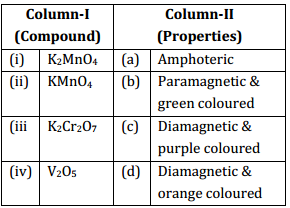
Match the column :
d- and f- Block Elements – NEET-11692
  1. A i-a, ii-b, iii-c, iv-d
  2. B i-c, ii-d, iii-b, iv-a
  3. C i-b, ii-c, iii-d, iv-a
  4. D i-d, ii-a, iii-b, iv-c
Show answer & explanation

Correct answer: C

(i) K$_{2}$MnO$_{4}$ → Mn$^{+6}$ (3d$^{1}$) Paramagnetic and green coloured
(ii) KMnO$_{4}$ → Mn$^{+7}$ (3d$^{0}$) Purple colour due to charge transfer
(iii) K$_{2}$Cr$_{2}$O$_{7}$ → Cr$^{+6}$ (3d$_{0}$) orange colour
(iv) V$_{2}$O$_{5}$ → Amphoteric (reacts with both acids & bases)
10
What is incorrect about the reactions of $\mathrm { KMnO } _ { 4 }$ and oxalic acid
  1. A $\mathrm { CO } _ { 2 }$ is formed
  2. B decolourisation is fast in begining but become slow after some time
  3. C $\mathrm { Mn } ^ { 2 + }$ is autocatalyst
  4. D It is a redox change
Show answer

Correct answer: B

11
Among the lanthanoids the one obtained by synthetic method is:
  1. A Lu
  2. B Pm
  3. C Pr
  4. D Gd
Show answer

Correct answer: B

12
Which of the following pair have almost similar size?
  1. A ${ } _ { 22 } \mathrm { Ti }$ and ${ } _ { 40 } \mathrm { Zr }$
  2. B ${ } _ { 41 } \mathrm { Nb }$ and ${ } _ { 73 } \mathrm { Ta }$
  3. C ${ } _ { 39 } \mathrm { Y }$ and ${ } _ { 57 } \mathrm { La }$
  4. D ${ } _ { 20 } \mathrm { Ca }$ and ${ } _ { 77 } \mathrm { Ir }$
Show answer & explanation

Correct answer: B

Radius 4d ≈ 5d (V B)
13
Lanthanoids for which + II and + III oxidation states are common is:
  1. A La
  2. B Nd
  3. C Ce
  4. D Eu
Show answer

Correct answer: D

14
Which element does not show + 4 oxidation state:-
  1. A Ce
  2. B Ti
  3. C Pt
  4. D Eu
Show answer & explanation

Correct answer: D

Europium does not show +4 oxidation state.
15
Which of the following element does not $[ \mathrm { Ar } ] 3 \mathrm {~d} ^ { 5 }$ in its electronic configuration.
(A) Cr
(B) Fe
(C) Mn
(D) Ni
  1. A If A, B and C options are correct.
  2. B If A & B both options are correct.
  3. C If B & D both are options correct.
  4. D If A & C both are options correct.
Show answer & explanation

Correct answer: C

Fe :- [Ar]3d$^{6}$4s$^{2}$
Ni :- [Ar]3d$^{8}$4s$^{2}$
16
Which of the following does not give disproportionation reaction in acidic or basic medium?
  1. A $\mathrm { MnO } _ { 4 } { } ^ { - 2 }$
  2. B $\mathrm { HNO } _ { 2 }$
  3. C $\mathrm { CrO } _ { 4 } { } ^ { - 2 }$
  4. D $\mathrm { Cl } _ { 2 }$
Show answer

Correct answer: C

17
The yellow colour solution of $\mathrm { Na } _ { 2 } \mathrm { CrO } _ { 4 }$ changes to orange red on passing $\mathrm { CO } _ { 2 }$ gas due to the formation of :-
  1. A $\mathrm { CrO } _ { 5 }$
  2. B $\mathrm { CrO } _ { 3 }$
  3. C $\mathrm { Na } _ { 2 } \mathrm { Cr } _ { 2 } \mathrm { O } _ { 7 }$
  4. D $\mathrm { Cr } _ { 2 } \mathrm { O } _ { 3 }$
Show answer

Correct answer: C

18
Given below are two statements; one is labelled as Assertion (A) and the other is labelled as Reason (R).
Assertion (A) : Eu$^{+2}$ & Yb$^{+2}$ are reducing agent.
Reason (R) : Both ions have strong tendency to convert into stable +3 in its aq. solution.
In the light of the above statements, choose the most appropriate answer from the options given below :
  1. A If (A) & (R) both are correct and (R) is the correct explanation of (A).
  2. B If (A) & (R) both are correct but (R) is not the correct explanation of (A).
  3. C (A) is not correct but (R) is incorrect.
  4. D (A) & (R) both are correct.
Show answer & explanation

Correct answer: A

Eu$^{+2}$ & Yb$^{+2}$ have strong tendency to convert in +3 oxidation state therefore they act as reducing agent.
19
Given below are two statements; one is labelled as Assertion (A) and the other is labelled as Reason (R).
Assertion (A) : The 3 rd ionisation energy of Gd is abnormally low.
Reason (R) : Exchange energy of 4f subshell is high.
In the light of the above statements, choose the most appropriate answer from the options given below :
  1. A If (A) & (R) both are correct and (R) is the correct explanation of (A).
  2. B If (A) & (R) both are correct but (R) is not the correct explanation of (A).
  3. C (A) is not correct but (R) is incorrect.
  4. D (A) & (R) both are correct.
Show answer & explanation

Correct answer: A

Gd :- $_{54}$[Xe]4f$^{7}$5d$^{1}$6s$^{2}$
Gd$^{+3}$ :- $_{54}$[Xe]4f$^{7}$
20
Formula of halide of lanthanoid may be
  1. A $\mathrm { LnX } _ { 3 }$
  2. B $\operatorname { Ln } _ { 5 }$
  3. C $\mathrm { LnX } _ { 2 }$
  4. D $\mathrm { LnX } _ { 6 }$
Show answer & explanation

Correct answer: A

Formula of halide of Lanthanoid will become LnX$_{3}$ as Lanthanoids generally have +3 (oxidation sate)

Attempt this as a timed test

Reading answers is not the same as sitting the paper. Attempt it timed and you get your score, per-question timing, and the mistakes tracked for revision.

Start free

More d- and f- Block Elements tests

All d- and f- Block Elements tests →