Electrochemistry — DPP 2

20 NEET questions from Electrochemistry, with answers and explanations. Attempt it as a timed test to get scoring, accuracy breakdown and mistake tracking.

Attempt this test free 20 questions · 30 minutes · +80 marks
1
Fluorine is the best oxidising agent because it has:
  1. A highest electron affinity.
  2. B highest reduction potential.
  3. C highest oxidising potential.
  4. D lowest electron affinity.
Show answer

Correct answer: B
2
$\mathrm { E } ^ { \circ }$ for $\mathrm { F } _ { 2 } + 2 \mathrm { e } ^ { - } \rightarrow 2 \mathrm {~F} ^ { - }$is 2.8 V ,
$\mathrm { E } ^ { \circ }$ for $\frac { 1 } { 2 } \mathrm {~F} _ { 2 } + \mathrm { e } ^ { - } \rightarrow \mathrm { F } ^ { - }$is
  1. A 2.8 V
  2. B 1.4 V
  3. C - 2.8 V
  4. D - 1.4 V
Show answer

Correct answer: A

3
For a spontaneous reaction, $\Delta \mathrm { G }$, equilibrium constant K and $\mathrm { E } _ { \text {cell } } ^ { \circ }$ will be respectively:
  1. A -ve, > 1, +ve
  2. B $+ \mathrm { ve } , > 1 , - \mathrm { ve }$
  3. C -ve, <1, -ve
  4. D -ve, >1, -ve
Show answer

Correct answer: A

4
In a Daniell cell:
  1. A the chemical energy liberated during the redox reaction is converted to electrical energy.
  2. B the electrical energy of the cell is converted to chemical energy.
  3. C the energy of the cell is utilised in conduction of the redox reaction.
  4. D the potential energy of the cell is converted into electrical energy.
Show answer

Correct answer: A

5
The reaction $1 / 2 \mathrm { H } _ { 2 } ( \mathrm {g} ) + \mathrm { Ag } ^ { + } ( \mathrm { aq } ) \rightarrow \mathrm { H } ^ { + } ( \mathrm { aq } ) + \mathrm { Ag } ( \mathrm { s } )$ can be represented in the galvanic cell as:
  1. A $\mathrm { Ag } | \mathrm { AgCl } ( \mathrm { s } ) | \mathrm { KCl } ( \mathrm { aq } ) \| \mathrm { AgNO } _ { 3 } ( \mathrm { aq } ) \mid \mathrm { Ag } ( \mathrm { s } )$.
  2. B $\mathrm { Pt } , \mathrm { H } _ { 2 } ( \mathrm {~g} ) \left| \mathrm { HCl } ( \mathrm { aq } ) \| \mathrm { AgNO } _ { 3 } ( \mathrm { aq } ) \right| \mathrm { Ag } ( \mathrm { s } )$.
  3. C $\mathrm { Pt } , \mathrm { H } _ { 2 } ( \mathrm {~g} ) | \mathrm { HCl } ( \mathrm { aq } ) \| \mathrm { AgCl } ( \mathrm { s } ) | \mathrm { Ag } ( \mathrm { s } )$.
  4. D $\mathrm { H } _ { 2 } ( \mathrm {~g} ) | \mathrm { HCl } ( \mathrm { aq } ) \| \mathrm { AgCl } ( \mathrm { s } ) | \mathrm { Ag } ( \mathrm { s } )$.
Show answer

Correct answer: B

6
In a galvanic cell, the reactions taking place in the anodic half cell and the cathodic half cell will be:
  1. A reduction only.
  2. B oxidation only.
  3. C oxidation and reduction respectively.
  4. D reduction and oxidation respectively.
Show answer

Correct answer: C

7
Which of the following options is correct for the electrochemical Daniell cell?
  1. A Electrons flows from copper electrode to zinc electrode.
  2. B Currents flows from zinc electrode to copper electrode.
  3. C Cations moves towards copper electrode.
  4. D Cations moves towards zinc electrode.
Show answer

Correct answer: C

8
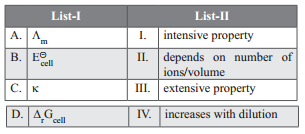
Match the List-I with List-II and mark the correct option.
Electrochemistry – NEET-21042
  1. A A-(II); B-(III); C-(IV); D-(I)
  2. B A-(II); B-(IV); C-(III); D-(I)
  3. C A-(III); B-(IV); C-(I); D-(II)
  4. D A-(II); B-(I); C-(III); D-(IV)
Show answer

Correct answer: C

9
For cell reaction, $\mathrm { Zn } + \mathrm { Cu } ^ { 2 + } \rightarrow \mathrm { Zn } ^ { 2 + } + \mathrm { Cu }$, cell representation is:
  1. A $\mathrm { Zn } \left| \mathrm { Zn } ^ { 2 + } \| \mathrm { Cu } ^ { 2 + } \right| \mathrm { Cu }$
  2. B $\mathrm { Cu } \left| \mathrm { Cu } ^ { 2 + } \| \mathrm { Zn } ^ { 2 + } \right| \mathrm { Zn }$
  3. C $\mathrm { Cu } \left| \mathrm { Zn } ^ { \mathrm { z } ^ { + } } \| \mathrm { Zn } \right| \mathrm { Cu } ^ { 2 + }$
  4. D $\mathrm { Cu } ^ { 2 + } \left| \mathrm { Zn } \| \mathrm { Zn } ^ { 2 + } \right| \mathrm { Cu }$
Show answer

Correct answer: A

10
Directions: These questions consist of two statements each, printed as Assertion and Reason. While answering these questions, you are required to choose any one of the following four responses.
Assertion (A): Conductivity of all electrolytes decreases on dilution.
Reason (R): On dilution number of ions per unit volume decreases
  1. A Both Assertion and Reason are True and the Reason is a correct explanation of the Assertion.
  2. B Both Assertion and Reason are True but Reason is not a correct explanation of the Assertion.
  3. C Assertion is True but the Reason is False.
  4. D Assertion is False but Reason is True.
Show answer

Correct answer: A

11
Which one of the following metal will not reduce $\mathrm { H } _ { 2 } \mathrm { O }$ ?
  1. A Ca
  2. B Na
  3. C Cu
  4. D Li
Show answer

Correct answer: C

12
Standard hydrogen electrode has zero electrode potential because:
  1. A hydrogen is a gas.
  2. B it is easiest to oxidise hydrogen.
  3. C hydrogen has only one electron.
  4. D it is assumed to be zero.
Show answer

Correct answer: D

13
Amount of charge required for reduction of $17 \mathrm {~g} \mathrm { H } _ { 2 } \mathrm { O } _ { 2 }$ into $\mathrm { O } _ { 2 }$ is:
  1. A 1 F
  2. B 6 F
  3. C 2 F
  4. D None of these
Show answer

Correct answer: A

14
Which of the following is incorrectly matched?
  1. A Molar conductance $- \mathrm { S } \mathrm { m } ^ { 2 } \mathrm {~mol} ^ { - 1 }$
  2. B Conductivity $- \mathrm { S } \mathrm { m } ^ { - 1 }$
  3. C Specific conductance $- \mathrm { S } \mathrm { m } ^ { 2 }$
  4. D Equivalent conductance $- \mathrm { S } \mathrm { m } ^ { 2 } e q ^ { - 1 }$
Show answer

Correct answer: C

15
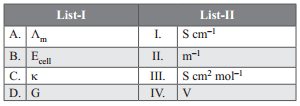
Match the List-I with List-II and mark the correct option.
Electrochemistry – NEET-21043
  1. A A-(I); B-(II); C-(III); D-(IV)
  2. B A-(IV); B-(I); C-(II); D-(III)
  3. C A-(I); B-(IV); C-(III); D-(II)
  4. D A-(III); B-(II); C-(I); D-(IV)
Show answer

Correct answer: B

16
Directions: These questions consist of two statements each, printed as Assertion and Reason. While answering these questions, you are required to choose any one of the following four responses.
Assertion (A): $\Lambda_{\mathrm{m}}$ for weak electrolytes shows a sharp increase when the electrolytic solution is diluted.
Reason (R): For weak electrolytes degree of dissociation increases with dilution of solution.
  1. A Both Assertion and Reason are True and the Reason is a correct explanation of the Assertion.
  2. B Both Assertion and Reason are True but Reason is not a correct explanation of the Assertion.
  3. C Assertion is True but the Reason is False.
  4. D Assertion is False but Reason is True.
Show answer

Correct answer: A

17
Given that $\Lambda _ { \mathrm { m } } ^ { \circ } = 133.45 \mathrm {~S} \mathrm {~cm} ^ { 2 } \mathrm {~mol} ^ { - 1 } \left( \mathrm { AgNO } _ { 3 } \right)$ :
$\Lambda _ { \mathrm { m } } ^ { \circ } = 149.95 \mathrm {~S} \mathrm {~cm} ^ { 2 } \mathrm {~mol} ^ { - 1 } ( \mathrm { KCl } ) ; \Lambda _ { \mathrm { m } } ^ { \circ } = 144.9 \mathrm {~S} \mathrm {~cm} ^ { 2 } \mathrm {~mol} ^ { - 1 } \left( \mathrm { KNO } _ { 3 } \right)$, the molar conductivity at infinite dilution for AgCl is:
  1. A $132 \mathrm {~S} \mathrm {~cm} ^ { 2 } \mathrm {~mol} ^ { - 1 }$
  2. B $140 \mathrm {~S} \mathrm {~cm} ^ { 2 } \mathrm {~mol} ^ { - 1 }$
  3. C $138 \mathrm {~S} \mathrm {~cm} ^ { 2 } \mathrm {~mol} ^ { - 1 }$
  4. D $134 \mathrm {~S} \mathrm {~cm} ^ { 2 } \mathrm {~mol} ^ { - 1 }$
Show answer

Correct answer: C

18
For which of the following SOP and SRP are equal?
  1. A SHE
  2. B Mg Electrode
  3. C Ni electrode
  4. D Cu electrode
Show answer

Correct answer: A

19
Cathodic standard reduction potential minus anodic standard reduction potential is equal to:
  1. A faraday.
  2. B coulomb.
  3. C cell potential.
  4. D ampere.
Show answer

Correct answer: C

20
The electrochemical cell stops working after some time because:
  1. A electrode potentials of both electrodes become zero.
  2. B electrode potentials of both electrodes become equal.
  3. C temperature of the cell increases.
  4. D the reaction starts proceeding in opposite direction.
Show answer

Correct answer: B

Attempt this as a timed test

Reading answers is not the same as sitting the paper. Attempt it timed and you get your score, per-question timing, and the mistakes tracked for revision.

Start free

More Electrochemistry tests

All Electrochemistry tests →