Redox Reactions — DPP 1

20 NEET questions from Redox Reactions, with answers and explanations. Attempt it as a timed test to get scoring, accuracy breakdown and mistake tracking.

Attempt this test free 20 questions · 30 minutes · +80 marks
1
In the balanced reaction, the value of $a , b$ and $c$ are:
$\mathrm { aI } _ { 2 } + \mathrm { OH } ^ { - } \rightarrow \mathrm { bIO } _ { 3 } ^ { - } + \mathrm { cl } ^ { - } + \mathrm { H } _ { 2 } \mathrm { O }$
  1. A 1, 2 and 3
  2. B 3, 1 and 5
  3. C 1, 3 and 5
  4. D 1, 1 and 1
Show answer

Correct answer: B
2
The number of moles of $\mathrm{Cr}_{2} \mathrm{O}_{7}^{2-}$ needed to oxidise 0.136 equivalents of $\mathrm{N}_{2} \mathrm{H}_{5}^{+}$by the reaction $\mathrm{N}_{2} \mathrm{H}_{5}^{+}+\mathrm{Cr}_{2} \mathrm{O}_{7}^{2-} \longrightarrow \mathrm{N}_{2}+\mathrm{Cr}^{3+}+\mathrm{H}_{2} \mathrm{O}$ is;
  1. A 0.136
  2. B 0.272
  3. C 0.816
  4. D 0.0227
Show answer & explanation

Correct answer: D

n -factor of $\mathrm{Cr}_{2} \mathrm{O}_{7}^{2-}$ in the given reaction is 6 .
${ }^{+6} \mathrm{Cr}_{2} \mathrm{O}_{7}^{2-} \longrightarrow \mathrm{Cr}^{3+}$

Equivalents of $\mathrm{Cr}_{2} \mathrm{O}_{7}^{2-}$ needed to oxidise $\mathrm{N}_{2} \mathrm{H}_{5}^{+}=$
Equivalents of $\mathrm{N}_{2} \mathrm{H}_{5}^{+}=0.136$
Moles of $\mathrm{Cr}_{2} \mathrm{O}_{7}^{2-}$ needed to oxidise $\mathrm{N}_{2} \mathrm{H}_{5}^{+}=$
$\frac{\text { Equivalents }}{n \text {-factor }}=\frac{0.136}{6}=0.0227$
Therefore, option (4) is the correct answer.
3
$2 \mathrm { MnO } _ { 4 } ^ { - } + 5 \mathrm { H } _ { 2 } \mathrm { O } _ { 2 } + 6 \mathrm { H } ^ { + } \rightarrow 2 \mathrm { Z } + 5 \mathrm { O } _ { 2 } + 8 \mathrm { H } _ { 2 } \mathrm { O }$. In this balanced reaction Z is;
  1. A $\mathrm { Mn } ^ { 2 + }$
  2. B $\mathrm { Mn } ^ { 4 + }$
  3. C $\mathrm { MnO } _ { 2 }$
  4. D Mn
Show answer

Correct answer: A

4
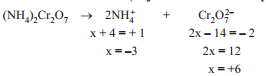
Oxidation number of N and Cr in given compound $\left(\mathrm{NH}_{4}\right)_{2} \mathrm{Cr}_{2} \mathrm{O}_{7}$ is;
  1. A +3 and +6
  2. B -3 and +6
  3. C -3 and -6
  4. D 0 and 0
Show answer & explanation

Correct answer: B

Redox Reactions – NEET-20736 Therefore, option (2) is the correct answer.
5
In the following redox reaction:
$\mathrm { pFe } ^ { 2 + } + \mathrm { Cr } _ { 2 } \mathrm { O } _ { 7 } ^ { 2 - } + \mathrm { qH } ^ { + } \rightarrow \mathrm { rFe } ^ { 3 + } + \mathrm { sCr } ^ { 3 + } + 7 \mathrm { H } _ { 2 } \mathrm { O }$
the values of coefficients $\mathrm { p } , \mathrm { q } , \mathrm { r }$ and s are, respectively:
  1. A $14,6,2$ and 6
  2. B $6,2,14$ and 6
  3. C 6, 14, 6 and 2
  4. D 2, 14, 6 and 6
Show answer

Correct answer: C

6
If $10 \mathrm{~g} \mathrm{~V}_{2} \mathrm{O}_{5}$ is dissolved in acid and reduced to $\mathrm{V}^{2+}$ by treatment with zinc metal, how many moles of $\mathrm{I}_{2}$ could be reduced by the resulting $\mathrm{V}^{2+}$ solution, as it is oxidised to $\mathrm{V}^{4+}$ ? (Molar mass of $\mathrm{V}=51 \mathrm{~g} \mathrm{~mol}^{-1}$)
$\mathrm{V}_{2} \mathrm{O}_{5}+10 \mathrm{H}^{+}+6 \mathrm{e}^{-} \longrightarrow 2 \mathrm{~V}^{2+}+5 \mathrm{H}_{2} \mathrm{O}$
$\mathrm{~V}^{2+}+\mathrm{I}_{2}+\mathrm{H}_{2} \mathrm{O} \longrightarrow 2 \mathrm{I}^{-}+\mathrm{VO}^{2+}+2 \mathrm{H}^{+}$
  1. A 0.02
  2. B 0.11
  3. C 0.4
  4. D 0.3
Show answer & explanation

Correct answer: B

From the above equations,
1 mol of $\mathrm{V}_{2} \mathrm{O}_{5}$ reduces 2 mol of $\mathrm{V}^{2+}$
1 mol of $\mathrm{V}^{2+}$ reduces 1 mol of $\mathrm{I}_{2}$
Thus, 1 mol of $\mathrm{V}_{2} \mathrm{O}_{5}$ reduces 2 mol of $\mathrm{I}_{2}$
Hence, 10 g of $\mathrm{V}_{2} \mathrm{O}_{5}$ reduces $\frac{2 \times 10}{182} \mathrm{~mol}$ of $\mathrm{I}_{2}$
= 0.11 mol I$_{2}$
Therefore, option (2) is the correct answer
7
In acidic medium, $\mathrm { H } _ { 2 } \mathrm { O } _ { 2 }$ changes $\mathrm { Cr } _ { 2 } \mathrm { O } _ { 7 } ^ { 2 - }$ to $\mathrm { CrO } _ { 5 }$ which has two ( $- \mathrm { O } - \mathrm { O } -$ ) bonds. Oxidation state of Cr in $\mathrm { CrO } _ { 5 }$ is;
  1. A + 5
  2. B + 3
  3. C + 6
  4. D - 10
Show answer

Correct answer: C

8
When sulphur dioxide is passed in an acidified $\mathrm { K } _ { 2 } \mathrm { Cr } _ { 2 } \mathrm { O } _ { 7 }$ solution, the oxidation state of sulphur is changed from;
  1. A + 4 to 0
  2. B + 4 to + 2
  3. C + 4 to + 6
  4. D + 6 to + 4
Show answer

Correct answer: C

9
Oxidation number of Mn in $\mathrm { K } _ { 2 } \mathrm { MnO } _ { 4 }$ and $\mathrm { MnSO } _ { 4 }$ are respectively;
  1. A + 7 and + 2
  2. B + 6 and + 2
  3. C + 5 and + 2
  4. D + 2 and + 6
Show answer

Correct answer: C

10
At 298 K , the standard electrode potentials of $\mathrm { Cu } ^ { 2 + } / \mathrm { Cu } , \mathrm { Zn } ^ { 2 + } / \mathrm { Zn } , \mathrm { Fe } ^ { 2 + } / \mathrm { Fe }$ and $\mathrm { Ag } ^ { + } / \mathrm { Ag }$ are $0.34 \mathrm {~V} , - 0.76 \mathrm {~V}$, - 0.44 V and 0.80 V , respectively. On the basis of standard electrode potential, predict which of the following reaction can not occur?
  1. A $2 \mathrm { CuSO } _ { 4 } ( \mathrm { aq } ) + 2 \mathrm { Ag } ( \mathrm { s } ) \rightarrow 2 \mathrm { Cu } ( \mathrm { s } ) + \mathrm { Ag } _ { 2 } \mathrm { SO } _ { 4 } ( \mathrm { aq } )$
  2. B $\mathrm { CuSO } _ { 4 } ( \mathrm { aq } ) + \mathrm { Zn } ( \mathrm { s } ) \rightarrow \mathrm { ZnSO } _ { 4 } ( \mathrm { aq } ) + \mathrm { Cu } ( \mathrm { s } )$
  3. C $\mathrm { CuSO } _ { 4 } ( \mathrm { aq } ) + \mathrm { Fe } ( \mathrm { s } ) \rightarrow \mathrm { FeSO } _ { 4 } ( \mathrm { aq } ) + \mathrm { Cu } ( \mathrm { s } )$
  4. D $\mathrm { FeSO } _ { 4 } ( \mathrm { aq } ) + \mathrm { Zn } ( \mathrm { s } ) \rightarrow \mathrm { ZnSO } _ { 4 } ( \mathrm { aq } ) + \mathrm { Fe } ( \mathrm { s } )$
Show answer

Correct answer: A

11
Equal volumes of 1 M each of $\mathrm{KMnO}_{4}$ and $\mathrm{K}_{2} \mathrm{Cr}_{2} \mathrm{O}_{7}$ are used to oxidise Fe (II) solution in an acidic medium. The amount of Fe oxidised would be;
  1. A more with $\mathrm{KMnO}_{4}$.
  2. B equal with both oxidising agents.
  3. C more with $\mathrm{K}_{2} \mathrm{Cr}_{2} \mathrm{O}_{7}$.
  4. D None of these
Show answer & explanation

Correct answer: C

The n -factor of $\mathrm{KMnO}_{4}$ in its reaction with Fe (II) would be 5 while that of $\mathrm{K}_{2} \mathrm{Cr}_{2} \mathrm{O}_{7}$ would be 6 . So, for the same number of moles, $\mathrm{K}_{2} \mathrm{Cr}_{2} \mathrm{O}_{7}$ will have greater equivalents than $\mathrm{KMnO}_{4}$ - So, more equivalents of Fe (II) would be oxidised by $\mathrm{K}_{2} \mathrm{Cr}_{2} \mathrm{O}_{7}$ than by $\mathrm{KMnO}_{4}$.
Therefore, option (3) is the correct answer.
12
The oxidation states of sulphur in the anions $\mathrm { SO } _ { 3 } ^ { 2 - }$, $\mathrm { S } _ { 2 } \mathrm { O } _ { 4 } ^ { 2 - }$ and $\mathrm { S } _ { 2 } \mathrm { O } _ { 6 } ^ { 2 - }$ follow the order:
  1. A $\mathrm { S } _ { 2 } \mathrm { O } _ { 4 } ^ { 2 - } < \mathrm { SO } _ { 3 } ^ { 2 - } < \mathrm { S } _ { 2 } \mathrm { O } _ { 6 } ^ { 2 - }$
  2. B $\mathrm { SO } _ { 3 } ^ { 2 - } < \mathrm { S } _ { 2 } \mathrm { O } _ { 4 } ^ { 2 - } < \mathrm { S } _ { 2 } \mathrm { O } _ { 6 } ^ { 2 - }$
  3. C $\mathrm { S } _ { 2 } \mathrm { O } _ { 4 } ^ { 2 - } < \mathrm { S } _ { 2 } \mathrm { O } _ { 6 } ^ { 2 - } < \mathrm { SO } _ { 3 } ^ { 2 - }$
  4. D $\mathrm { S } _ { 2 } \mathrm { O } _ { 6 } ^ { 2 - } < \mathrm { S } _ { 2 } \mathrm { O } _ { 4 } ^ { 2 - } < \mathrm { SO } _ { 3 } ^ { 2 - }$
Show answer

Correct answer: A

13
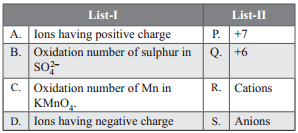
Match the List-I with List-II to fid out the correct option.
Redox Reactions – NEET-20753
  1. A A-(R); B-(Q); C-(P); D-(S)
  2. B A-(P); B-(R); C-(Q); D-(S
  3. C A-(P); B-(S); C-(R); D-(Q)
  4. D A-(S); B-(P); C-(R); D-(Q)
Show answer

Correct answer: A

14
The equivalent weight of $\mathrm { KIO } _ { 3 }$ in the reaction,
$2 \mathrm { Cr } ( \mathrm { OH } ) _ { 3 } + 4 \mathrm { OH } + \mathrm { KIO } _ { 3 } \rightarrow 2 \mathrm { CrO } _ { 4 } ^ { 2 - } + 5 \mathrm { H } _ { 2 } \mathrm { O } + \mathrm { KI }$, is;
  1. A M
  2. B $\frac { \mathrm { M } } { 6 }$
  3. C $\frac { \mathrm { M } } { 2 }$
  4. D $\frac { \mathrm { M } } { 3 }$
Show answer

Correct answer: B

15
The normality of $0.3 \mathrm{M} \mathrm{H}_{3} \mathrm{PO}_{3}$ when it undergoes the following reaction:
$\mathrm{H}_{3} \mathrm{PO}_{3}+2 \mathrm{OH}^{-} \longrightarrow \mathrm{HPO}_{3}^{2-}+2 \mathrm{H}_{2} \mathrm{O}$
would be;
  1. A 0.6 N
  2. B 0.15 N
  3. C 0.9 N
  4. D 0.1 N
Show answer & explanation

Correct answer: A

Molar ratio of reactants is $1: 2$, so the n -factor ratio has to be 2 : 1 .
OR
n-factor of $\mathrm{H}_{3} \mathrm{PO}_{3}=$ number or replaced $\mathrm{H}^{+}$.
∴ Normality of $\mathrm{H}_{3} \mathrm{PO}_{3}=\mathrm{M} \times \mathrm{n}$-factor $=0.3 \times 2=0.6 \mathrm{~N}$
Therefore, option (1) is the correct answer.
16
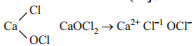
Oxidation number of two Cl atoms in bleaching powder $\left( \mathrm { CaOCl } _ { 2 } \right)$ is;
  1. A - 1 and - 1
  2. B + 1 and - 1
  3. C + 1 and + 1
  4. D 0 and + 1
Show answer & explanation

Correct answer: B

Redox Reactions – NEET-20737For $\mathrm{Cl}^{-}$oxidation number of $\mathrm{Cl}=-1$
For $\mathrm{OCl}^{-}$oxidation number of Cl is $=\mathrm{x}$
∴ -2 + $\mathrm{x}$ = -1
$\Rightarrow \mathrm{x}$ = +1

Therefore, option (2) is the correct answer.
17
Oxidation number of Fe in $\mathrm { Fe } _ { 3 } \mathrm { O } _ { 4 }$ is:
  1. A $\frac { 1 } { 2 }$
  2. B $\frac { 2 } { 6 }$
  3. C $\frac { 8 } { 3 }$
  4. D $\frac { 3 } { 2 }$
Show answer

Correct answer: C

18
Identify the correct type of redox reaction in the following equation:
$2 \mathrm { Fe } + 3 \mathrm { Cl } _ { 2 } \rightarrow 2 \mathrm { FeCl } _ { 3 }$
  1. A Combination redox reaction
  2. B Decomposition redox reaction
  3. C Displacement redox reaction
  4. D Disproportionation redox reaction
Show answer

Correct answer: A

19
What would be equivalent weight of the reductant in the given reaction?
$\left[ \mathrm { Fe } ( \mathrm { CN } ) _ { 6 } \right] ^ { 3 - } + \mathrm { H } _ { 2 } \mathrm { O } _ { 2 } + 2 \mathrm { OH } ^ { - } \rightarrow 2 \left[ \mathrm { Fe } ( \mathrm { CN } ) _ { 6 } \right] ^ { 4 - } + 2 \mathrm { H } _ { 2 } \mathrm { O } +$
  1. A 17
  2. B 212
  3. C 34
  4. D 32
Show answer

Correct answer: A

20
Oxidation number of S in $\mathrm { H } _ { 2 } \mathrm { SO } _ { 5 }$ is 6. This is observed because;
  1. A there are five oxygen atoms in the molecule.
  2. B the hydrogen atom is directly linked with non-metal.
  3. C there is peroxide linkage in the molecule.
  4. D the sulphur atom shows coordinate linkage.
Show answer

Correct answer: C

Attempt this as a timed test

Reading answers is not the same as sitting the paper. Attempt it timed and you get your score, per-question timing, and the mistakes tracked for revision.

Start free

More Redox Reactions tests

All Redox Reactions tests →