Solutions — DPP 2

20 NEET questions from Solutions, with answers and explanations. Attempt it as a timed test to get scoring, accuracy breakdown and mistake tracking.

Attempt this test free 20 questions · 30 minutes · +80 marks
1
Which of the following has no units?
  1. A Molarity
  2. B Normality
  3. C Molality
  4. D Mole fraction
Show answer

Correct answer: D
2
Assertion: When NaCl is added to water, a depression in freezing point is observed.
Reason: The lowering of vapour pressure of a solution causes depression in the freezing point.
  1. A Assertion and reason both are true and reason is correct explanation for assertion.
  2. B Assertion and reason both are true but reason is not correct explanation for assertion.
  3. C Assertion is true but reason is false.
  4. D Assertion is false but reason is true.
Show answer

Correct answer: A

3
To make 2.5 kg of 0.25 m aqueous solution, the mass of urea required is; (Molar mass of urea = 60 gmol$^ { - 1 }$)
  1. A 37.0 g
  2. B 3.75 g
  3. C 73.5 g
  4. D 0.625 g
Show answer

Correct answer: A

4
Molarity of 0.1 N oxalic acid is:
  1. A 0.05 M
  2. B 0.1 M
  3. C 0.2 M
  4. D 0.3 M
Show answer

Correct answer: A

5
Assertion: When methyl alcohol is added to water, boiling point of water increases.
Reason: When a non-volatile solute is added to a volatile solvent elevation in boiling point is observed.
  1. A Assertion and reason both are true and reason is correct explanation for assertion.
  2. B Assertion and reason both are true but reason is not correct explanation for assertion.
  3. C Assertion is true but reason is false.
  4. D Assertion is false but reason is true.
Show answer

Correct answer: D

6
When the volume of the solution is doubled, which of the following becomes exactly half ?
  1. A Molality
  2. B Mole fraction
  3. C Molarity
  4. D Weight percent
Show answer

Correct answer: C

7
The number of moles of solute present in 2.0 litres of 0.5 M NaOH solution is:
  1. A 2
  2. B 1
  3. C 4
  4. D 0.1
Show answer

Correct answer: B

8
$2.5 \mathrm {~cm} ^ { 3 }$ of $0.2 \mathrm {~M } \mathrm {~H } _ { 2 } \mathrm { SO } _ { 4 }$ solution is diluted to $0.5 \mathrm {~dm } ^ { 3 }$. Find normality of the diluted solution.
  1. A 0.2 N
  2. B 0.02 N
  3. C 0.002 N
  4. D 0.04 N
Show answer

Correct answer: C

9
How much amount of benzoic acid $\left( \mathrm { C } _ { 6 } \mathrm { H } _ { 5 } \mathrm { COOH } \right)$ is required for preparing 250 mL of 0.15 M solution in methanol?
  1. A 45.75 g
  2. B 4.575 g
  3. C 0.2 g
  4. D 9.15 g
Show answer

Correct answer: B

10
Freezing point of an aqueous solution is –0.166°C. Elevation of boiling point of same solution would be-
(K$_\mathrm{b}$ = 0.512 Kg mol$^{–1}$ and K$_\mathrm{f}$ = 1.66 Kg mol$^{–1}$)
  1. A 0.18°C
  2. B 0.05°C
  3. C 0.09°C
  4. D 0.23°C
Show answer

Correct answer: B

11
How many millilitres of $1 \mathrm {~M } \mathrm {~H } _ { 2 } \mathrm { SO } _ { 4 }$ will be neutralised by 10 mL of 1 M NaOH solution?
  1. A 10
  2. B 20
  3. C 2.5
  4. D 5
Show answer

Correct answer: D

12
A solution is prepared from 186 g of ethylene glycol $\left( \mathrm { C } _ { 2 } \mathrm { H } _ { 6 } \mathrm { O } _ { 2 } \right)$ and 200 g of water. The molality of the solution would be:
  1. A 26 m
  2. B 18 m
  3. C 30 m
  4. D 15 m
Show answer

Correct answer: D

13
Molarity of $4 \% ( \mathrm { w } / \mathrm { V } )$ solution of NaOH is:
  1. A 0.1
  2. B 0.5
  3. C 0.001
  4. D 1.0
Show answer

Correct answer: D

14
100 g of liquid A (molar mas $140 \mathrm {~g} \mathrm {~mol} ^ { - 1 }$) was dissolved in 1000 g of liquid B (molar mass $180 \mathrm {~g} \mathrm {~mol} ^ { - 1 }$). The vapour pressure of pure liquid B was found to be 500 torr. If the total vapour pressure of the solution is 475 torr, the vapour pressure of pure liquid A will be:
  1. A 326 torr
  2. B 226 torr
  3. C 360.7 torr
  4. D 280.7 torr
Show answer

Correct answer: D

15
A semi molar solution is the one, which contains:
  1. A 1 mole solute in 2 litres of solution.
  2. B 2 moles solute in 2 litres of solution.
  3. C 0.1 mole solute in 1 litre of solution.
  4. D 0.2 moles solute in 2 litres of solution.
Show answer

Correct answer: A

16
1 kg of NaOH is added to 10 ml of 0.1 N HCl , the resulting solution will:
  1. A turn blue litmus red.
  2. B turn phenolphthalein solution pink.
  3. C turn methyl orange red.
  4. D will have no effect on red or blue litmus paper.
Show answer

Correct answer: B

17
Which of the following aqueous solution has the highest boiling point?
  1. A $0.1 \mathrm {~M } \mathrm {~KNO } _ { 3 }$
  2. B $0.1 \mathrm {~M } \mathrm {~Na } _ { 3 } \mathrm { PO } _ { 4 }$
  3. C $0.1 \mathrm {~M } \mathrm {~BaCl } _ { 2 }$
  4. D $0.1 \mathrm {~M } \mathrm {~K } _ { 2 } \mathrm { SO } _ { 4 }$
Show answer

Correct answer: B

18
138 g ethyl alcohol is mixed with 72 g of water. The ratio of mole fraction of alcohol to water is:
  1. A $3 : 4$
  2. B $1 : 2$
  3. C $1 : 4$
  4. D $1 : 1$
Show answer

Correct answer: A

19
Which of the following solutions would have the highest osmotic pressure:
  1. A $\frac { \mathrm { M } } { 10 } \mathrm { NaCl }$
  2. B $\frac { \mathrm { M } } { 10 }$ Urea
  3. C $\frac { \mathrm { M } } { 10 } \mathrm { BaCl } _ { 2 }$
  4. D $\frac { \mathrm { M } } { 10 }$ Glucose
Show answer

Correct answer: C

20
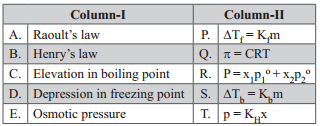
Match the law given in column-I with expressions given in column-II.
Solutions – NEET-8674
  1. A A-(R); B-(T); C-(S); D-(P); E-(Q)
  2. B A-(T); B-(R); C-(P); D-(Q); E-(S)
  3. C A-(S); B-(P); C-(R); D-(T); E-(Q)
  4. D A-(Q); B-(S); C-(T); D-(P ); E-(R)
Show answer

Correct answer: A

Attempt this as a timed test

Reading answers is not the same as sitting the paper. Attempt it timed and you get your score, per-question timing, and the mistakes tracked for revision.

Start free

More Solutions tests

All Solutions tests →