Some Basic Concepts Of Chemistry - Mole Concept — DPP 2

20 NEET questions from Some Basic Concepts in Chemistry, with answers and explanations. Attempt it as a timed test to get scoring, accuracy breakdown and mistake tracking.

Attempt this test free 20 questions · 30 minutes · +80 marks
1
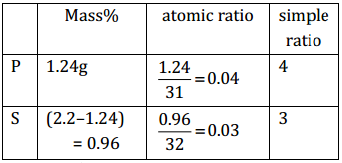
2.2 g of a compound of phosphorous and sulphur has 1.24 g of 'P' in it. Its empirical formula is -
  1. A $\mathrm {P} _ { 2 } \mathrm {S} _ { 3 }$
  2. B $\mathrm {P} _ { 3 } \mathrm {S} _ { 2 }$
  3. C $\mathrm { P } _ { 3 } \mathrm {~S} _ { 4 }$
  4. D $\mathrm { P } _ { 4 } \mathrm {~S} _ { 3 }$
Show answer & explanation

Correct answer: D

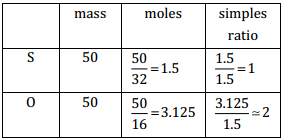
Some Basic Concepts Of Chemistry - Mole Concept – NEET-5693E.F. = P$_{4}$S$_{3}$

2
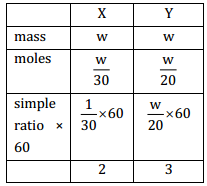
A compound of X and Y has equal mass of them. If their atomic weights are 30 and 20 respectively. Molecular formula of the compound is :-
  1. A $\mathrm {X} _ { 2 } \mathrm {Y} _ { 2 }$
  2. B $\mathrm {X} _ { 3 } \mathrm {Y} _ { 3 }$
  3. C $\mathrm {X} _ { 2 } \mathrm {Y} _ { 3 }$
  4. D $\mathrm { X } _ { 3 } \mathrm { Y } _ { 2 }$
Show answer & explanation

Correct answer: C

Some Basic Concepts Of Chemistry - Mole Concept – NEET-5685Molecular formula = X$_{2}$Y$_{3}$
3
The equation :
$2 \mathrm { Al } _ { ( \mathrm { s } ) } + \frac { 3 } { 2 } \mathrm { O } _ { 2 } ( \mathrm {~g} ) \rightarrow \mathrm { Al } _ { 2 } \mathrm { O } _ { 3 ( \mathrm {~s} ) }$ shows that :-
  1. A 2 mol of Al reacts with $\frac { 3 } { 2 } \mathrm {~mol}$ of $\mathrm { O } _ { 2 }$ to produce $\frac { 7 } { 2 } \mathrm {~mol}$ of $\mathrm { Al } _ { 2 } \mathrm { O } _ { 3 }$
  2. B 2 g of Al reacts with $\frac { 3 } { 2 } \mathrm {~g}$ of $\mathrm { O } _ { 2 }$ to produce one mol of $\mathrm { Al } _ { 2 } \mathrm { O } _ { 3 }$
  3. C 2 g of Al reacts with $\frac { 3 } { 2 } \mathrm {~L}$ of $\mathrm { O } _ { 2 }$ to produce 1 mol of $\mathrm { Al } _ { 2 } \mathrm { O } _ { 3 }$
  4. D 2 mol of Al reacts with $\frac { 3 } { 2 } \mathrm {~mol}$ of $\mathrm { O } _ { 2 }$ to produce 1 mol of $\mathrm { Al } _ { 2 } \mathrm { O } _ { 3 }$
Show answer & explanation

Correct answer: D

$2 \mathrm { Al } _ { ( \mathrm { s } ) } + \frac { 3 } { 2 } \mathrm { O } _ { 2 } ( \mathrm {~g} ) \rightarrow \mathrm { Al } _ { 2 } \mathrm { O } _ { 3 ( \mathrm {~s} ) }$
2 mol of Al reacts with $\frac{3}{2}$ mol of O$_{2}$ to produce
1 mol of Al$_{2}$O$_{3}$
4
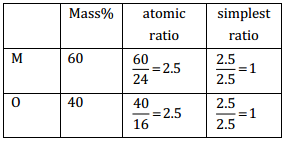
An oxide of metal M has $40 \%$ by mass of oxygen. Metal M has atomic mass of 24. The empirical formula of the oxide is :-
  1. A $\mathrm { M } _ { 2 } \mathrm { O }$
  2. B $\mathrm { M } _ { 2 } \mathrm { O } _ { 3 }$
  3. C $\mathrm { MO }$
  4. D $\mathrm { M } _ { 3 } \mathrm { O } _ { 4 }$
Show answer & explanation

Correct answer: C

Some Basic Concepts Of Chemistry - Mole Concept – NEET-5689 E.F = MO

5
5.6 L of oxygen at NTP is equivalent to -
  1. A 1 mol
  2. B $1 / 2 \mathrm {~mol}$
  3. C $1 / 4 \mathrm {~mol}$
  4. D $1 / 8 \mathrm {~mol}$
Show answer & explanation

Correct answer: C

$\mathrm{n}_{\mathrm{O}_{2}}=\frac{5.6}{22.4}=\frac{1}{4}$
6
Caffine has a molecular weight of 194. It contains $28.9 \%$ by mass of nitrogen Number of atoms of nitrogen in one molecule of it is :-
  1. A 2
  2. B 3
  3. C 4
  4. D 5
Show answer & explanation

Correct answer: C

% of N = $\frac{\text { mass of } \mathrm{N} \times \text { no.of atoms }}{\text { molecolar wt. of Insulin }}$ × 100
28.9 = $\frac{14 \times n}{194}$ × 100
⇒ n = $\frac{28.9 \times 194}{14 \times 100}$ ≈ 4
7
In a given reaction, 9 g of $ \mathrm { Al }$ will react with $2 \mathrm { Al } + \frac { 3 } { 2 } \mathrm { O } _ { 2 } \rightarrow \mathrm { Al } _ { 2 } \mathrm { O } _ { 3 }$
  1. A $6 \mathrm {g} \mathrm {~O} _ { 2 }$
  2. B $8 \mathrm {g} \mathrm {~O} _ { 2 }$
  3. C $9 \mathrm {g} \mathrm {~O} _ { 2 }$
  4. D $4 \mathrm {g} \mathrm {~O} _ { 2 }$
Show answer & explanation

Correct answer: B

$2 \mathrm { Al } + \frac { 3 } { 2 } \mathrm { O } _ { 2 } \rightarrow \mathrm { Al } _ { 2 } \mathrm { O } _ { 3 }$
n = $\frac{9}{27}=\frac{1}{3}$
2 mol Al → $\frac{3}{2}$ mol O$_{2}$
1 mol Al → $\frac{3}{4}$ mol O$_{2}$
$\frac{1}{3}$ mol Al → $\frac{3}{4} \times \frac{1}{3}$ mol O$_{2}$
$\mathrm{n}_{\mathrm{O}_{2}}=\frac{1}{4}$
wt. of O$_{2}$ = $\frac{1}{4}$ × 32 = 8g
8
The number of molecule in 4.25 g of $\mathrm { NH } _ { 3 }$ is -
  1. A $1.505 \times 10 ^ { 23 }$
  2. B $3.01 \times 10 ^ { 23 }$
  3. C $6.02 \times 10 ^ { 23 }$
  4. D None of these
Show answer & explanation

Correct answer: A

$\mathrm{n}_{\mathrm{NH}_{3}}=\frac{4.25}{17}=\frac{1}{4}$
Number of NH₃ molecules
= $\frac{1}{4}$ × 6.022 × 10$^{23}$
= 1.505 × 10$_{23}$
9
The number of atoms of Cr and O are $4.8 \times 10 ^ { 10 }$ and $9.6 \times 10 ^ { 10 }$ respectively. Its empirical formula is -
  1. A $\mathrm { Cr } _ { 2 } \mathrm { O } _ { 3 }$
  2. B $\mathrm { CrO } _ { 2 }$
  3. C $\mathrm { Cr } _ { 2 } \mathrm { O } _ { 4 }$
  4. D $\mathrm { CrO } _ { 5 }$
Show answer & explanation

Correct answer: B

E. f. ⇒ obtain from simples ratio of atom
Gives Cr = 4.8 × 10$^{10}$, 0 = 9.6 × 10$^{10}$
Simplest ratio 1 : 2
Empirical formula = CrO$_{2}$
10
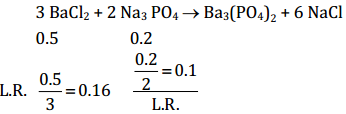
If 0.5 mol of $\mathrm { BaCl } _ { 2 }$ is mixed with 0.2 mol of $\mathrm { Na } _ { 3 } \mathrm { PO } _ { 4 }$, the maximum number of moles of $\mathrm { Ba } _ { 3 } \left( \mathrm { PO } _ { 4 } \right) _ { 2 }$ that can be formed is
$3 \mathrm { BaCl } _ { 2 } + 2 \mathrm { Na } _ { 3 } \mathrm { PO } _ { 4 } \rightarrow \mathrm { Ba } _ { 3 } \left( \mathrm { PO } _ { 4 } \right) _ { 2 } + 6 \mathrm { NaCl }$
  1. A 0.7
  2. B 0.5
  3. C 0.3
  4. D 0.1
Show answer & explanation

Correct answer: D

Some Basic Concepts Of Chemistry - Mole Concept – NEET-5707 2 mol Na$_{3}$PO$_{4}$ → 1 mol Ba$_{3}$(PO$_{4}$)$_{2}$
1 mol Na$_{3}$PO$_{4}$ → $\frac{1}{2}$ mol Ba$_{3}$(PO$_{4}$)$_{2}$
1 0.2 mol Na$_{3}$PO$_{4}$ → $\frac{1}{2}$ × 0.2 mol Ba$_{3}$(PO$_{4}$)$_{2}$
$\mathrm{n}_{\mathrm{Ba}_{3}\left(\mathrm{PO}_{4}\right)_{2}}$ = 0.1
11
An oxide of sulphur contains $50 \%$ of sulphur in it. Its empirical formula is -
  1. A $\mathrm { SO } _ { 2 }$
  2. B $\mathrm { SO } _ { 3 }$
  3. C $\mathrm {SO}$
  4. D $\mathrm { S } _ { 2 } \mathrm { O }$
Show answer & explanation

Correct answer: A

Some Basic Concepts Of Chemistry - Mole Concept – NEET-5686Empirical formula = SO$_{2}$
12
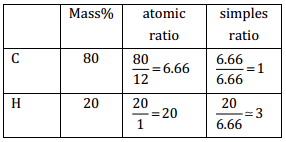
A hydrocarbon contains $80 \%$ of carbon, then the hydrocarbon is -
  1. A $\mathrm { CH } _ { 4 }$
  2. B $\mathrm { C } _ { 2 } \mathrm { H } _ { 4 }$
  3. C $\mathrm { C } _ { 2 } \mathrm { H } _ { 6 }$
  4. D $\mathrm { C } _ { 2 } \mathrm { H } _ { 2 }$
Show answer & explanation

Correct answer: C

Some Basic Concepts Of Chemistry - Mole Concept – NEET-5687 C$_{1}$ H$_{3}$
1 : 3
C$_{2}$ H$_{6}$
13
If $1 / 2$ mol of oxygen combine with Aluminium to form $\mathrm { Al } _ { 2 } \mathrm { O } _ { 3 }$ then weight of Aluminium metal used in the reaction is $( \mathrm { Al } = 27 )$ -
  1. A 27 g
  2. B 18 g
  3. C 54 g
  4. D 40.5 g
Show answer & explanation

Correct answer: B

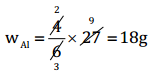
4Al + 3O$_{2}$ → 2Al$_{2}$O$_{3}$
3 mol O$_{2}$ → 4 mol of Al
1 mol O$_{2}$ → $\frac{4}{3}$ mol of Al
$\frac{1}{2}$ mol O$_{2}$ → $\frac{4}{3} \times \frac{1}{2}$ mol of Al
n$_\mathrm{Al}$ = $\frac{4}{6}$
Some Basic Concepts Of Chemistry - Mole Concept – NEET-5706
14
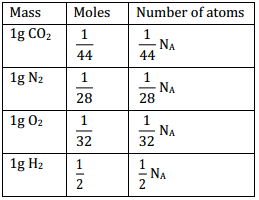
Which contains least number of molecules :-
  1. A $1 \mathrm {g}$ $\mathrm { CO } _ { 2 }$
  2. B $1 \mathrm {g}$ $\mathrm {N} _ { 2 }$
  3. C $1 \mathrm {g}$ $\mathrm { O } _ { 2 }$
  4. D $1 \mathrm {g}$ $\mathrm { H } _ { 2 }$
Show answer & explanation

Correct answer: A

Some Basic Concepts Of Chemistry - Mole Concept – NEET-5676
15
Insulin contains $3.4 \%$ sulphur by mass. The minimum molecular weight of insulin is :
  1. A 941.176
  2. B 944
  3. C 945.27
  4. D None
Show answer & explanation

Correct answer: A

% of S ⇒ 3.4 = $\frac{1 \times 32}{\text { Min.mol.wt. }}$ × 100
Minimum molecular wt. = $\frac{32 \times 100}{3.4}$ ≈ 941.176
16
Empirical formula of glucose is -
  1. A $\mathrm { C } _ { 6 } \mathrm { H } _ { 12 } \mathrm { O } _ { 6 }$
  2. B $\mathrm { C } _ { 3 } \mathrm { H } _ { 6 } \mathrm { O } _ { 3 }$
  3. C $\mathrm { C } _ { 2 } \mathrm { H } _ { 4 } \mathrm { O } _ { 2 }$
  4. D $\mathrm { CH } _ { 2 } \mathrm { O }$
Show answer & explanation

Correct answer: D

Molecular formula of glucose = C$_{6}$H$_{12}$O$_{6}$
Some Basic Concepts Of Chemistry - Mole Concept – NEET-5688 E. F. of glucose = CH$_{2}$O
17
The number of atoms in 4.25 g of $\mathrm { NH } _ { 3 }$ is approx:-
  1. A $1 \times 10 ^ { 23 }$
  2. B $1.5 \times 10 ^ { 23 }$
  3. C $2 \times 10 ^ { 23 }$
  4. D $6 \times 10 ^ { 23 }$
Show answer & explanation

Correct answer: D

$\mathrm{n}_{\mathrm{NH}_{3}}=\frac{4.25}{17}=\frac{1}{4}$
Number of atoms
$\begin{array}{l}=\mathrm{n}_{\mathrm{NH}_{3}} \times \mathrm{N}_{\mathrm{A}} \times \text { atomicity } \\ =\frac{1}{4} \times \mathrm{N}_{\mathrm{A}} \times 4 \\ =\mathrm{N}_{\mathrm{A}}=6 \times 10^{23}\end{array}$
18
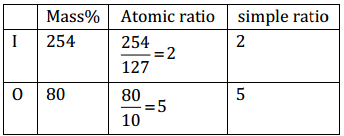
On analysis, a certain compound was found to contain iodine and oxygen in the mass ratio of 254:80. The formula of the compound is : (At mass $\mathrm { I } = 127,\mathrm { O } = 16$)
  1. A $\mathrm {IO}$
  2. B $\mathrm { I } _ { 2 } \mathrm { O }$
  3. C $\mathrm { I } _ { 5 } \mathrm { O } _ { 2 }$
  4. D $\mathrm { I } _ { 2 } \mathrm { O } _ { 5 }$
Show answer & explanation

Correct answer: D

Some Basic Concepts Of Chemistry - Mole Concept – NEET-5694 Formula = I$_{2}$O$_{5}$
19
If $3.01 \times 10 ^ { 20 }$ molecules are removed from 98 mg of $\mathrm { H } _ { 2 } \mathrm { SO } _ { 4 }$, then the number of moles of $\mathrm { H } _ { 2 } \mathrm { SO } _ { 4 }$ left are :-
  1. A $0.1 \times 10 ^ { - 3 }$
  2. B $0.5 \times 10 ^ { - 3 }$
  3. C $1.66 \times 10 ^ { - 3 }$
  4. D $9.95 \times 10 ^ { - 2 }$
Show answer & explanation

Correct answer: B

Initial mass of $\mathrm { H } _ { 2 } \mathrm { SO } _ { 4 }$ = 98mg = 98 × 10$^{–3}$g
Initial moles of $\mathrm { H } _ { 2 } \mathrm { SO } _ { 4 }$ = $\frac{98 \times 10^{-3}}{98}$ = 10$^{-3}$ mol

Number of molecules removed = 3.01 × 10$^{ 20}$
Number of moles removed
$=\frac{3.01 \times 10^{20}}{6.02 \times 10^{23}}$ = 0.5 × 10$^{-3}$ mol

Moles of $\mathrm { H } _ { 2 } \mathrm { SO } _ { 4 }$ left = 10$^{–3}$ – [0.5 × 10$^{–3}$]
= 0.5 × 10$^{–3}$
20
Given that one mole of $\mathrm { N } _ { 2 }$ at NTP occupies 22.4 L the density of $\mathrm { N } _ { 2 }$ is -
  1. A $1.25 \mathrm {~g} \mathrm {~L} ^ { - 1 }$
  2. B $0.80 \mathrm {~g} \mathrm {~L} ^ { - 1 }$
  3. C $2.5 \mathrm {~g} \mathrm {~L} ^ { - 1 }$
  4. D $1.60 \mathrm {~g} \mathrm {~L} ^ { - 1 }$
Show answer & explanation

Correct answer: A

Vol. of 1 mole N$_{2}$ [at N.T.P.] = 22.4 L
mass of 1 mole N$_{2}$ = 28g
Density of N$_{2 }$ $=\frac{\text { mass }}{\text { volume }}=\frac{28 \mathrm{~g}}{22.4 \mathrm{~L}}$
= 1.25 g L$^{-1}$

Attempt this as a timed test

Reading answers is not the same as sitting the paper. Attempt it timed and you get your score, per-question timing, and the mistakes tracked for revision.

Start free

More Some Basic Concepts in Chemistry tests

All Some Basic Concepts in Chemistry tests →