Some Basic Principles of Organic Chemistry — DPP 3

20 NEET questions from Some Basic Principles of Organic Chemistry, with answers and explanations. Attempt it as a timed test to get scoring, accuracy breakdown and mistake tracking.

Attempt this test free 20 questions · 30 minutes · +80 marks
1
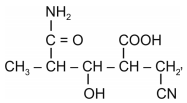
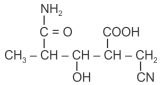
In the structure
Some Basic Principles of Organic Chemistry – NEET-13754 number of functional groups presents is
  1. A Two
  2. B Four
  3. C Five
  4. D Three
Show answer & explanation

Correct answer: B

Some Basic Principles of Organic Chemistry – NEET-13754 Functional groups present are $-\mathrm{CONH}_{2},-\mathrm{OH},-\mathrm{COOH}$ and -CN

2
In detection of 'P' by fusing with $\mathrm { Na } _ { 2 } \mathrm { O } _ { 2 }$ and then extracting it with water, we add $\mathrm { HNO } _ { 3 }$ (conc.) and ammonium molybdate to get
  1. A Yellow ppt of $\left( \mathrm { NH } _ { 3 } \right) _ { 3 } \mathrm { PO } _ { 4 }$
  2. B Yellow ppt of $\left( \mathrm { NH } _ { 4 } \right) _ { 3 } \mathrm { PO } _ { 4 } \cdot 12 \mathrm { MoO } _ { 3 }$
  3. C White ppt of $\left( \mathrm { NH } _ { 4 } \right) _ { 3 } \mathrm { PO } _ { 4 }$
  4. D White ppt. of $\left( \mathrm { NH } _ { 4 } \right) _ { 2 } \mathrm { HPO } _ { 3 }$
Show answer & explanation

Correct answer: B

Some Basic Principles of Organic Chemistry – NEET-13885
3
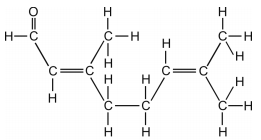
The sum of $\sigma$ and $\pi$-bonds present in the given molecule is
Some Basic Principles of Organic Chemistry – NEET-13945
  1. A 26
  2. B 28
  3. C 29
  4. D 30
Show answer & explanation

Correct answer: C

Some Basic Principles of Organic Chemistry – NEET-13945 Number of $\sigma$ bonds $=26$
Number of $\pi$ bonds $=3$
4
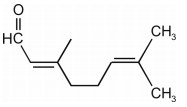
The most stable alkene is
  1. A $\mathrm { CH } _ { 2 } = \mathrm { CH } - \mathrm { CH } _ { 2 } - \mathrm { CH } _ { 3 }$
  2. B
  3. C $\mathrm { CH } _ { 2 } = \mathrm { CH } - \mathrm { CH } = \mathrm { CH } _ { 2 }$
  4. D $\mathrm { CH } _ { 3 } - \mathrm { CH } = \mathrm { CH } - \mathrm { CH } _ { 3 }$
Show answer & explanation

Correct answer: B

This alkene is a conjugated alkene and conjugated alkenes are stabilized by resonance. Also more substituted alkenes are more stable.
5
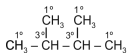
Which alkane would have only primary and tertiary carbon?
  1. A Pentane
  2. B 2-Methylbutane
  3. C 2, 2-Dimethyl propane
  4. D 2, 3-Dimethylbutane
Show answer & explanation

Correct answer: D

Some Basic Principles of Organic Chemistry – NEET-13765 $1^{\circ}$ Primary carbon
$3^{\circ}$ Tertiary carbon
6
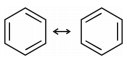
Number of resonating structures possible for benzene are
  1. A 1
  2. B 2
  3. C 3
  4. D 4
Show answer & explanation

Correct answer: B

Some Basic Principles of Organic Chemistry – NEET-13940
7
The most stable carbocation is

  1. A $\mathrm { CH } _ { 3 } - \stackrel { \oplus } { \mathrm { CH } } - \mathrm { CH } _ { 3 }$
  2. B $\mathrm { CH } _ { 3 } - \stackrel { \oplus } { \mathrm { CH } } - \mathrm { CH } _ { 2 } - \mathrm { CH } _ { 3 }$
  3. C $\mathrm { CH } _ { 3 } - \stackrel { \oplus } { \mathrm { CH } } - \mathrm { CH } _ { 2 } - \mathrm { CH } _ { 2 } - \mathrm { CH } _ { 3 }$
  4. D $\mathrm { CH } _ { 3 } - \mathrm { CH } _ { 2 } - \stackrel { \oplus } { \mathrm { CH } } - \mathrm { CH } _ { 2 } - \mathrm { CH } _ { 3 }$
Show answer & explanation

Correct answer: A

All the given carbocations are secondary but maximum number of hyperconjugative structures are possible for this carbocation as it contains maximum number of alpha hydrogens.
8
The number of chain isomers possible in $\mathrm { C } _ { 5 } \mathrm { H } _ { 12 }$ is
  1. A 2
  2. B 3
  3. C 4
  4. D 5
Show answer & explanation

Correct answer: B

Chain isomers of $\mathrm{C}_{5} \mathrm{H}_{12}$ are
Some Basic Principles of Organic Chemistry – NEET-13787
9
The substance which can be used as an adsorbent in column chromatography is
  1. A $\mathrm { Na } _ { 2 } \mathrm { O }$
  2. B NaCl
  3. C $\mathrm { Al } _ { 2 } \mathrm { O } _ { 3 }$
  4. D Alum
Show answer & explanation

Correct answer: C

Alumina is generally used as adsorbent in column chromatography
10
Which is not correct match?
  1. A Carius method - Halogens
  2. B Leibig's method - C and hydrogen
  3. C Kjeldahl's method $- \mathrm { N } _ { 2 }$
  4. D Lassaigne's test $- \mathrm { O } _ { 2 }$
Show answer & explanation

Correct answer: D

Lassaigne's test is only used for the detection of nitrogen, sulphur, halogens and phosphorous.
11
The mixture of urea and naphthalene can be separated by
  1. A Filtration
  2. B Sublimation
  3. C Chromatographic
  4. D Distillation
Show answer & explanation

Correct answer: B

Naphthalene is an aromatic solid which can directly undergo into gaseous state from solid state upon heating. This phenomenon is called sublimation and can be used to separate sublime solid, Urea is not a sublime solid.
12
The IUPAC name of $\mathrm { CH } _ { 3 } \mathrm { OC } _ { 2 } \mathrm { H } _ { 5 }$ is
  1. A Ethoxymethane
  2. B Methoxyethane
  3. C Methyl ethyl ether
  4. D Ethyl methyl ether
Show answer & explanation

Correct answer: B

Some Basic Principles of Organic Chemistry – NEET-13769 $\mathrm{CH}_{3} \mathrm{O}$ is the substituent and ethane is the parent compound
13
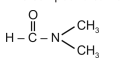
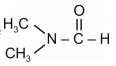
The IUPAC name of
Some Basic Principles of Organic Chemistry – NEET-13784
  1. A $\mathrm { N } , \mathrm { N }$-dimethylmethanal
  2. B $\mathrm { N } , \mathrm { N }$-dimethylmethanamide
  3. C N, N-dimethylcarbaldehyde
  4. D None of these
Show answer & explanation

Correct answer: B

The compound can be written as
Some Basic Principles of Organic Chemistry – NEET-13784 The numbering is done keeping lowest sum rule in mind.
14
The number of C atoms present in allyl vinyl acetylene is $\_\_\_\_$ and it has $\_\_\_\_$ degree of unsaturation
  1. A 7 and 4
  2. B 7 and 3
  3. C 5 and 4
  4. D 5 and 3
Show answer & explanation

Correct answer: A

7 and 4
$\mathrm{CH}_{2}=\mathrm{CH}-\mathrm{CH}_{2}-\mathrm{C}=\mathrm{C}-\mathrm{CH}=\mathrm{CH}_{2}$
Allyl vinyl acetylene, it contains seven carbon atoms and four $\pi$ bonds
15
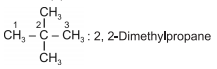
IUPAC name for the compound having formula $\mathrm { C } \left( \mathrm { CH } _ { 3 } \right) _ { 4 }$ is
  1. A Tetramethylmethane
  2. B 1, 1, 1, 1-Tetramethylmethane
  3. C 2, 2-Dimethylpropane
  4. D 2, 2-Dimethylisopropane
Show answer & explanation

Correct answer: C

Some Basic Principles of Organic Chemistry – NEET-13756
16
0.4 g of organic compound gave 0.188 g of AgBr . The percentage of Br in the compound is
  1. A 39.8
  2. B 46.0
  3. C 20.0
  4. D 40.0
Show answer & explanation

Correct answer: C

$\begin{aligned} \% \text { of halogen } & =\frac{\text { At. mass of } \mathrm{Br}}{\text { At. mass of } \mathrm{AgBr}} \times \frac{\text { Mass of } \mathrm{AgBr}}{\text { Mass of compound }} \times 100 \\ & =\frac{80}{188} \times \frac{0.188}{0.4} \times 100=20 \% \\ \% \text { of bromine } & =20 \%\end{aligned}$
17
The correct decreasing priority order of given functional groups while writing the IUPAC nomenclature is
  1. A $- \mathrm { COOH } , - \mathrm { SO } _ { 3 } \mathrm { H } , - \mathrm { COOR } , - \mathrm { COCl }$
  2. B $- \mathrm { COOH } , - \mathrm { SO } _ { 3 } \mathrm { H } , - \mathrm { COCl } , - \mathrm { COOR }$
  3. C $- \mathrm { COOH } , - \mathrm { COOR } , - \mathrm { SO } _ { 3 } \mathrm { H } , - \mathrm { COCl }$
  4. D $- \mathrm { COOH } , - \mathrm { COCl } , - \mathrm { SO } _ { 3 } \mathrm { H } , - \mathrm { COOR }$
Show answer & explanation

Correct answer: A

As per IUPAC priority for functional group is
$-\mathrm{COOH},-\mathrm{SO}_{3} \mathrm{H},-\mathrm{COOR},-\mathrm{COCl}$
18
Glycerol decomposes at its boiling point. The purification of glycerol can be affected by
  1. A Crystallisation
  2. B Simple distillation
  3. C Distillation under reduced pressure
  4. D Fractional crystallisation
Show answer & explanation

Correct answer: C

When external pressure is lowered, boiling point is also lowered and a liquid can boil below its normal boiling point. This technique is used for purification of glycerol by distillation under reduced pressure.
19
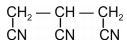
The IUPAC name of the compound is
Some Basic Principles of Organic Chemistry – NEET-13770
  1. A 1, 2, 3-Cyanopropene
  2. B 1, 2, 3-Cyanopropane
  3. C 3-Cyanopentan-1,5,-dinitrile
  4. D Propane-1,2,3-Tricarbonitrile
Show answer & explanation

Correct answer: D

Here three nitrile groups are taken as functional groups, so suffix carbonitrile is used with largest carbon chain of 3 C atoms.
20
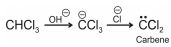
The correct statement for $\alpha$-elimination is
  1. A It forms cyclic compounds
  2. B It forms carbene or substituted carbene
  3. C Two atoms are removed from $\alpha$ and $\beta$ positions
  4. D In CHCl$_{3} ; \alpha$ elimination is not possible
Show answer & explanation

Correct answer: B

Alpha elimination leads to the generation of carbenes
Some Basic Principles of Organic Chemistry – NEET-13819

Attempt this as a timed test

Reading answers is not the same as sitting the paper. Attempt it timed and you get your score, per-question timing, and the mistakes tracked for revision.

Start free

More Some Basic Principles of Organic Chemistry tests

All Some Basic Principles of Organic Chemistry tests →