Current Electricity — DPP 2

20 NEET questions from Current Electricity, with answers and explanations. Attempt it as a timed test to get scoring, accuracy breakdown and mistake tracking.

Attempt this test free 20 questions · 30 minutes · +80 marks
1
A resistance coil and a battery is given. In which of the following cases the heat generated is maximum?
  1. A When the coil is directly connected to the battery as such
  2. B When the coil is divided into two equal parts and both parts are connected to the battery in parallel
  3. C When the coil is divided into four equal parts which are connected to the battery in parallel
  4. D When only half the coil is connected to the battery
Show answer & explanation

Correct answer: C

Since battery supplies constant emf.
So power, $P=\frac{V^{2}}{R}$ or Power $\propto \frac{1}{R}$
So, R should be minimum to generate maximum heat.
In option (C) resistance would be minimum.
So, heat generated would be maximum.
2
The same mass of copper is drawn into two wires 1 mm and 2 mm thick. The two wires are connected in series and current is passed through them. Heat produced in the two wires is in the ratio;
  1. A 2 : 1
  2. B 4 : 1
  3. C 8 : 1
  4. D 16 : 1
Show answer

Correct answer: D

3
To send 10% of the main current through a moving coil galvanometer of resistance 99 Ω, the shunt required as;
  1. A 9.9 Ω
  2. B 10 Ω
  3. C 11 Ω
  4. D 9 Ω
Show answer

Correct answer: C

4
The current density at a point is $\bar { J } = \left( 2 \times 10 ^ { 4 } \hat { j } \right) \mathrm { Am } ^ { - 2 }$. Find the rate of charge flow through a cross sectional area $\bar { S } = ( 2 \hat { i } \times 3 \hat { j } ) \mathrm { cm } ^ { 2 }$
  1. A 2 A
  2. B 4 A
  3. C 6 A
  4. D 8 A
Show answer

Correct answer: C

5
If n, e, τ and m are representing electron density, charge, relaxation time and mass of an electron respectively, then the resistance of a wire of length l and cross-sectional area A is given by
  1. A $\frac { m l } { n e ^ { 2 } \tau A }$
  2. B $\frac { m \tau A } { n e ^ { 2 } l }$
  3. C $\frac { n e ^ { 2 } \tau A } { m l }$
  4. D $\frac { n e ^ { 2 } A } { m \tau l }$
Show answer

Correct answer: A

6
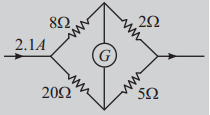
In the given figure, when galvanometer shows no deflection, the current (in ampere) flowing through 5 Ω resistance will be;
Current Electricity – NEET-10072
  1. A 0.5
  2. B 0.6
  3. C 0.9
  4. D 1.5
Show answer

Correct answer: B

7
A potential difference is applied across the ends of a metallic wire. If the potential difference is doubled, the drift velocity will
  1. A Be doubled
  2. B Be halved
  3. C Be quadrupled
  4. D Remain unchanged
Show answer & explanation

Correct answer: A

Drift velocity, $v_{d}^{\prime}=\frac{-e \bar{E} \tau}{m}=\frac{-e \tau}{m}\left(\frac{V}{I}\right)$
$\therefore \quad v_{d} \propto V$
As V is doubled
∴ v$_{d}$ also doubles
Therefore, option (A) is the correct answer.
8
A wire of resistance x ohm is drawn out, so that its length is increased to twice its original length, and its new resistance becomes 20 Ω, then x will be
  1. A 5 Ω
  2. B 10 Ω
  3. C 15 Ω
  4. D 20 Ω
Show answer

Correct answer: A

9
A galvanometer can be converted into an ammeter by connecting;
  1. A low resistance in series
  2. B high resistance in parallel
  3. C low resistance in parallel
  4. D high resistance in series
Show answer

Correct answer: C

10
In a meter bridge, the balancing length from the left end (standard resistance of one ohm is in the right gap) is found to be 20 cm. The value of the unknown resistance is
  1. A 0.8 Ω
  2. B 0.5 Ω
  3. C 0.4 Ω
  4. D 0.25 Ω
Show answer & explanation

Correct answer: D

$\frac{P}{Q}=\frac{l_{1}}{l_{2}} \Rightarrow P=\frac{20}{80} \times 1=0.25 \Omega$
Therefore, option (D) is the correct answer.
11
The plates of a capacitor of capacitance 10 μF, charged to 60 μC, are joined together by a wire of resistance 10 Ω at t = 0, then the charge on the capacitor in the circuit at t = 0 is;
  1. A 120 μC
  2. B 60 μC
  3. C 30 μC
  4. D 44 μC
Show answer

Correct answer: B

12
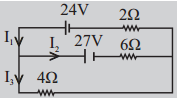
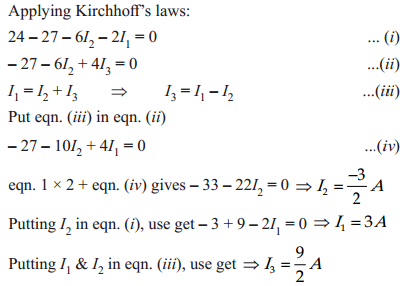
In given circuit, the value of currents I$_{1}$, I$_{2}$ and I$_{3}$ are
Current Electricity – NEET-10125
  1. A $3 \mathrm{~A}, \frac{-3}{2} \mathrm{~A}, \frac{9}{2} \mathrm{~A}$
  2. B $\frac{9}{2} \mathrm{~A}, 3 \mathrm{~A}, \frac{-3}{2} \mathrm{~A}$
  3. C 5A, 4A,-3A
  4. D $7 \mathrm{~A}, \frac{5}{4} \mathrm{~A}, \frac{9}{2} \mathrm{~A}$
Show answer & explanation

Correct answer: A

Current Electricity – NEET-10125 Therefore, option (B) is the correct answer.
13
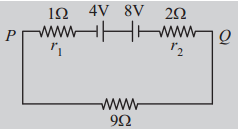
Two batteries of emf 4 V and 8 V with internal resistances 1 Ω and 2 Ω are connected in a circuit with a resistance of 9 Ω as shown in figure. The current and potential difference between the points P and Q are
Current Electricity – NEET-10104
  1. A $\frac { 1 } { 3 } \mathrm {~A}$ and 3 V
  2. B $\frac { 1 } { 6 } \mathrm {~A}$ and 4 V
  3. C $\frac { 1 } { 9 } \mathrm {~A}$ and 9 V
  4. D $\frac { 1 } { 2 } \mathrm {~A}$ and 12 V
Show answer

Correct answer: A

14
Refer to the circuit shown. What will be the total power dissipation in the circuit if P is the power dissipated in $R _ { 1 }$ ? It is given that $R _ { 2 } = 4 R _ { 1 }$ and $R _ { 3 } = 12 R _ { 1 }$
Current Electricity – NEET-10100
  1. A 4P
  2. B 7P
  3. C 13P
  4. D 17P
Show answer

Correct answer: A

15
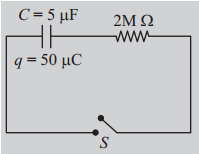
The following circuit consist of a 5 μF capacitor, having charge 50 μC as shown. The switch is closed at t = 0. The value of current in 2 MΩ resistor at t = 0 is;
Current Electricity – NEET-10108
  1. A 1 μA
  2. B 2 μA
  3. C 5 μA
  4. D 5 A
Show answer

Correct answer: C

16
100 mA current gives a full-scale deflection in a galvanometer of 2 Ω resistance. The resistance connected with the galvanometer to convert it into a voltmeter to measure 5 V is;
  1. A 98 Ω
  2. B 52 Ω
  3. C 50 Ω
  4. D 48 Ω
Show answer

Correct answer: D

17
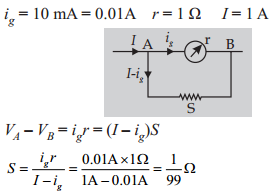
A milliammeter of range 10 mA has a coil of resistance 1 Ω. To use it as an ammeter of range 1A, the required shunt must have a resistance of
  1. A $\frac{1}{101}$ Ω
  2. B $\frac{1}{100}$ Ω
  3. C $\frac{1}{99}$ Ω
  4. D $\frac{1}{9}$ Ω
Show answer & explanation

Correct answer: C

Current Electricity – NEET-10142 Therefore, option (C) is the correct answer.
18
If the length of a wire is increased by 5% by stretching, what is the increase in its resistance?
  1. A 5%
  2. B 10%
  3. C 2.5%
  4. D 20%
Show answer & explanation

Correct answer: B

$\begin{array}{l}\therefore R=\rho \frac{l}{A}=\frac{\rho l^{2}}{V}[\therefore \text { Volume } V=A l] \\ \Rightarrow R \propto l^{2} \therefore \frac{\Delta R}{R}=\frac{2 \Delta l}{l} \\ \Rightarrow \frac{\Delta R}{R} \times 100=2\left(\frac{\Delta l}{l} \times 100\right)=2 \times 5 \%=10 \%\end{array}$
Therefore, option (B) is the correct answer.
19
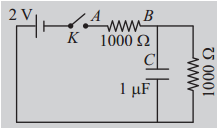
When the key K is pressed at time t = 0, then which of the following statements about the current I in the resistor AB of resistance 1000 Ω of the given circuit is true?
Current Electricity – NEET-10109
  1. A I oscillates between 1 mA and 2 mA
  2. B At t = 0 , I = 2 mA and with time it goes to 1 mA
  3. C I = 1 mA at all t
  4. D I = 2 mA at all t
Show answer

Correct answer: B

20
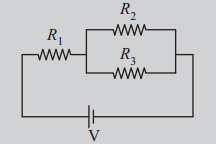
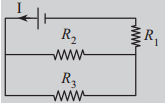
Three identical resistors $R _ { 1 } = R _ { 2 } = R _ { 3 }$ are connected as shown to a battery of constant e.m.f. The power dissipated is;
Current Electricity – NEET-10099
  1. A the least in $R _ { 1 }$
  2. B greatest in $R _ { 1 }$
  3. C in the ratio 1 : 2 in resistance $R _ { 1 }$ and $R _ { 2 }$ respectively
  4. D same in $R _ { 1 }$ and in the parallel combination of $R _ { 2 }$ and $R _ { 3 }$
Show answer

Correct answer: B

Attempt this as a timed test

Reading answers is not the same as sitting the paper. Attempt it timed and you get your score, per-question timing, and the mistakes tracked for revision.

Start free

More Current Electricity tests

All Current Electricity tests →