Motion in a plane — DPP 3

20 NEET questions from Motion in a plane, with answers and explanations. Attempt it as a timed test to get scoring, accuracy breakdown and mistake tracking.

Attempt this test free 20 questions · 30 minutes · +80 marks
1
Two equal forces have their resultant equal to either of the force, at what angle are they inclined?
  1. A $120 ^ { \circ }$
  2. B $360 ^ { \circ }$
  3. C $90 ^ { \circ }$
  4. D $60 ^ { \circ }$
Show answer

Correct answer: A
2
Two vectors $\overline{\mathrm{A}}$ and $\overline{\mathrm{B}}$ are such that $|\overline{\mathrm{A}}+\overline{\mathrm{B}}|=|\overline{\mathrm{A}}-\overline{\mathrm{B}}|$ then the angle between the two vectors $\overline{\mathrm{A}}$ and $\overline{\mathrm{B}}$ will be:
  1. A π
  2. B $\frac{\pi}{3}$
  3. C $\frac{\pi}{6}$
  4. D $\frac{\pi}{2}$
Show answer

Correct answer: D

3
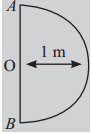
In 1 s, a particle goes from point A to point B moving in a semicircle as shown in figure. The magnitude of the average velocity is
Motion in a plane – NEET-18014
  1. A Zero
  2. B 1 m/s
  3. C 2 m/s
  4. D 3.14 m/s
Show answer

Correct answer: C

4
Given $\vec { A } = 2 \hat { i } + p \hat { j } + q \hat { k }$ and $\vec { B } = 5 \hat { i } + 7 \hat { j } + 3 \hat { k }$. If $\vec { A } \| \vec { B }$, then the values of p and q are, respectively,
  1. A $\frac { 14 } { 5 }$ and $\frac { 6 } { 5 }$
  2. B $\frac { 14 } { 3 }$ and $\frac { 6 } { 5 }$
  3. C $\frac { 6 } { 5 }$ and $\frac { 1 } { 3 }$
  4. D $\frac { 3 } { 4 }$ and $\frac { 1 } { 4 }$
Show answer

Correct answer: A

5
An arrow is shot into air. Its range is 200 m and time of flight is 5 sec. Horizontal component of velocity of the arrow is:
  1. A 12.5 m/s
  2. B 25.0 m/s
  3. C 31.25 m/s
  4. D 40 m/s
Show answer & explanation

Correct answer: D

$\begin{array}{l}R=\frac{u^{2} \sin 2 \theta}{g}=200 \\ T=\frac{2 \mathrm{u} \sin \theta}{g}=5 \\ \frac{\mathrm{R}}{\mathrm{T}}=\frac{200}{5}=\frac{2 \mathrm{u}^{2} \sin \theta \cos \theta}{2 \mathrm{u} \sin \theta} \\ 40=\mathrm{u} \cos \theta=\mathrm{u}_{\mathrm{x}} \\ \therefore \mathrm{u}_{\mathrm{x}}=40 \mathrm{~m} / \mathrm{s}\end{array}$
Therefore, option (D) is the correct answer.
6
The vector projection of a vector $3 \hat { \mathrm { i } } + 5 \hat { \mathrm { k } }$ on y-axis is:
  1. A 5
  2. B 4
  3. C 3
  4. D Zero
Show answer

Correct answer: D

7
An object moves at a constant speed along a circular path in a horizontal XY-plane, with the center at the origin. When the object is at x = -2 m, its velocity is $- ( 4 \mathrm {~m} / \mathrm { s } ) \hat { j }$. What is the object's acceleration when it is at y = 2 m?
  1. A $- \left( 8 \mathrm {~m} / \mathrm { s } ^ { 2 } \right) \hat { j }$
  2. B $\left( 8 \mathrm {~m} / \mathrm { s } ^ { 2 } \right) \hat { i }$
  3. C $- \left( 4 \mathrm {~m} / \mathrm { s } ^ { 2 } \right) \hat { j }$
  4. D $- \left( 8 \mathrm {~m} / \mathrm { s } ^ { 2 } \right) \hat { i }$
Show answer

Correct answer: A

8
If $\overline { \mathrm { A } } = 4 \hat { \mathrm { i } } - 3 \hat { \mathrm { j } }$ and $\overline { \mathrm { B } } = 5 \hat { \mathrm { i } } + 18 \hat { \mathrm { j } }$ then magnitude and direction of $\overline { \mathrm { A } } + \overline { \mathrm { B } }$ will be:
  1. A 17.49 , tan$^{-1}$(2)
  2. B 15, tan$^{-1}$(4/3)
  3. C 20, tan$^{-1}$(4/5)
  4. D 17.49 , tan$^{-1}$(5/3)
Show answer

Correct answer: D

9
What would be the distance-time graph of uniform circular motion?
  1. A Parabola
  2. B Straight line
  3. C Semicircle
  4. D Hyperbola
Show answer

Correct answer: B

10
If a vector $2 \hat { i } + 4 \hat { j } + 6 \hat { k }$ is perpendicular to the vector $5 \hat { \mathrm { i } } + 6 \hat { \mathrm { j } } - \mathrm { a } \hat { \mathrm { k } }$. Then the value of a is:
  1. A 14/3
  2. B 17/9
  3. C 14/5
  4. D 17/3
Show answer

Correct answer: D

11
Assertion (A): The cross product of two vectors is commutative, meaning $\vec{A} \times \vec{B}=\vec{B} \times \vec{A}$.
Reason (R): The cross product is defined as the product of magnitudes of two vectors, the sine of the angle between them, and the unit vector perpendicular to the plane containing the two vectors.
  1. A Both Assertion (A) and Reason (R) are True and the Reason (R) is a correct explanation of the Assertion (A)
  2. B Both Assertion (A) and Reason (R) are True but Reason (R) is not a correct explanation of the Assertion (A).
  3. C Assertion (A) is True but the Reason (R) is False.
  4. D Assertion (A) is False but Reason (R) is True.
Show answer

Correct answer: D

12
The resultant of two vectors $\bar { P }$ and $\bar { Q }$ is $\bar { R }$. If Q is doubled; the new resultant is perpendicular to P, then R equals to:
  1. A P
  2. B Q
  3. C P + Q
  4. D P - Q
Show answer

Correct answer: B

13
The magnitude of the vector $6 \hat { \mathrm { i } } + 2 \hat { \mathrm { j } } + 3 \hat { \mathrm { k } }$ is equal to:
  1. A 5
  2. B 1
  3. C 7
  4. D 12
Show answer

Correct answer: C

14
Assertion (A): In the case of ground-to-ground projection of a projectile from the ground the angle of projection with the horizontal is θ = 30°. There is no point on its path at which the instantaneous velocity is normal to the initial velocity.
Reason (R): Maximum deviation of the projectile is 2θ = 60°
  1. A Both Assertion (A) and Reason (R) are True and the Reason (R) is a correct explanation of the Assertion (A).
  2. B Both Assertion (A) and Reason (R) are True but Reason (R) is not a correct explanation of the Assertion (A).
  3. C Assertion (A) is True but the Reason (R) is False.
  4. D Assertion (A) is False but Reason (R) is True.
Show answer

Correct answer: A

15
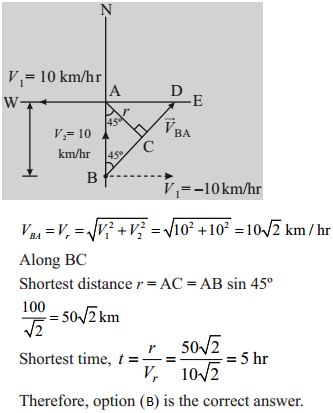
A ship 'A' moving towards west with a speed of 10 km/hr and ship 'B' 100 km south of 'A' is moving northward with a speed of 10 km/hr. The time after which the distance between them is shortest and the shortest distance between them are:
  1. A 0 hr, 100 km
  2. B $5 \mathrm { hr } , 50 \sqrt { 2 } \mathrm {~km}$
  3. C $50 \sqrt { 2 } \mathrm { hr } , 50 \mathrm {~km}$
  4. D $10 \sqrt { 2 } \mathrm { hr } , 50 \sqrt { 2 } \mathrm {~km}$
Show answer & explanation

Correct answer: B

Motion in a plane – NEET-18002
16
If R and H represent horizontal range and maximum height of the projectile, then the angle of projection with the horizontal is:
  1. A $\tan ^ { - 1 } \left( \frac { H } { R } \right)$
  2. B $\tan ^ { - 1 } \left( \frac { 2 H } { R } \right)$
  3. C $\tan ^ { - 1 } \left( \frac { 4 H } { R } \right)$
  4. D $\tan ^ { - 1 } \left( \frac { 4 R } { H } \right)$
Show answer & explanation

Correct answer: C

$H=\frac{u^{2} \sin ^{2} \theta}{2 g}, R=\frac{u^{2} \sin 2 \theta}{g}$
$\begin{array}{l}R=\frac{u^{2} \sin 2 \theta}{g}=\frac{2 u^{2} \sin \theta \cos \theta}{g} \\ \frac{H}{R}=\frac{\sin \theta}{2 \times 2 \cos \theta} \\ \frac{H}{R}=\frac{\tan \theta}{4} \Rightarrow \tan \theta=\frac{4 H}{R} \Rightarrow \theta=\tan ^{-1}\left(\frac{4 H}{R}\right)\end{array}$
Therefore, option (C) is the correct answer.
17
If $\overrightarrow { \mathrm { A } } = 3 \hat { \mathrm { i } } + 5 \hat { \mathrm { j } } - 7 \hat { \mathrm { k } }$, the direction of cosines of the vector are:
  1. A $\frac { 2 } { \sqrt { 83 } } , \frac { 5 } { \sqrt { 83 } } , \frac { 7 } { \sqrt { 83 } }$
  2. B $\frac { 3 } { \sqrt { 83 } } , \frac { 5 } { \sqrt { 83 } } , \frac { 7 } { \sqrt { 83 } }$
  3. C $\frac { 1 } { \sqrt { 83 } } , \frac { 2 } { \sqrt { 83 } } , \frac { 5 } { \sqrt { 83 } }$
  4. D $\frac { 3 } { \sqrt { 83 } } , \frac { 5 } { \sqrt { 83 } } , \frac { - 7 } { \sqrt { 83 } }$
Show answer

Correct answer: D

18
A ball is thrown at angle of $45 ^ { \circ }$ with horizontal with kinetic energy E. The kinetic energy at the highest point during the flight is:
  1. A Zero
  2. B $\frac { E } { 2 }$
  3. C E
  4. D $\sqrt { 2 } E$
Show answer & explanation

Correct answer: B

$\begin{array}{l}V_{x}=u \cos \theta=u \cos 45^{\circ}=\frac{u}{\sqrt{2}} \\ E_{2}=\frac{1}{2} m\left(\frac{u}{\sqrt{2}}\right)^{2}=\frac{E}{2}\end{array}$
Therefore, option (B) is the correct answer.
19
Two vectors of magnitudes 4 and 6 are acting through a point. Magnitude of resultant R is;
  1. A $4 \leq R \leq 6$
  2. B $4 < R < 10$
  3. C $2 \leq R \leq 10$
  4. D $0 \leq R < 2$
Show answer

Correct answer: C

20
Which pair of the following forces will never give resultant force of 2N?
  1. A 2N and 2N
  2. B 1N and 1N
  3. C 1N and 3N
  4. D 1N and 4N
Show answer

Correct answer: D

Attempt this as a timed test

Reading answers is not the same as sitting the paper. Attempt it timed and you get your score, per-question timing, and the mistakes tracked for revision.

Start free

More Motion in a plane tests

All Motion in a plane tests →