Motion in a Straight Line — DPP 2

20 NEET questions from Motion in a Straight Line, with answers and explanations. Attempt it as a timed test to get scoring, accuracy breakdown and mistake tracking.

Attempt this test free 20 questions · 30 minutes · +80 marks
1
Find the max acceleration:
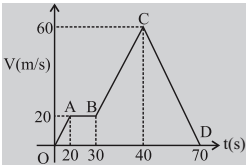
Motion in a Straight Line – NEET-17691
  1. A 18 m/s$^{2}$
  2. B 4 m/s$^{2}$
  3. C 2 m/s$^{2}$
  4. D 10 m/s$^{2}$
Show answer & explanation

Correct answer: B

Slope $\mathrm{OA}=\frac{20}{20}=1 \mathrm{~m} / \mathrm{s}^{2}$
Slope $\mathrm{AB}=0 \mathrm{~m} / \mathrm{s}^{2}$
Slope $B C=\frac{60-20}{40-30}=4 \mathrm{~m} / \mathrm{s}^{2}$ (maximum)
Slope $C D=\frac{-60}{30}=-2 \mathrm{~m} / \mathrm{s}^{2}$
Therefore, option (B) is the correct answer.
2
A bullet fired into a fixed block of wood loses half its velocity after penetrating 60 cm before coming to rest it penetrates a further distance of:
  1. A 60 cm
  2. B 30 cm
  3. C 20 cm
  4. D 10 cm
Show answer & explanation

Correct answer: C

$\begin{array}{l}\mathrm{S}=60 \mathrm{~cm} \\ \mathrm{~S}=0.6 \mathrm{~m}, \mathrm{v}=\frac{u}{2} \\ 2 \times(-a) \times 0.6=\left(\frac{u}{2}\right)^{2}-u^{2}, a=\frac{3}{4} \times \frac{u^{2}}{1.2}=\frac{u^{2}}{1.6}\end{array}$
Now, $\mathrm{S}^{\prime}=?, u^{\prime}=\frac{u}{2}, \mathrm{v}=0$
$\begin{array}{l}\left(2 \times \frac{u^{2}}{1.6}\right) S^{\prime}=\frac{u^{2}}{4} \\ S^{\prime}=0.2 \mathrm{~m}=20 \mathrm{~cm}\end{array}$
Therefore, option (C) is the correct answer.
3
Consider the motion of the tip of the second hand of a clock. In one minute (R be the length of second hand), its
  1. A displacement is 2πR
  2. B distance covered is 2R
  3. C displacement is zero
  4. D distance covered is zero
Show answer

Correct answer: C

4
A rocket is initialized from the earth surface so that it has a acceleration of $19.6 \mathrm {~m} / \mathrm { s } ^ { 2 }$. If its engine is switched off after 5 second of its launch, then maximum height attained by the rocket will be:
  1. A 245 m
  2. B 490 m
  3. C 980 m
  4. D 735 m
Show answer & explanation

Correct answer: D

Distance travelled by rocket in 5 sec
$\mathrm{u}=0, \mathrm{~s}=\frac{1}{2} \times 19.6 \times 25=245 \mathrm{~m}$
Velocity attained $=19.6 \times 5=98 \mathrm{~m} / \mathrm{s}$
Distance travelled till velocity reached zero
$\begin{array}{l}2 \times(-9.8) \mathrm{s}=0-(98)^{2} \Rightarrow \mathrm{~s}=\frac{98 \times 98}{98} \times \frac{10}{2}=490 \mathrm{~m} \\ \therefore \text { Height achieved }=490+245=735 \mathrm{~m}\end{array}$
Therefore, option (D) is the correct answer.
5
Two trains of length 50 m are approaching each other on parallel rails. Their velocities are 10 m/sec and 15 m/sec. They will cross each other in:
  1. A 2 sec
  2. B 4 sec
  3. C 10 sec
  4. D 6 sec
Show answer & explanation

Correct answer: B

Total length to be travelled = 50 + 50 = 100 m
Relative velocity $\mathrm{v}_{\mathrm{r}}=15+10=25 \mathrm{~m} / \mathrm{s}$
∴ Time to cross $\mathrm{t}=\frac{100}{25}=4$ second
Therefore, option (B) is the correct answer.

6
A body is projected vertically upward with speed 10 m/s and other at same time with same speed in downward direction from the top of a tower. The magnitude of acceleration of first body with respect to second is (take g = 10 m/s$^{2}$)
  1. A Zero
  2. B $10 \mathrm {~m} / \mathrm { s } ^ { 2 }$
  3. C $5 \mathrm {~m} / \mathrm { s } ^ { 2 }$
  4. D $20 \mathrm {~m} / \mathrm { s } ^ { 2 }$
Show answer

Correct answer: A

7
The position of a particle moving along x-axis given by $x = \left( - 2 t ^ { 3 } + 3 t ^ { 2 } + 5 \right) \mathrm { m }$. The acceleration of particle at the instant its velocity becomes zero is
  1. A 12 m/s$^{2}$
  2. B -12 m/s$^{2}$
  3. C –6 m/s$^{2}$
  4. D Zero
Show answer

Correct answer: C

8
The displacement x of a particle moving in one dimensional motion is related to time by equation t = √x + 3 where x is in meters and t in seconds. The displacement when velocity is zero is:
  1. A 0 m
  2. B 1 m
  3. C 9 m
  4. D 4 m
Show answer & explanation

Correct answer: A

$\begin{array}{l}t=\sqrt{x}+3, x=(t-3)^{2} \\ \frac{d x}{d t}=2(t-3)=\text { velocity }=0\end{array}$
t = 3
at t = 3 sec
x = 0 m
Therefore, option (A) is the correct answer.
9
A particle located at x = 0 at time t = 0, starts moving along the positive x direction with a velocity v that varies as $\mathrm { v } \propto \sqrt { \mathrm { x } }$. The displacement of the particle varies with time as:
  1. A $t ^ { 1 / 2 }$
  2. B $t ^ { 3 }$
  3. C $t ^ { 2 }$
  4. D t
Show answer & explanation

Correct answer: C

$\begin{array}{l}v \propto \sqrt{x} \\ \frac{d x}{d t} \propto \sqrt{x} \Rightarrow \int \frac{d x}{\sqrt{x}}=\int \alpha d t \Rightarrow 2 \sqrt{x}=\alpha t+c \\ \therefore x \propto t^{2}\end{array}$
Therefore, option (C) is the correct answer.
10
Assertion (A): A body can have acceleration even if its velocity is zero at a given instant of time.
Reason (R): A body is momentarily at rest when it reverses its direction of motion.
  1. A Both Assertion (A) and Reason (R) are True and the Reason (R) is a correct explanation of the Assertion (A).
  2. B Both Assertion (A) and Reason (R) are True but Reason (R) is not a correct explanation of the Assertion (A)
  3. C Assertion (A) is True but the Reason (R) is False
  4. D Assertion (A) is False but Reason (R) is True
Show answer

Correct answer: A

11
A body in one dimensional motion has zero speed at an instant. At that instant, it must have
  1. A zero velocity
  2. B zero acceleration
  3. C non-zero velocity
  4. D non-zero acceleration
Show answer

Correct answer: A

12
A particle is moving along a circle such that it completes one revolution in 40 seconds. In 2 minutes and 20 seconds, the ratio $\frac { \text { displacement } } { \text { distance } }$ is
  1. A 0
  2. B $\frac { 1 } { 7 }$
  3. C $\frac { 2 } { 7 }$
  4. D $\frac { 2 } { 7 \pi }$
Show answer

Correct answer: D

13
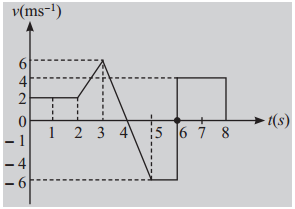
The velocity-time graph of a body is shown in figure. The displacement of the body in 8 s is:
Motion in a Straight Line – NEET-17635
  1. A 9 m
  2. B 12 m
  3. C 10 m
  4. D 28 m
Show answer

Correct answer: C

14
A body is moving with variable acceleration (a) along a straight line. The average acceleration of body in time interval $t _ { 1 }$ to $t _ { 2 }$ is
  1. A $\frac { a \left[ t _ { 2 } + t _ { 1 } \right] } { 2 }$
  2. B $\frac { a \left[ t _ { 2 } - t _ { 1 } \right] } { 2 }$
  3. C $\frac { \int _ { t _ { 1 } } ^ { t _ { 2 } } a d t } { t _ { 2 } + t _ { 1 } }$
  4. D $\frac { \int _ { t _ { 1 } } ^ { t _ { 2 } } a d t } { t _ { 2 } - t _ { 1 } }$
Show answer

Correct answer: D

15
Which of the following statements is/are true?
Motion in a Straight Line – NEET-17738 A. For the motion of the car from O to P, the magnitude of displacement is equal to the path length.
B. For the motion of the car from O to P and back to Q, the magnitude of the displacement is equal to + 240 m.
C. For the motion of the car from O to P and back to Q, the magnitude of the displacement is not equal to the path length.
  1. A Only A
  2. B Only B
  3. C Only C
  4. D All of these
Show answer

Correct answer: D

16
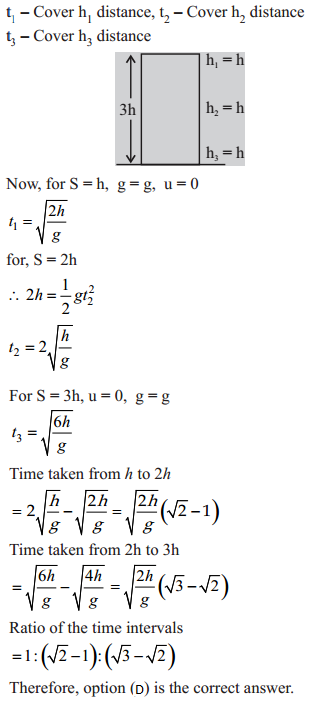
A particle is released from rest from a tower of height 3h. The ratio of the intervals of time to cover three equal heights h is:
  1. A 3 : 2 : 1
  2. B $1 : ( \sqrt { 3 } - 2 ) : 2$
  3. C $\sqrt { 3 } : \sqrt { 2 } : 1$
  4. D $1 : ( \sqrt { 2 } - 1 ) : ( \sqrt { 3 } - \sqrt { 2 } )$
Show answer & explanation

Correct answer: D

Motion in a Straight Line – NEET-17692
17
If a car covers $\frac { 2 } { 5 }$ th of total distance with $v _ { 1 }$ speed and $\frac { 3 } { 5 }$ th distance with $v _ { 2 }$ speed then the average speed is:
  1. A $\frac { 1 } { 2 } \sqrt { v _ { 1 } v _ { 2 } }$
  2. B $\frac { v _ { 1 } + v _ { 2 } } { 2 }$
  3. C $\frac { 2 v _ { 1 } + v _ { 2 } } { v _ { 1 } + v _ { 2 } }$
  4. D $\frac { 5 v _ { 1 } v _ { 2 } } { 3 v _ { 1 } + 2 v _ { 2 } }$
Show answer

Correct answer: D

18
The displacement of car in moving from O to P and its displacement in moving from P to Q are
Motion in a Straight Line – NEET-17737
  1. A +360 m and -120 m
  2. B -120 m and +360 m
  3. C +360 m and +120 m
  4. D +360 m and -600 m
Show answer

Correct answer: A

19
With reference to the given figure, the position coordinate of point P and R are:
Motion in a Straight Line – NEET-17734
  1. A P = (+ 360, 0, 0); R = (–120, 0, 0)
  2. B P = (–360, 0, 0); R = (+120, 0, 0)
  3. C P = (0, +360, 0); R = (–120, 0,0)
  4. D P = (0, 0, + 360); R = (0, 0, –120)
Show answer

Correct answer: A

20
Assertion (A): The motion of body projected under the effect of gravity without air resistance is uniformly accelerated motion.
Reason (R): If a body is projected upwards or downwards, then the direction of acceleration is downward.
  1. A Both Assertion (A) and Reason (R) are True and the Reason (R) is a correct explanation of the Assertion (A).
  2. B Both Assertion (A) and Reason (R) are True but Reason (R) is not a correct explanation of the Assertion (A).
  3. C Assertion (A) is True but the Reason (R) is False.
  4. D Assertion (A) is False but Reason (R) is True.
Show answer

Correct answer: B

Attempt this as a timed test

Reading answers is not the same as sitting the paper. Attempt it timed and you get your score, per-question timing, and the mistakes tracked for revision.

Start free

More Motion in a Straight Line tests

All Motion in a Straight Line tests →

