Ray Optics and Optical Instruments — DPP 3

20 NEET questions from Ray Optics and Optical Instruments, with answers and explanations. Attempt it as a timed test to get scoring, accuracy breakdown and mistake tracking.

Attempt this test free 20 questions · 30 minutes · +80 marks
1
A convex lens is dipped in a liquid whose refractive index is equal to the refractive index of the lens. Then its focal length will :-
  1. A Become zero
  2. B Become infinite
  3. C Become small, but non-zero
  4. D Remain unchanged
Show answer

Correct answer: B

2
A convex lens is made up of three different materials as shown in the figure. For a point object placed on its axis, the number of images formed are
Ray Optics and Optical Instruments – NEET-20915
  1. A 1
  2. B 3
  3. C 4
  4. D 5
Show answer & explanation

Correct answer: B

R.I ∝ no. of images
3
The minimum distance between the object and its real image for concave mirror is
  1. A f
  2. B 2 f
  3. C 4 f
  4. D Zero
Show answer

Correct answer: D

4
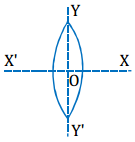
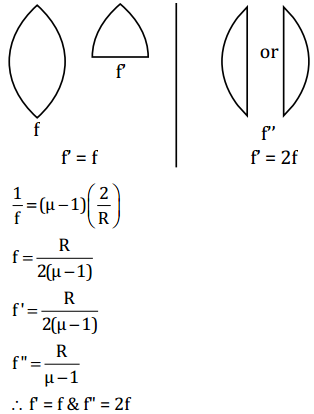
An equiconvex lens is cut into two halves along (i) XOX' and (ii) YOY' as shown in the figure. Let $\mathrm { f } , \mathrm { f } ^ { \prime } , \mathrm { f } ^ { \prime \prime }$ be the focal lengths of the complete lens, of each half in case (i), and of each half in case (ii), respectively Choose the correct statement from the following:
Ray Optics and Optical Instruments – NEET-20925
  1. A $\mathrm { f } ^ { \prime } = \mathrm { f } , \mathrm { f } ^ { \prime \prime } = 2 \mathrm { f }$
  2. B $\mathrm { f } ^ { \prime } = 2 \mathrm { f } , \mathrm { f } ^ { \prime \prime } = \mathrm { f }$
  3. C $\mathrm { f } ^ { \prime } = \mathrm { f } , \mathrm { f } ^ { \prime \prime } = \mathrm { f }$
  4. D $\mathrm { f } ^ { \prime } = 2 \mathrm { f } , \mathrm { f } ^ { \prime \prime } = 2 \mathrm { f }$
Show answer & explanation

Correct answer: A

Ray Optics and Optical Instruments – NEET-20925
5
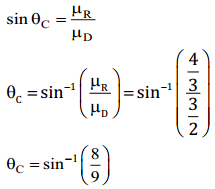
A ray of light propagates from glass (refractive index = 3/2) to water (refractive index = 4/3). The value of the critical angle
  1. A $\sin ^ { - 1 } ( 1 / 2 )$
  2. B $\sin ^ { - 1 } \left( \frac { \sqrt { 8 } } { 9 } \right)$
  3. C $\sin ^ { - 1 } ( 8 / 9 )$
  4. D $\sin ^ { - 1 } ( 5 / 7 )$
Show answer & explanation

Correct answer: C

Ray Optics and Optical Instruments – NEET-20859
6
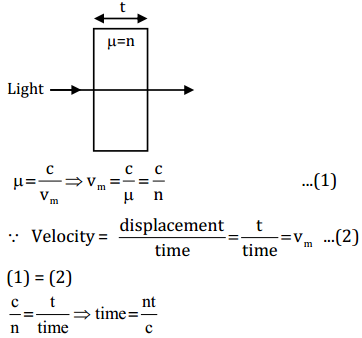
Light travels through a glass plate of thickness t and having refractive index n. If c is the velocity of light in vacuum. The time taken by the light to travel this thickness of glass is
  1. A $\frac { \mathrm { t } } { \mathrm { nc } }$
  2. B tnc
  3. C $\frac { \mathrm { nt } } { \mathrm { c } }$
  4. D $\frac { t c } { n }$
Show answer & explanation

Correct answer: C

Ray Optics and Optical Instruments – NEET-20858
7
A convex lens of Focal length of 40 cm is in contact with a concave lens of focal length 25 cm. The power of the combination is.
  1. A -1.5 D
  2. B -6.5 D
  3. C +6.5 D
  4. D +6.67 D
Show answer & explanation

Correct answer: A

$\begin{array}{l}\frac{1}{f}=\frac{1}{f_{1}}+\frac{1}{f_{2}} \\ \Rightarrow P=\frac{1}{f}=\frac{100}{40}-\frac{100}{25}=2.5-4 \\ \Rightarrow P=-1.5 D\end{array}$
8
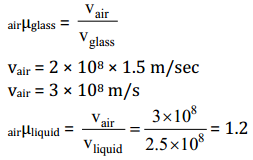
Velocity of light in glass, whose refractive index w.r.t. air is 1.5 , is $2 \times 10 ^ { 8 } \mathrm {~m} / \mathrm { Sec }$. In a certain liquid the velocity of light is found to be $2.5 \times 10 ^ { 8 } \mathrm {~m} / \mathrm { Sec }$. The refractive index of liquid w.r.t. air is
  1. A 0.64
  2. B 0.80
  3. C 1.20
  4. D 1.44
Show answer & explanation

Correct answer: C

Ray Optics and Optical Instruments – NEET-20851
9
Given below are two statements: One is labelled as Assertion (A) and the other is labelled as Reason (R).
Assertion (A): Magnifying power of a simple microscope is inversely proportional to focal length of lens in normal adjustment.
Reason (R): Magnifying power of simple microscope can be infinite.
In the light of the above statements, choose the most appropriate answer from the options given below:
  1. A Both (A) and (R) are true and (R) is the correct explanation of (A).
  2. B Both (A) and (R) are true and (R) is NOT the correct explanation of (A).
  3. C (A) is true but (R) is false.
  4. D (A) is false but (R) is true.
Show answer & explanation

Correct answer: C

$M \cdot P \propto \frac{1}{f}$ (for normal adjustment $\left.M \cdot P=\frac{D}{f}\right)$
10
The focal length of convex lens is 2.5 cm. Its magnifying power for minimum distance of distinct vision will be -
  1. A 25
  2. B 52
  3. C 11
  4. D 1.1
Show answer & explanation

Correct answer: C

$\begin{array}{l}\mathrm{m}=1+\frac{\mathrm{D}}{\mathrm{f}_{\mathrm{e}}} \\ \mathrm{m}=1+\frac{25}{2.5} ; \mathrm{m}=11\end{array}$
11
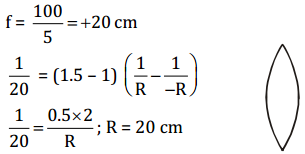
An equiconvex lens has a power of 5 dioptre. If it is made of glass of refractive index 1.5. then radius of curvature of its each surface will be?
  1. A 20 cm
  2. B 10 cm
  3. C 40 cm
  4. D ∞
Show answer & explanation

Correct answer: A

Ray Optics and Optical Instruments – NEET-20910
12
A plane glass slab is kept over various coloured letters; the letter which appears least raised is
  1. A blue
  2. B voilet
  3. C green
  4. D red
Show answer & explanation

Correct answer: D

Apparent depth = $\frac{\text { Actual depth }}{\mu}$ and $\mu \propto \frac{1}{\lambda}$
13
An object placed at a distance of 9 cm from first principal focus of convex lens, produces a real image at a distance of 25 cm from its second principal focus. Then focal length of lens is
  1. A 9 cm
  2. B 25 cm
  3. C 15 cm
  4. D 17 cm
Show answer & explanation

Correct answer: C

$\begin{array}{l}f^{2}=x_{1} x_{2} \\ f^{2}=9 \times 25 \Rightarrow f=15 \mathrm{~cm}\end{array}$
14
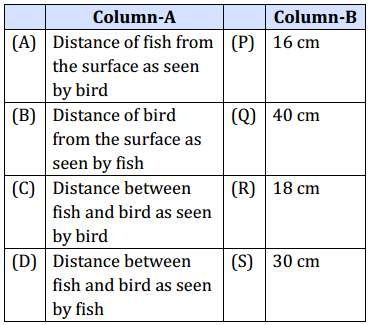
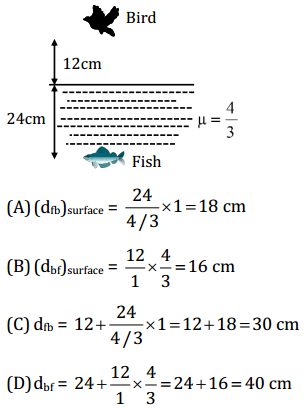
A bird is flying at a height of 12 cm from the surface of a lake and a fish is swimming at a depth of 24 cm from the surface. (Take is μ = 4/3)
Ray Optics and Optical Instruments – NEET-20922
  1. A A → P, B → R, C → S, D → Q
  2. B A → R, B → P, C → Q, D → S
  3. C A → R, B → P, C → S, D → Q
  4. D A → P, B → R, C → Q, D → S
Show answer & explanation

Correct answer: C

Ray Optics and Optical Instruments – NEET-20922
15
If a convex lens of focal length 80 cm and a concave lens of focal length 50 cm are combined together, what will be their resulting power
  1. A +6.5 D
  2. B -6.5 D
  3. C +7.5 D
  4. D -0.75 D
Show answer & explanation

Correct answer: D

$P=P_{1}+P_{2}=\frac{100}{80}+\frac{100}{(-50)}$
P = 1.25 – 2
P = –0.75 D
16
Lenses of powers 3D and -5D are combined to form a compound lens. An object is placed at a distance of 50 cm from this lens. Calculate the position of its image.
  1. A -10 cm
  2. B +10 cm
  3. C -25 cm
  4. D +25 cm
Show answer & explanation

Correct answer: C

$\begin{array}{l}P_{n e t}=P_{1}+P_{2} ; P_{n e t}=3-5 ; P_{n e t}=-2 D \\ f=-\frac{100}{2}=-50 \mathrm{~cm} \\ \frac{1}{v}-\frac{1}{-50}=\frac{1}{-50} ; v=-25 \mathrm{~cm}\end{array}$
17
Two lenses of power +2.50D and -3.75D are combined to form a compound lens. Its focal length in cm will be -
  1. A 40
  2. B -40
  3. C -80
  4. D 160
Show answer & explanation

Correct answer: C

$\begin{array}{l}P=P_{1}-P_{2} \Rightarrow P=+2.50-3.75 \\ P=-1.25 \\ f=\frac{-100}{1.25}=-80 \mathrm{~cm}\end{array}$
18
Given below are two statements:
Statement-1: Magnifying power of a simple microscope is positive.
Statement-2: Magnifying power of a compound microscope is negative.
In light of above statement choose the most appropriate answer from the options given below:
  1. A Both statement I and statement II are correct.
  2. B Statement I is correct and statement II is incorrect.
  3. C Statement I is incorrect and statement II is correct.
  4. D Both statements I and statements II are incorrect.
Show answer & explanation

Correct answer: A

Simple microscope forms erect image while compound microscope form inverted image.
19
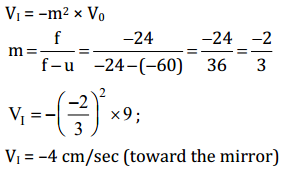
A point object is moving on the principal axis of a concave mirror of focal length 24 cm towards the mirror. When it is at a distance of 60 cm from the mirror, its velocity is 9 cm/sec. What is the velocity of the image at that instant?
  1. A 5 cm/sec
  2. B 12 cm/sec
  3. C 4 cm/sec
  4. D 9 cm/sec
Show answer & explanation

Correct answer: C

Ray Optics and Optical Instruments – NEET-20840
20
The angle of a glass prism is $4.5 ^ { \circ }$ and its refractive index is 1.52. The angle of minimum deviation will be -
  1. A $1.5 ^ { \circ }$
  2. B $2.3 ^ { \circ }$
  3. C $4.5 ^ { \circ }$
  4. D $2 ^ { \circ }$
Show answer & explanation

Correct answer: B

$\begin{array}{l}\delta_{m}=\left(\mu_{p}-1\right) \mathrm{A} \\ \delta_{m}=(1.52-1) \times 4.5^{\circ} \\ \delta_{m}=0.52 \times 4.5^{\circ} \\ \delta_{m}=2.34^{\circ}\end{array}$

Attempt this as a timed test

Reading answers is not the same as sitting the paper. Attempt it timed and you get your score, per-question timing, and the mistakes tracked for revision.

Start free

More Ray Optics and Optical Instruments tests

All Ray Optics and Optical Instruments tests →