Morphology Of Flowering Plants — DPP 2

20 NEET questions from Morphology Of Flowering Plants, with answers and explanations. Attempt it as a timed test to get scoring, accuracy breakdown and mistake tracking.

Attempt this test free 20 questions · 30 minutes · +80 marks
1
Mark the option with incorrect pairing.
A. Leaves - Originate from shoot apical meristem.
B. Veins - Provide rigidity to the leaf blade.
C. Pulvinus - Present in the leaves of most monocots.
D. Venation-Arrangement of leaves on the stem or branch.
E. Australian acacia - Petioles in these plants expand and become green and synthesise food
  1. A A, B and C
  2. B D and E only
  3. C C and D
  4. D B, D and E
Show answer

Correct answer: C
2
Assertion (A): Endosperm is bulky and store food in maize.
Reason (R): In monocot, the inner covering of endosperm separates the embryo by a proteinous layer called aleurone layer.
  1. A Both Assertion (A) and Reason (R) are True and the Reason (R) is a correct explanation of the Assertion (A).
  2. B Both Assertion (A) and Reason (R) are True but Reason (R) is not a correct explanation of the Assertion (A).
  3. C Assertion (A) is True but the Reason (R) is False.
  4. D Assertion (A) is False but the Reason (R) is True.
Show answer

Correct answer: C

3
Assertion (A): Hypogynous flowers have superior ovaries.
Reason (R): Gynoecium occupies the highest position while, petals, sepals and stamens are situated below the ovary.
  1. A Both Assertion (A) and Reason (R) are True and the Reason (R) is a correct explanation of the Assertion (A).
  2. B Both Assertion (A) and Reason (R) are True but Reason (R) is not a correct explanation of the Assertion (A).
  3. C Assertion (A) is True but the Reason (R) is False.
  4. D Assertion (A) is False but the Reason (R) is True.
Show answer

Correct answer: A

4
Assertion (A): In Monstera and banyan trees, roots are adventitious.
Reason (R): When roots arise from other parts of the plant than radicles, they are called adventitious roots.
  1. A Both Assertion (A) and Reason (R) are True and the Reason (R) is a correct explanation of the Assertion (A).
  2. B Both Assertion (A) and Reason (R) are True but Reason (R) is not a correct explanation of the Assertion (A).
  3. C Assertion (A) is True but the Reason (R) is False.
  4. D Assertion (A) is False but the Reason (R) is True.
Show answer

Correct answer: A

5
Assertion (A): In parietal placentation, the ovules develop on the inner wall of the ovary or on the peripheral part.
Reason (R): Two chamber conditions arise in parietal placentation due to formation of false septum.
  1. A Both Assertion (A) and Reason (R) are True and the Reason (R) is a correct explanation of the Assertion (A).
  2. B Both Assertion (A) and Reason (R) are True but Reason (R) is not a correct explanation of the Assertion (A).
  3. C Assertion (A) is True but the Reason (R) is False.
  4. D Assertion (A) is False but the Reason (R) is True.
Show answer

Correct answer: B

6
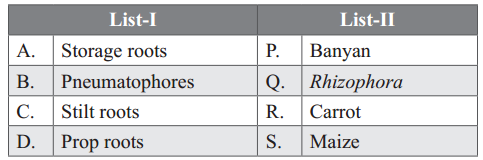
Match the List-I and List-II select the correct option.
Morphology Of Flowering Plants – NEET-5670
  1. A A-P; B-R; C-Q; D-S
  2. B A-R; B-Q; C-P; D-S
  3. C A-P; B-S; C-Q; D-R
  4. D A-Q; B-R; C-P; D-S
Show answer

Correct answer: A

7
Which of the given fruits is a parthenocarpic fruit?
  1. A Apple
  2. B Banana
  3. C Mango
  4. D Tomato
Show answer

Correct answer: B

8
Statement-I: Leaflets are present on a common axis in palmately compound leaves.
Statement-II: In racemose inflorescence, the main axis terminates in a flower.
  1. A Both Statement-I and Statement-II are correct.
  2. B Both Statement-I and Statement-II are incorrect.
  3. C Statement-I is correct and Statement-II is incorrect.
  4. D Statement-I is incorrect and Statement-II is correct.
Show answer

Correct answer: B

9
Assertion (A): In cymose type of inflorescence the main axis has limited growth.
Reason (R): In cymose inflorescence the flowers are borne in acropetal succession.
  1. A Both Assertion (A) and Reason (R) are True and the Reason (R) is a correct explanation of the Assertion (A).
  2. B Both Assertion (A) and Reason (R) are True but Reason (R) is not a correct explanation of the Assertion (A).
  3. C Assertion (A) is True but the Reason (R) is False.
  4. D Assertion (A) is False but the Reason (R) is True.
Show answer

Correct answer: C

10
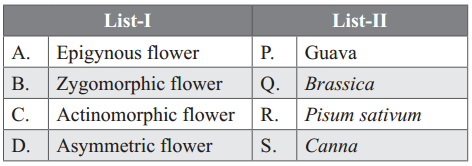
Match the List-I and List-II select the correct option.
Morphology Of Flowering Plants – NEET-5667
  1. A A-R; B-Q; C-S; D-P
  2. B A-Q; B-R; C-S; D-P
  3. C A-R; B-S; C-Q; D-P
  4. D A-R; B-P; C-Q; D-S
Show answer

Correct answer: A

11
Statement-I: In some flowers, the calyx and corolla are not distinct and are termed as perianth.
Statement-II: In compound leaves, incisions of the lamina reach up to the midrib, breaking it into a number of leaflets.
  1. A Both Statement-I and Statement-II are correct.
  2. B Both Statement-I and Statement-II are incorrect.
  3. C Statement-I is correct and Statement-II is incorrect.
  4. D Statement-I is incorrect and Statement-II is correct.
Show answer

Correct answer: A

12
Assertion (A): Each anther has four lobes and two chambers.
Reason (R): A sterile stamen is called staminode.
  1. A Both Assertion (A) and Reason (R) are True and the Reason (R) is a correct explanation of the Assertion (A).
  2. B Both Assertion (A) and Reason (R) are True but Reason (R) is not a correct explanation of the Assertion (A).
  3. C Assertion (A) is True but the Reason (R) is False.
  4. D Assertion (A) is False but the Reason (R) is True.
Show answer

Correct answer: D

13
Statement-I: Fibrous root system originates from the base of the stem.
Statement-II: Meristematic zone is proximal to the elongation zone.
  1. A Both Statement-I and Statement-II are correct.
  2. B Both Statement-I and Statement-II are incorrect.
  3. C Statement-I is correct and Statement-II is incorrect.
  4. D Statement-I is incorrect and Statement-II is correct.
Show answer

Correct answer: C

14
Statement-I: Leaves originate from lateral meristems and are arranged in an acropetal order.
Statement-II: In mango and coconut fruits, they develop from monocarpellary superior ovaries and are one seeded.
  1. A Both Statement-I and Statement-II are correct.
  2. B Both Statement-I and Statement-II are incorrect.
  3. C Statement-I is correct and Statement-II is incorrect.
  4. D Statement-I is incorrect and Statement-II is correct.
Show answer

Correct answer: D

15
Read the following statements and select the suitable option.
A. Generally petals are green, leaf like and protect the flower in the bud stage.
B. Sepals are brightly coloured to attract insects for pollination.
C. If stamens in a flower remain free, then this condition is called polyandrous.
D. Each ovary bears one or more ovules attached to a flattened, cushion like placenta.
E. There may be a variation in the length of filaments of stamen within a flower, as in Salvia and mustard.
  1. A A, B and D are true but C and E are false
  2. B C, D and E are true but A and B are false
  3. C C and D are true but A, B and E are false
  4. D D and E are true but A, B and C are false
Show answer

Correct answer: B

16
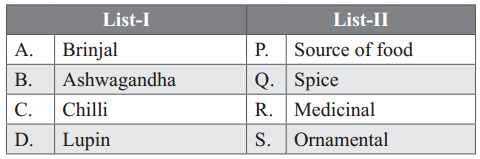
Match the List-I and List-II select the correct option.
Morphology Of Flowering Plants – NEET-5668
  1. A A-P; B-R; C-Q; D-S
  2. B A-S; B-R; C-Q; D-P
  3. C A-Q; B-R; C-P; D-S
  4. D A-R; B-P; C-Q; D-S
Show answer

Correct answer: A

17
Assertion (A): Sepals are green, leaf-like and protect the flower in the bud stage.
Reason (R): Sepals when united with each other are called polysepalous.
  1. A Both Assertion (A) and Reason (R) are True and the Reason (R) is a correct explanation of the Assertion (A).
  2. B Both Assertion (A) and Reason (R) are True but Reason (R) is not a correct explanation of the Assertion (A).
  3. C Assertion (A) is True but the Reason (R) is False.
  4. D Assertion (A) is False but the Reason (R) is True.
Show answer

Correct answer: C

18
Assertion (A): In monocot seed, endosperm does not touch the embryo directly.
Reason (R): Aleurone layer is present in the seed.
  1. A Both Assertion (A) and Reason (R) are True and the Reason (R) is a correct explanation of the Assertion (A).
  2. B Both Assertion (A) and Reason (R) are True but Reason (R) is not a correct explanation of the Assertion (A).
  3. C Assertion (A) is True but the Reason (R) is False.
  4. D Assertion (A) is False but the Reason (R) is True.
Show answer

Correct answer: A

19
Statement-I: Petioles allow leaf blades to flutter in wind, helping in cooling the leaf and bringing fresh air to the leaf surface.
Statement-II: Cotyledons in mature seeds without endosperm, are called albuminous.
  1. A Both Statement-I and Statement-II are correct.
  2. B Both Statement-I and Statement-II are incorrect.
  3. C Statement-I is correct and Statement-II is incorrect.
  4. D Statement-I is incorrect and Statement-II is correct.
Show answer

Correct answer: C

20
Statement-I: Plants belonging to the Fabaceae family are sources of pulses and characteristic representative of monocotyledonous plants.
Statement-II: Hilum represents the site through which seed is attached to fruit.
  1. A Both Statement-I and Statement-II are correct.
  2. B Both Statement-I and Statement-II are incorrect.
  3. C Statement-I is correct and Statement-II is incorrect.
  4. D Statement-I is incorrect and Statement-II is correct.
Show answer

Correct answer: D

Attempt this as a timed test

Reading answers is not the same as sitting the paper. Attempt it timed and you get your score, per-question timing, and the mistakes tracked for revision.

Start free

More Morphology Of Flowering Plants tests

All Morphology Of Flowering Plants tests →