Morphology Of Flowering Plants — DPP 3

20 NEET questions from Morphology Of Flowering Plants, with answers and explanations. Attempt it as a timed test to get scoring, accuracy breakdown and mistake tracking.

Attempt this test free 20 questions · 30 minutes · +80 marks
1
Read the following statements and find out the incorrect statement.
  1. A Both stem tendrils and thorns are the modification of axillary buds.
  2. B Thorns are woody, curved and pointed structures found in Citrus and Bougainvillea for protecting them from browsing animals.
  3. C Opuntia and Euphorbia are found in arid regions. They contain chlorophyll in their stem and carry out photosynthesis.
  4. D Stem tendrils are found in gourds and grapevines that are slender and spirally coiled and help plants to climb.
Show answer

Correct answer: B
2
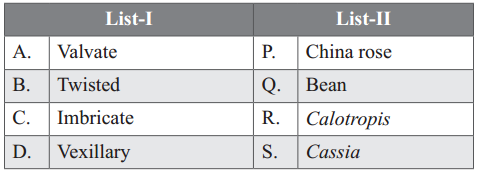
Match the following List-I and List-II select the correct option.
Morphology Of Flowering Plants – NEET-5672
  1. A A-P; B-Q; C-R; D-S
  2. B A-Q; B-P; C-S; D-R
  3. C A-S; B-Q; C-P; D-R
  4. D A-Q; B-S; C-P; D-R
Show answer

Correct answer: A

3
A leguminous plant whose seed is a source of oil is:
  1. A Rice
  2. B Sunflower
  3. C Groundnut
  4. D Mustard
Show answer

Correct answer: C

4
Which of the following is NOT a part of embryo?
  1. A Cotyledons
  2. B Tegmen
  3. C Radicle
  4. D Embryonal axis
Show answer

Correct answer: B

5
Choose the correct sequence (from inside to outside) of walls present in seed.
  1. A Pericarp - Mesocarp - Endocarp
  2. B Epicarp-Mesocarp- Pericarp
  3. C Endocarp - Mesocarp - Epicarp
  4. D Epicarp - Mesocarp - Endocarp
Show answer

Correct answer: C

6
_______ is indicated by enclosing the figure within bracket and _________ by a line drawn above the symbols of the floral parts.
  1. A Adhesion, cohesion
  2. B Fusion, adhesion
  3. C Cohesion, fusion
  4. D Adhesion, fusion
Show answer

Correct answer: B

7
Which of the following options is correct about family Solanaceae?
  1. A Pentamerous, bisexual, actinomorphic, hypogynous
  2. B Trimerous, actinomorphic, bisexual, hypogynous
  3. C Pentamerous, actinomorphic, unisexual, hypogynous
  4. D Pentamerous, zygomorphic, bisexual, epigynous
Show answer

Correct answer: A

8
Zygomorphic condition is when the flower can be divided into two ______ halves only in one particular vertical plane.
  1. A radial
  2. B unequal
  3. C similar
  4. D None of these
Show answer

Correct answer: C

9
Select the incorrect statement/s from the following.
  1. A Mesocarp is fibrous in coconut.
  2. B Maize and pea are dicotyledonous.
  3. C Banana is referred as false fruit.
  4. D Both (2) & (3)
Show answer

Correct answer: D

10
A flower was observed where the length of one filament was different from other filament. In second observation there were more filaments whose length were found to be different from other. The flower is:
  1. A Salvia
  2. B Citrus
  3. C Mustard
  4. D Both (1) & (2)
Show answer

Correct answer: D

11
A small pore is generally seen on hilum. It is:
  1. A Tegmen
  2. B Plumule
  3. C Micropyle
  4. D Coleoptile
Show answer

Correct answer: C

12
Leaves are modified into tendrils, spines, pitchers and bladders respectively in:
  1. A Sweet pea, Cactus, Nepenthes, Utricularia
  2. B Sweet Pea, Cactus, Utricularia, Nepenthes
  3. C Nepenthes, Sweet Pea, Cactus, Utricularia
  4. D Utricularia, Nepenthes, Cactus, Sweet Pea
Show answer

Correct answer: A

13
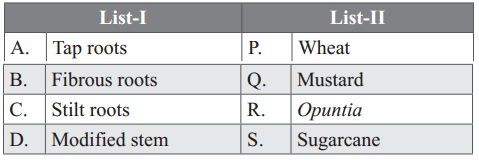
Match the List-I and List-II select the correct option.
Morphology Of Flowering Plants – NEET-5673
  1. A A-S; B-R; C-P; D-Q
  2. B A-R; B-S; C-P; D-Q
  3. C A-R; B-P; C-S; D-Q
  4. D A-S; B-P; C-R; D-Q
Show answer

Correct answer: C

14
Statement-I: Rosette of leaves and tuft of root on every node and short internode is found in Pistia.
Statement-II: New branch develops from bud at axil of leaf.
  1. A Both Statement-I and Statement-II are correct.
  2. B Both Statement-I and Statement-II are incorrect.
  3. C Statement-I is correct and Statement-II is incorrect.
  4. D Statement-I is incorrect and Statement-II is correct.
Show answer

Correct answer: A

15
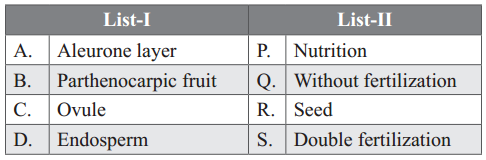
Match the List-I with List-II and select the correct option.
Morphology Of Flowering Plants – NEET-5671
  1. A A-P; B-R; C-Q; D-S
  2. B A-Q; B-P; C-S; D-R
  3. C A-Q; B-R; C-P; D-S
  4. D A-R; B-P; C-Q; D-S
Show answer

Correct answer: B

16
The shape of corolla may vary in plants. Which shape of corolla has never been observed in plants?
  1. A Funnel shaped
  2. B Tubular shaped
  3. C Dumb-bell shaped
  4. D Wheel shaped.
Show answer

Correct answer: C

17
When a dot is present at the top of floral diagram, what does it indicate?
  1. A Nature of flower
  2. B Position of gametes
  3. C Fusion of whorls
  4. D Position of mother axis
Show answer

Correct answer: D

18
The flowers are said to be actinomorphic or zygomorphic. Such classification is based on;
  1. A ovary position.
  2. B symmetry.
  3. C calyx and corolla position.
  4. D morphological characteristics.
Show answer

Correct answer: B

19
Statement-I: Some cells of elongation region, form fine and delicate, thread like structures called root hairs.
Statement-II: Tendrils of grapevines are modifications of stem.
  1. A Both Statement-I and Statement-II are correct.
  2. B Both Statement-I and Statement-II are incorrect.
  3. C Statement-I is correct and Statement-II is incorrect.
  4. D Statement-I is incorrect and Statement-II is correct.
Show answer

Correct answer: D

20
The sheath covering radicle and plumule, respectively are;
  1. A scutellum, coleorhiza.
  2. B coleorhiza, scutellum.
  3. C coleoptile, coleorhiza.
  4. D coleorhiza, coleoptile.
Show answer

Correct answer: D

Attempt this as a timed test

Reading answers is not the same as sitting the paper. Attempt it timed and you get your score, per-question timing, and the mistakes tracked for revision.

Start free

More Morphology Of Flowering Plants tests

All Morphology Of Flowering Plants tests →