1
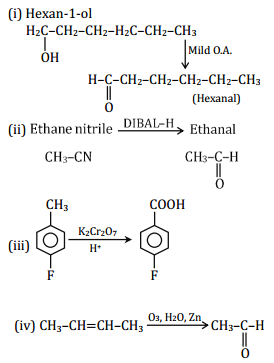
Select the incorrect option :
Conversion ⟶ Reagent
(i) Hexan-1-ol ⟶ hexanal $\mathrm{C}_{5} \mathrm{H}_{5} \mathrm{NH}^{+} \mathrm{CrO}_{3} \mathrm{Cl}^{-}$
(ii) Ethanenitrile ⟶ Ethanal DIBAL-H
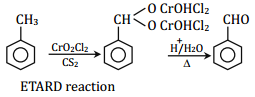
(iii) p-fluorotoluene, ⟶ $\mathrm{K}_{2} \mathrm{Cr}_{2} \mathrm{O}_{7}, \mathrm{H}^{+}$ p-fluorobenzaldehyde
(iv) But-2-ene ⟶ Ethanal $\mathrm{O}_{3}, \mathrm{H}_{2} \mathrm{O}-\mathrm{Zn}$ dust
- A Hexan-1-ol ⟶ hexanal $\mathrm{C}_{5} \mathrm{H}_{5} \mathrm{NH}^{+} \mathrm{CrO}_{3} \mathrm{Cl}^{-}$
- B Ethanenitrile ⟶ Ethanal DIBAL-H
- C p-fluorotoluene, ⟶ $\mathrm{K}_{2} \mathrm{Cr}_{2} \mathrm{O}_{7}, \mathrm{H}^{+}$ p-fluorobenzaldehyde
- D But-2-ene ⟶ Ethanal $\mathrm{O}_{3}, \mathrm{H}_{2} \mathrm{O}-\mathrm{Zn}$ dust
Show answer & explanation
Correct answer: C
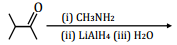
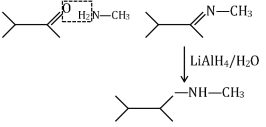
 can be converted to
 by:
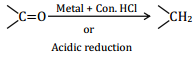
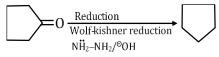 Clemmenson reduction $\mathrm{Zn}-\mathrm{Hg} / \mathrm{H}^{\oplus}$
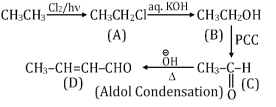
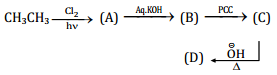 The product D is :-
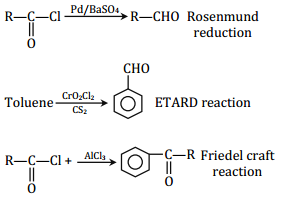
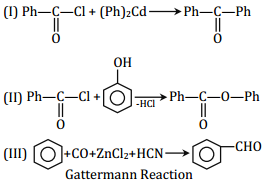
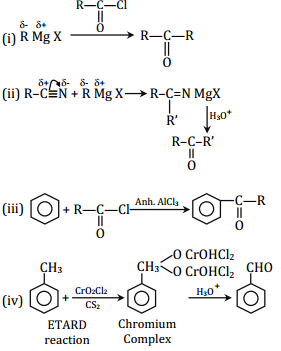
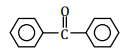 can be obtained by :-
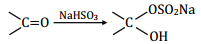 white crystal (water soluble)
 other are strong O.A. → further oxidation possible into acid.
 and
 are readily distinguished by their reaction with :-
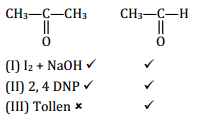
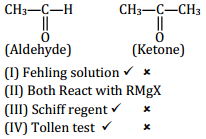
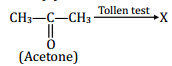 Tollen test is given by Aldehyde, formic acid α-hydroxy ketone, hemiacetal group.