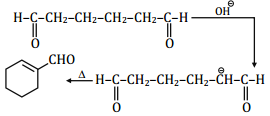
Aldehydes Ketones and Carboxylic Acids — DPP 2

20 NEET questions from Aldehydes Ketones and Carboxylic Acids, with answers and explanations. Attempt it as a timed test to get scoring, accuracy breakdown and mistake tracking.

Attempt this test free 20 questions · 30 minutes · +80 marks
1
Which of the following will not give iodoform test
  1. A
  2. B
  3. C
  4. D
Show answer & explanation

Correct answer: B

Aldehydes Ketones and Carboxylic Acids – NEET-20207 must be present to give haloform test.
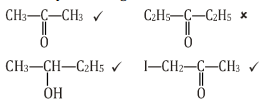
Aldehydes Ketones and Carboxylic Acids – NEET-20207
2
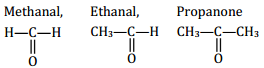
The methanal, ethanal and propanone are miscible with water because they form
  1. A Vander Waal's forces with water
  2. B H-bond with water
  3. C Dipole-dipole bond with water
  4. D Ion-dipole bond with water
Show answer & explanation

Correct answer: B

Aldehydes Ketones and Carboxylic Acids – NEET-20215 Miscible with water because they form hydrogen bond with water.

3
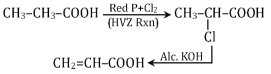
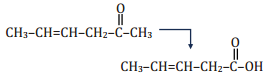
Aldehydes Ketones and Carboxylic Acids – NEET-20242 structure of B is :-
  1. A $\mathrm { CH } _ { 2 } = \mathrm { CH } - \mathrm { COOH }$
  2. B
  3. C
  4. D
Show answer & explanation

Correct answer: A

Aldehydes Ketones and Carboxylic Acids – NEET-20242
4
Acyl chlorides undergo :-
  1. A Nucleophilic addition reactions
  2. B Nucleophilic substitution reactions
  3. C Electrophilic substitution reactions
  4. D Electrophilic addition reactions
Show answer & explanation

Correct answer: B

Acid and acid chlorides undergo → NSR
5
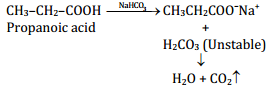
When propanoic acid is treated with aqueous sodium bicarbonate, $\mathrm{CO}_{2}$ is liberated. The C of $\mathrm{CO}_{2}$ comes from :-
  1. A Methyl group
  2. B Carboxylic acid group
  3. C Methylene group
  4. D Bicarbonate
Show answer & explanation

Correct answer: D

Aldehydes Ketones and Carboxylic Acids – NEET-20239 C of CO$_{2}$ comes from NaHCO$_{3}$
6
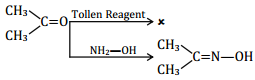
A compound with molecular formula $\mathrm { C } _ { 3 } \mathrm { H } _ { 6 } \mathrm { O }$, not gives silver mirror with Tollen's reagent but forms oxime with hydroxyl amine. Compound will be -
  1. A $\mathrm { CH } _ { 2 } = \mathrm { CH } - \mathrm { CH } _ { 2 } - \mathrm { OH }$
  2. B $\mathrm { CH } _ { 3 } \mathrm { CH } _ { 2 } \mathrm { CHO }$
  3. C $\mathrm { CH } _ { 2 } = \mathrm { CH } - \mathrm { O } - \mathrm { CH } _ { 3 }$
  4. D $\mathrm { CH } _ { 3 } \mathrm { COCH } _ { 3 }$
Show answer & explanation

Correct answer: D

Oxime formation ⇒ (Aldehyde or ketone)
Silver mirror test ✗, Ketone ✗, Aldehyde ✓
Aldehydes Ketones and Carboxylic Acids – NEET-20202
7
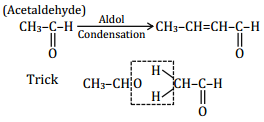
Which of the following can be converted to
$\mathrm{CH}_{3}-\mathrm{CH}=\mathrm{CH}-\mathrm{CHO}:-$
  1. A Acetone
  2. B Acetaldehyde
  3. C Propanaldehyde
  4. D Formaldehyde
Show answer & explanation

Correct answer: B

Aldehydes Ketones and Carboxylic Acids – NEET-20211
8
Carbonyl compounds readily undergo :-
  1. A Nucleophilic substitutions
  2. B Electrophilic addition reactions
  3. C Nucleophilic addition reactions
  4. D Free radical substitution reactions
Show answer & explanation

Correct answer: C

Carbonyl compound $\rightarrow$ NAR
9
Which of the following carbonyl group give the positive Fehling test?
  1. A Aliphatic aldehydes
  2. B Aromatic aldehydes
  3. C Ketones
  4. D Both (A) and (B)
Show answer & explanation

Correct answer: A

Fehling test given by Aliphatic aldehyde ✓
Aromatic Ald. ✗

Fehling reagent = (A) C$_{4}$SO$_{4}$. 5H₂O
(B) Na⁺ K⁺ tartarate (Rochelle salt)
10
Which of the following compounds does not give aldol condensation :-
  1. A $\mathrm { CH } _ { 3 } \mathrm { CHO }$
  2. B $\mathrm { CH } _ { 3 } \mathrm { CH } _ { 2 } \mathrm { CHO }$
  3. C HCHO
  4. D $\mathrm { CH } _ { 3 } \mathrm { CH } _ { 2 } \mathrm { CH } _ { 2 } \mathrm { CHO }$
Show answer & explanation

Correct answer: C

Aldol condensation ⟶ Minimum one $\alpha \mathrm{H}$ present
Aldehydes Ketones and Carboxylic Acids – NEET-20210 NO $\alpha$ H
NO aldol
11
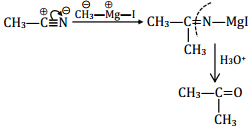
Acetone is obtained by the hydrolysis of the addition product of methyl magnesium iodide and:-
  1. A HCHO
  2. B $\mathrm { CH } _ { 3 } \mathrm { CHO }$
  3. C $\mathrm { CH } _ { 3 } \mathrm { COCH } _ { 3 }$
  4. D $\mathrm { CH } _ { 3 } - \mathrm { C } \equiv \mathrm { N }$
Show answer & explanation

Correct answer: D

Aldehydes Ketones and Carboxylic Acids – NEET-20124
12
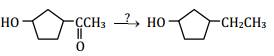
Which of the following reagent can be used for following conversion Aldehydes Ketones and Carboxylic Acids – NEET-20172
  1. A $\mathrm { Zn } - \mathrm { Hg } / \mathrm { HCl }$
  2. B Red $\mathrm { P } + \mathrm { HI }$
  3. C $\mathrm { NH } _ { 2 } - \mathrm { NH } _ { 2 } / \stackrel { \oplus } { \mathrm { O } } \mathrm { H }$
  4. D All of them
Show answer & explanation

Correct answer: C

Aldehydes Ketones and Carboxylic Acids – NEET-20172 OH group present $\therefore$ Acid sensitive reaction Avoid $\mathrm{Zn}-\mathrm{Hg} / \mathrm{HCl}$ (Clemmenson reduction) Used $\mathrm{NH}_{2}-\mathrm{NH}_{2} /{ }^{\ominus} \mathrm{OH}$ (Wolf- kishner reduction)
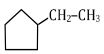
Red $+\mathrm{HI} \longrightarrow$ Reduced all given functional group
Aldehydes Ketones and Carboxylic Acids – NEET-20172
13
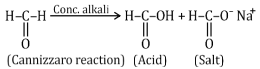
Formaldehyde reacts with conc. alkali to form :-
  1. A A resinous mass
  2. B Formic acid
  3. C A mixture of methanol and sodium formate
  4. D Methanol
Show answer & explanation

Correct answer: C

Aldehydes Ketones and Carboxylic Acids – NEET-20201
14
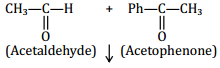
The reagent used for the separation of acetaldehyde from acetophenone is -
  1. A $\mathrm { NaHSO } _ { 3 }$
  2. B $\mathrm { C } _ { 6 } \mathrm { H } _ { 5 } \mathrm { NHNH } _ { 2 }$
  3. C $\mathrm { NH } _ { 2 } \mathrm { OH }$
  4. D $\mathrm { NaOH } + \mathrm { I } _ { 2 }$
Show answer & explanation

Correct answer: A

Aldehydes Ketones and Carboxylic Acids – NEET-20204 NaHSO$_{3}$ → All Aldehyde + Aliphatic methyl ketones gives positive test
Aromatic ketone ✗
15
The compounds A and B in the reaction sequence
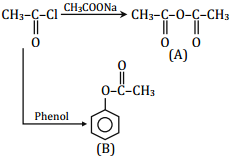
$\mathrm{B} \stackrel{\text { Phenol }}{\xrightarrow{ }} \mathrm{CH}_{3} \mathrm{COCl} \xrightarrow{\mathrm{CH}_{3} \mathrm{COONa}} \mathrm{~A}$ are given by the set respectively :-
  1. A $\mathrm{CH}_{3} \mathrm{CO}-\mathrm{O}-\mathrm{COCH}_{3}, \mathrm{C}_{6} \mathrm{H}_{5} \mathrm{CH}_{2} \mathrm{OH}$
  2. B $\mathrm{CH}_{3} \mathrm{CO}-\mathrm{O}-\mathrm{COCH}_{3}, \mathrm{C}_{6} \mathrm{H}_{5} \mathrm{OCOCH}_{3}$
  3. C $\mathrm{CH}_{3} \mathrm{COCH}_{3}, \mathrm{C}_{6} \mathrm{H}_{5} \mathrm{OCOCH}_{3}$
  4. D
Show answer & explanation

Correct answer: B

Aldehydes Ketones and Carboxylic Acids – NEET-20241
16
Cannizzaro reaction is given by :-
  1. A Aldehydes containing $\alpha$-hydrogen atoms
  2. B Aldehydes as well as ketones containing $\alpha$-hydrogen atoms
  3. C Aldehydes not containing $\alpha$-hydrogen atoms
  4. D Aldehydes containing $\beta$-hydrogen atoms
Show answer & explanation

Correct answer: C

Cannizzaro reaction is give by - Aldehyde not containing $\alpha$-hydrogen.
17
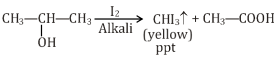
Which will give yellow ppt. with iodine and alkali
  1. A Propan-2-ol
  2. B Benzophenone
  3. C Methyl acetate
  4. D Acetamide
Show answer & explanation

Correct answer: A

It is Iodoform Test
Aldehydes Ketones and Carboxylic Acids – NEET-20209
18
Which is the most suitable reagent for the following conversionAldehydes Ketones and Carboxylic Acids – NEET-20200
  1. A $\xrightarrow[(\text { ii }) \mathrm{H}^{\oplus}]{\text { (i) Tollen's reagent }}$
  2. B $\xrightarrow [ \text { (ii) } \mathrm { H } ^ { \oplus } ] { \text { (i) Benzoyl peroxide } }$
  3. C $\xrightarrow [ \text { (ii) } \mathrm { H } ^ { \oplus } ] { \text { (i) } \mathrm { I } _ { 2 } \text {, and } \mathrm { NaOH } }$
  4. D $\xrightarrow { \mathrm { KMnO } _ { 4 } / \mathrm { H } ^ { \oplus } , \Delta }$
Show answer & explanation

Correct answer: C

Aldehydes Ketones and Carboxylic Acids – NEET-20200 Halo form reaction is best (Iodo form)
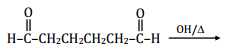
19
Aldehydes Ketones and Carboxylic Acids – NEET-20212 Product (A) is :-
  1. A
  2. B
  3. C
  4. D
Show answer & explanation

Correct answer: B

Aldehydes Ketones and Carboxylic Acids – NEET-20212
20
In a set of reactions acetic acid yielded a product C -
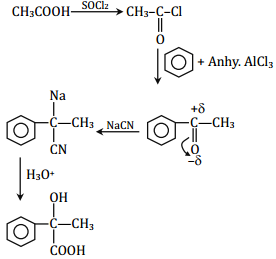
$\mathrm{CH}_{3} \mathrm{COOH} \xrightarrow{\mathrm{SOC}_{2}} \mathrm{~A} \xrightarrow[\text { Anhy.AlCl }{ }_{3}]{\text { Benzene }} \mathrm{B} \xrightarrow[\mathrm{H}^{+}]{\mathrm{NaCN}} \mathrm{C}$
The structure of C would be
  1. A
  2. B
  3. C
  4. D
Show answer & explanation

Correct answer: A

Aldehydes Ketones and Carboxylic Acids – NEET-20240

Attempt this as a timed test

Reading answers is not the same as sitting the paper. Attempt it timed and you get your score, per-question timing, and the mistakes tracked for revision.

Start free

More Aldehydes Ketones and Carboxylic Acids tests

All Aldehydes Ketones and Carboxylic Acids tests →