Atomic Structure — DPP 2

20 NEET questions from Atomic Structure, with answers and explanations. Attempt it as a timed test to get scoring, accuracy breakdown and mistake tracking.

Attempt this test free 20 questions · 30 minutes · +80 marks
1
Rutherford's α-particle scattering experiment proved that atom has :-
  1. A Electrons
  2. B Neutrons
  3. C Nucleus
  4. D Orbitals
Show answer & explanation

Correct answer: C

Rutherford's α scattering experiment proves that atom has Nucleus.
2
First excitation potential of H atom is :
  1. A 10.2 eV
  2. B 3.4 eV
  3. C 1.51 eV
  4. D - 3.4 eV
Show answer & explanation

Correct answer: A

First excitation potential of H
E$_{2}$ – E$_{1}$ = 10.2eV
3
Which is correct for any H like species :-
  1. A $\left( \mathrm { E } _ { 2 } - \mathrm { E } _ { 1 } \right) > \left( \mathrm { E } _ { 3 } - \mathrm { E } _ { 2 } \right) > \left( \mathrm { E } _ { 4 } - \mathrm { E } _ { 3 } \right)$
  2. B $\left( \mathrm { E } _ { 2 } - \mathrm { E } _ { 1 } \right) < \left( \mathrm { E } _ { 3 } - \mathrm { E } _ { 2 } \right) < \left( \mathrm { E } _ { 4 } - \mathrm { E } _ { 3 } \right)$
  3. C $\left( \mathrm { E } _ { 2 } - \mathrm { E } _ { 1 } \right) = \left( \mathrm { E } _ { 3 } - \mathrm { E } _ { 2 } \right) = \left( \mathrm { E } _ { 4 } - \mathrm { E } _ { 3 } \right)$
  4. D $\left( \mathrm { E } _ { 2 } - \mathrm { E } _ { 1 } \right) = 1 / 4 \left( \mathrm { E } _ { 3 } - \mathrm { E } _ { 2 } \right) = 1 / 9 \left( \mathrm { E } _ { 4 } - \mathrm { E } _ { 3 } \right)$
Show answer & explanation

Correct answer: A

E$_{2}$ – E$_{1}$ = 10.2ev
E$_{3}$ – E$_{2}$ = 1.89ev
E$_{4}$ – E$_{3}$ = 0.66ev
[E$_{2}$ – E$_{1}$] > [E$_{3}$ – E$_{2}$] > [E$_{4}$ – E$_{3}$]
4
The ratio of energies of hydrogen atom for first and second excited state is :-
  1. A $4 / 1$
  2. B $1 / 4$
  3. C $4 / 9$
  4. D $9 / 4$
Show answer & explanation

Correct answer: D

I$^\mathrm{st}$ exited state (n=2)
II$^\mathrm{nd}$ exited state (n=3)
$\frac{\mathrm{E}_{2}}{\mathrm{E}_{3}}=\frac{-13.6 \times \frac{(1)^{2}}{(2)^{2}}}{-13.6 \times \frac{(1)^{2}}{(3)^{2}}}=\frac{\frac{1}{4}}{\frac{1}{9}}=\frac{9}{4}$
5
The radiation of low frequency will be emitted in which transition of hydrogen atom :-
  1. A $n = 1$ to $n = 4$
  2. B $n = 2$ to $n = 5$
  3. C $n = 3$ to $n = 1$
  4. D $n = 5$ to $n = 2$
Show answer & explanation

Correct answer: D

In transition, away from, lowest frequency radiation will be emitted.
6
The energy of H -atom in $\mathrm { n } ^ { \text {th } }$ orbit is $\mathrm { E } _ { \mathrm { n } }$, then energy in $\mathrm { n } ^ { \text {th } }$ orbit of singly ionised helium ion will be:-
  1. A $4 \mathrm { E } _ { \mathrm { n } }$
  2. B $ \mathrm {E} _ { n } / 4$
  3. C $2 \mathrm { E } _ { \mathrm { n } }$
  4. D $ \mathrm {E} _ { n } / 2$
Show answer & explanation

Correct answer: A

For H–atom
⇒ E$_{n}$ = –13.6 × $\frac{1}{\mathrm{n}^{2}}$
For He$^{+}$ (Z=2)
⇒ E$_{n}$ = –13.6 × $\frac{4}{\mathrm{n}^{2}}$ = 4E$_{n}$
7
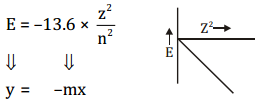
The graphical representation of energy of electron and atomic number is :-
  1. A
  2. B
  3. C
  4. D
Show answer & explanation

Correct answer: D

Atomic Structure – NEET-6394
8
If the ionization energy of hydrogen is 313.8 kcal per mol , then the energy of the electron in $2 ^ { \text {nd } }$ excited state will be :-
  1. A $- 113.2 \mathrm {~kcal } / \mathrm { mol }$
  2. B $- 78.45 \mathrm {~kcal } / \mathrm { mol }$
  3. C $- 313.8 \mathrm {~kcal } / \mathrm { mol }$
  4. D $- 35 \mathrm {~kcal } / \mathrm { mol }$
Show answer & explanation

Correct answer: D

I.E. = 313.8 [n$_{1}$ = 1, n$_{2}$ = ∞]
Energy in II$^\mathrm{nd}$ exited state
E = –313.8 × $\frac{1}{3^{2}}$ = –34.86 ≃ –35 kcal/mol
9
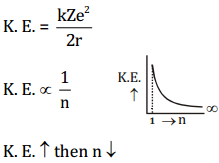
Going from K-shell to N-shell in case of H-atom :-
  1. A Kinetic energy decreases
  2. B Total energy decreases
  3. C Potential energy decreases
  4. D None of these
Show answer & explanation

Correct answer: A

As we know K.E. ∝ $\frac{1}{r}$
So going from K–shell to N–shell radius increases so we can say K.E. decreases
10
The Bohr orbit radius for the hydrogen atom (n = 1) is approximately $0.530 \AA$. The radius for the first excited state (n = 2) will be :-
  1. A $0.13 \AA$
  2. B $1.06 \AA$
  3. C $4.77 \AA$
  4. D $2.12 \AA$
Show answer & explanation

Correct answer: D

$\begin{array}{l}\mathrm{r}_{\mathrm{H}_{(1)}}=0.53 \mathrm{~A}^{\circ} \\ \mathrm{r}_{\mathrm{H}_{(2)}}=0.53 \times \frac{(2)^{2}}{1} \\ =0.53 \times \frac{4}{1}=2.12 \AA\end{array}$
11
If the potential energy (PE) of electron of hydrogen atom is - 3.02 eV then in which of the following excited level is electron present :-
  1. A $1 ^ { \text {st } }$
  2. B $2 ^ { \text {nd } }$
  3. C $3 ^ { \mathrm { rd } }$
  4. D $4 ^ { \text {th } }$
Show answer & explanation

Correct answer: B

$\begin{array}{l}\mathrm{E}=\frac{\text { P.E. }}{2}=\frac{-3.02}{2}=-1.51 \\ -1.51=-13.6 \times \frac{(1)^{2}}{(\mathrm{n})^{2}} \\ \mathrm{n}^{2}=\frac{13.6}{1.51} \simeq 9 \\ \mathrm{n}=3\left[\mathrm{II}^{\text {nd }} \text { exited state }\right]\end{array}$
12
The energy of one mole photons of radiation having frequency $5.01 \times 10 ^ { 14 } \mathrm {~Hz}$ is :
  1. A $160 \mathrm {~KJ } \mathrm {~mol } ^ { - 1 }$
  2. B $180 \mathrm {~KJ } \mathrm {~mol } ^ { - 1 }$
  3. C $200 \mathrm {~KJ } \mathrm {~mol } ^ { - 1 }$
  4. D $220 \mathrm {~KJ } \mathrm {~mol } ^ { - 1 }$
Show answer & explanation

Correct answer: C

E = hv
E = 6.626 × 10$^{-34}$ × 5.01 × 10$^{14}$
Thus the energy of 1 mole
E = 33.19 × 10$^{-20}$ × 6.023 × 10$^{23}$ = 200 KJ/mole
13
A and B are two elements which have same atomic weight and are having atomic number 27 and 30 respectively. If the atomic weight of A is 57 then number of neutron in B is :-
  1. A 27
  2. B 33
  3. C 30
  4. D 40
Show answer & explanation

Correct answer: A

${ }_{27} \mathrm{~A}^{57} \quad{ }_{30} \mathrm{~B}^{57}$
n$_{B}$ = 57 – 30 = 27
14
Energy required to remove an $\mathrm { e } ^ { - }$from M shell of H-atom is 1.51 eV , then energy of first excited state will be :-
  1. A - 1.51 eV
  2. B + 1.51 eV
  3. C - 3.4 eV
  4. D - 13.6 eV
Show answer & explanation

Correct answer: C

M shell [n = 4]
E$_{2}$ = –13.6 × $\frac{(1)^{2}}{(2)^{2}}$ First exited state (n = 2)
E$_{2}$ = –13.6 × $\frac{1}{4}$
E$_{2}$ = –3.4eV
15
For any anion $\mathrm { X } ^ { - 3 }$, the mass number is 14 . If anion has 10 electrons, then number of neutrons in $\mathrm { X } _ { 2 }$ nucleus :-
  1. A 10
  2. B 14
  3. C 7
  4. D 5
Show answer & explanation

Correct answer: B

${ }_{\mathrm{Z}}^{\mathrm{A}} \mathrm{X}^{3-}$
no. of e¯ = Z + 3 = 10
Z = 7
${ }_{7}^{14} \mathrm{X}^{-3}$ → no. of neutrons = 14 – 7 = 7
no. of neutrons in X$_{2}$ = 7 + 7 = 14
16
Which of the following electron transition will require the largest amount of energy in a hydrogen atom :-
  1. A From $n = 1$ to $n = 2$
  2. B From $n = 2$ to $n = 3$
  3. C From $n = \infty$ to $n = 1$
  4. D From $n = 3$ to $n = 5$
Show answer & explanation

Correct answer: A

In transition, closer to nucleus will require largest amount of energy, i.e. n = 1 to n = 2.
17
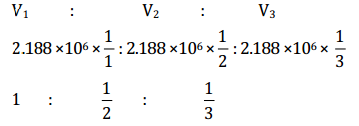
For any H like system, the ratio of velocities of electron in I, II & III orbit i.e., $\mathrm { V } _ { 1 } : \mathrm { V } _ { 2 } : \mathrm { V } _ { 3 }$ will be
  1. A $1 : 2 : 3$
  2. B $1 : 1 / 2 : 1 / 3$
  3. C $3 : 2 : 1$
  4. D $1 : 1 : 1$
Show answer & explanation

Correct answer: B

Atomic Structure – NEET-6388
18
Which of the following is a correct graph :-
  1. A
  2. B
  3. C
  4. D
Show answer & explanation

Correct answer: C

Atomic Structure – NEET-6406
19
Maximum frequency of emission is obtained for the transition :-
  1. A $n = 2$ to $n = 1$
  2. B $n = 6$ to $n = 2$
  3. C $n = 1$ to $n = 2$
  4. D $n = 2$ to $n = 6$
Show answer & explanation

Correct answer: A

e¯ jumps from higher to lower energy realises & lower to higher energy absorbed.
$\begin{array}{l}\frac{1}{\lambda}=\mathrm{R}_{\mathrm{H}} \mathrm{z}^{2}\left[\frac{1}{\mathrm{n}_{1}^{2}}-\frac{1}{\mathrm{n}_{2}^{2}}\right]- \\ \frac{\mathrm{c}}{\lambda}=\mathrm{R}_{\mathrm{H}} \mathrm{cz}^{2}\left[\frac{1}{\mathrm{n}_{1}^{2}}-\frac{1}{\mathrm{n}_{2}^{2}}\right]- \\ \mathrm{v}=\mathrm{R}_{\mathrm{H}} \mathrm{cz}^{2}\left[\frac{1}{1}-\frac{1}{4}\right]=\frac{3 \mathrm{R}_{\mathrm{H}} \mathrm{cz}^{2}}{4} \text { [minimum] }\end{array}$
20
Which is not a correct order of energy for $1 ^ { \text {st } }$, $2 ^ { \text {nd } } \& 3 ^ { \text {rd } }$ orbit :-
  1. A $\mathrm { E } _ { 1 } > \mathrm { E } _ { 2 } > \mathrm { E } _ { 3 }$
  2. B $( \mathrm { PE } ) _ { 1 } < ( \mathrm { PE } ) _ { 2 } < ( \mathrm { PE } ) _ { 3 }$
  3. C $( \mathrm { KE } ) _ { 1 } > ( \mathrm { KE } ) _ { 2 } > ( \mathrm { KE } ) _ { 3 }$
  4. D (A) & (B) both
Show answer & explanation

Correct answer: A

E = –13.6 × $\frac{\mathrm{z}^{2}}{\mathrm{n}^{2}}$
E ∝ $\frac{-1}{\mathrm{n}^{2}}$
n ↑ E ↑
Energy order E$_{1}$ > E$_{2}$ > E$_{3}$ is not true real order
will be E$_{3}$ > E$_{2}$ > E$_{1}$

Attempt this as a timed test

Reading answers is not the same as sitting the paper. Attempt it timed and you get your score, per-question timing, and the mistakes tracked for revision.

Start free

More Atomic Structure tests

All Atomic Structure tests →