Atomic Structure — DPP 3

20 NEET questions from Atomic Structure, with answers and explanations. Attempt it as a timed test to get scoring, accuracy breakdown and mistake tracking.

Attempt this test free 20 questions · 30 minutes · +80 marks
1
Which one of the following species will give a series of spectral lines similar to that of $\mathrm { Mg } ^ { 2 + }$ :-
  1. A $\mathrm { Al } ^ { 3 + }$
  2. B Na
  3. C $\mathrm { Mg } ^ { + }$
  4. D F
Show answer & explanation

Correct answer: A

Mg$^{+2}$ → 10e¯
Al$^{+3}$ → 10e¯
Same number of electrons.
2
The ionisation energy for excited hydrogen atom in eV will be :-
  1. A 13.6
  2. B Less than 13.6
  3. C Greater than 13.6
  4. D 3.4 or less
Show answer & explanation

Correct answer: D

E$_{2}$ = –13.6 × $\frac{(1)^{2}}{(2)^{2}}$
= –3.4eV
3.4 or less
3
The ratio between kinetic energy and the total energy of the electron of hydrogen atom according to Bohr's model is :-
  1. A $2 : 1$
  2. B $1 : 1$
  3. C $1 : - 1$
  4. D $1 : 2$
Show answer & explanation

Correct answer: C

As we know
T.E. = –K.E.
T.E. : – K.E.
1 : – 1
4
The energy required to excite an electron of H -atom from first orbit to second orbit is :-
  1. A $\frac { 3 } { 4 }$ of its ionisation energy
  2. B $\frac { 1 } { 2 }$ of its ionisation energy
  3. C $\frac { 1 } { 4 }$ of its ionisation energy
  4. D None of these
Show answer & explanation

Correct answer: A

E$_{2}$ – E$_{1}$ = –13.6 × (1)²$\left[\frac{1}{4}-\frac{1}{1}\right]$
E$_{2}$ – E$_{1}$ = 13.6$\left[\frac{3}{4}\right]$
5
The first emission line in the H-atom spectrum in the Balmer series will have wave number :-
  1. A $\frac { 5 \mathrm { R } } { 36 } \mathrm {~cm} ^ { - 1 }$
  2. B $\frac { 3 R } { 4 } \mathrm {~cm} ^ { - 1 }$
  3. C $\frac { 7 \mathrm { R } } { 144 } \mathrm {~cm} ^ { - 1 }$
  4. D $\frac { 9 \mathrm { R } } { 400 } \mathrm {~cm} ^ { - 1 }$
Show answer & explanation

Correct answer: A

$\overline{\mathrm{v}}=\mathrm{Rz}^{2}\left[\frac{1}{\mathrm{n}_{1}^{2}}-\frac{1}{\mathrm{n}_{2}^{2}}\right]$

$\bar{v}=R(1)^{2}\left[\frac{1}{4}-\frac{1}{9}\right]$

$\bar{v}=\frac{5 \mathrm{R}}{36} \mathrm{~cm}^{-1}$
6
In H -atom, electron transits from $6 ^ { \text {th } }$ orbit to $2 ^ { \text {nd } }$ orbit in multi step. Then total spectral lines (without Balmer series) will be :-
  1. A 6
  2. B 10
  3. C 4
  4. D 0
Show answer & explanation

Correct answer: A

n$_{2}$ = 6 to n$_{1}$ = 3
Total spectral lines = $\frac{\left(\mathrm{n}_{2}-\mathrm{n}_{1}\right)\left(\mathrm{n}_{2}-\mathrm{n}_{1}+1\right)}{2}$
= $\frac{(6-3)(6-3+1)}{2}$ = 6
7
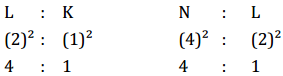
The ratio of the radii of two Bohr orbits of H-atom is $4 : 1$, what would be their nomenclature?
  1. A K & L
  2. B L & K
  3. C N & L
  4. D (B) & (C) both
Show answer & explanation

Correct answer: D

Atomic Structure – NEET-6384
8
The ionisation potential of a singly ionised helium ion is equivalent to :-
  1. A Kinetic energy of first orbit
  2. B Energy of last orbit
  3. C Average energy in orbits
  4. D Maximum energy in orbits
Show answer & explanation

Correct answer: A

I. P. of He$^{+}$ Ion is equivalent to K.E. of first orbit.
Singly Ionized He$^{+}$ Contain only 1 electron & also e¯ present in Ist orbit hence this energy is equal to K.E. I$^\mathrm{st}$ orbit.
9
An atom has x energy level, then total number of lines in its spectrum are:-
  1. A 1 + 2 + 3 .......(x + 1)
  2. B 1 + 2 + 3 ...... (x$^{2}$)
  3. C 1 + 2 + 3 ...... (x - 1)
  4. D (x + 1)(x + 2)(x + 4)
Show answer & explanation

Correct answer: C

Let n = 7
Total spectral lines = $\frac{\left(\mathrm{n}_{2}-\mathrm{n}_{1}\right)\left(\mathrm{n}_{2}-\mathrm{n}_{1}+1\right)}{2}$

$\frac{(7-1)(7-1+1)}{2}=\frac{6 \times 7}{2}$= 21
10
In a hydrogen atom, if energy of an electron in ground state is - 13.6 eV , then energy in the $2 ^ { \text {nd } }$ excited state is :-
  1. A - 1.51 eV
  2. B - 3.4 eV
  3. C - 6.04 eV
  4. D - 13.6 eV
Show answer & explanation

Correct answer: A

$\frac{\mathrm{E}_{1}}{\mathrm{E}_{3}} \Rightarrow \frac{-13.6 \times\left(\frac{1}{12}\right)}{-13.6 \times\left(\frac{1}{3^{2}}\right)}=\frac{-13.6}{\mathrm{E}_{3}}$
E$_{3}$ = –13.6 × $\frac{1}{9}$
E$_{3}$ = –1.51eV
11
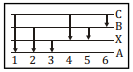
The figure indicates the energy level diagram for the origin of six spectral lines in emission spectrum (e.g. line no. 5 arises from the transition from level B to X) which of the following spectral lines will not occur in the absorption spectrum :–
Atomic Structure – NEET-6592
  1. A 1, 2, 3
  2. B 3, 2
  3. C 4, 5, 6
  4. D 3, 2, 1
Show answer & explanation

Correct answer: C

1, 2, 3 → Coming to energy level A but 4, 5, 6 → are not coming to energy level A So they will not appear in the absorption spectrum.
12
The ratio of potential energy and total energy of an electron in a Bohr orbit of hydrogen like species is :-
  1. A 2
  2. B - 2
  3. C 1
  4. D - 1
Show answer & explanation

Correct answer: A

$\frac{\text { P.E. }}{2}$ = T.E
P.E = 2 T.E
$\frac{\text { P.E. }}{\text { T.E }}=\frac{2}{1}$ = 2
13
The ionisation potential of the hydrogen atom is 13.6 eV . The energy needed to ionise a hydrogen atom which is in its second excited state is about:-
  1. A 13.6 eV
  2. B 10.2 eV
  3. C 3.4 eV
  4. D 1.51 eV
Show answer & explanation

Correct answer: D

Second exited state [n = 3]
I. E. = 13.6 × $\frac{1}{\mathrm{n}^{2}}$ = 13.6 × $\frac{1}{9}$ = 1.51eV
14
Find out ratio of following for photon $\left( v _ { \text {max } } \right) _ { \text {Lyman } } : \left( v _ { \text {max } } \right) _ { \text {Brackett } }$
  1. A $1 : 16$
  2. B $16 : 1$
  3. C $4 : 1$
  4. D $1 : 4$
Show answer & explanation

Correct answer: B

$\begin{array}{l}v_{\operatorname{maxL}}=\mathrm{cRZ}^{2}\left[\frac{1}{1^{2}}-\frac{1}{\infty^{2}}\right]=\mathrm{cRZ}^{2} \\ v_{\operatorname{maxB}}=\mathrm{cRZ}^{2}\left[\frac{1}{4^{2}}-\frac{1}{\infty^{2}}\right]=\frac{\mathrm{cRZ}^{2}}{16} \\ \frac{v_{\operatorname{maxL}}}{v_{\operatorname{maxB}}}=\frac{\mathrm{cRZ}^{2}}{\frac{\mathrm{cRZ}^{2}}{16}}=\frac{16}{1}\end{array}$
15
Which one of the following electronic transition between energy levels produces the line of shortest wavelength in hydrogen spectrum?
  1. A n$_ { 2 }$ → n$_ { 1 }$
  2. B n$_ { 3 }$ → n$_ { 1 }$
  3. C n$_ { 4 }$ → n$_ { 1 }$
  4. D n$_ { 4 }$ → n$_ { 3 }$
Show answer & explanation

Correct answer: C

Energy difference maximum then wavelength will be lower.
n$_ { 4 }$ → n$_ { 1 }$
16
The ratio of minimum frequency of Lyman \& Balmer series will be :-
  1. A 1.25
  2. B 0.25
  3. C 5.4
  4. D 10
Show answer & explanation

Correct answer: C

$\frac{\mathrm{v}_{\mathrm{L}}}{\mathrm{v}_{\mathrm{B}}}=\frac{\mathrm{RZ}^{2}\left[\frac{1}{1}-\frac{1}{4}\right]}{\mathrm{RZ}^{2}\left[\frac{1}{4}-\frac{1}{4}\right]}$

$\frac{v_{\mathrm{L}}}{v_{\mathrm{B}}}=\frac{\frac{3}{4}}{\frac{5}{36}}$

$\frac{v_{\mathrm{L}}}{v_{\mathrm{B}}}=\frac{3 \times 36}{5 \times 4}=\frac{27}{5}=5.4$
17
The first Lyman transition in the hydrogen spectrum has $\Delta \mathrm { E } = 10.2 \mathrm { eV }$. The same energy change is observed in the second Balmer transition of :-
  1. A $\mathrm { Li } ^ { 2 + }$
  2. B $\mathrm { Li } ^ { + }$
  3. C $\mathrm { He } ^ { + }$
  4. D $\mathrm { Be } ^ { 3 + }$
Show answer & explanation

Correct answer: C

Lyman [2 to 1] → H → 10.2ev
Balmer [4 to 2] → 10.2ev

∆E = –13.6 × Z$^{2}$$\left[\frac{1}{\mathrm{n}_{2}^{2}}-\frac{1}{\mathrm{n}_{1}^{2}}\right]$

10.2 = –13.6 × 2²$\left[\frac{1}{4^{2}}-\frac{1}{2^{2}}\right]$

Z$^{2}$ = 4 ⇒ Z = 2 (He$^{+}$)
18
The ratio of wavelengths of first line of Lyman series in $\mathrm { Li } ^ { + 2 }$ and first line of Lyman series in deuterium $\left( { } _ { 1 } ^ { 2 } \mathrm { H } \right)$ is :-
  1. A $1 : 9$
  2. B $9 : 1$
  3. C $1 : 4$
  4. D $4 : 1$
Show answer & explanation

Correct answer: A

$\lambda_{\mathrm{L}^{+2}}=\frac{1}{\mathrm{R}(3)^{2}\left[\frac{1}{1^{2}}-\frac{1}{2^{2}}\right]}=\frac{1}{9 \mathrm{R}\left(\frac{3}{4}\right)}$

$\lambda_{\mathrm{D}}=\frac{1}{\mathrm{R}(1)^{2}\left[\frac{1}{1^{2}}-\frac{1}{2^{2}}\right]}=\frac{1}{\left(\frac{3}{4}\right) \mathrm{R}}$

$\frac{\lambda_{\mathrm{L}^{+2}}}{\lambda_{\mathrm{D}}}=\frac{\mathrm{R}\left(\frac{3}{4}\right)}{9 \mathrm{R}\left(\frac{3}{4}\right)}=\frac{1}{9}$
19
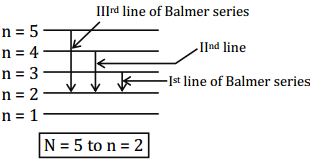
Third line of Balmer series is produced by which transition in spectrum of H -atom
  1. A $n = 5$ to $n = 2$
  2. B $n = 5$ to $n = 1$
  3. C $n = 4$ to $n = 2$
  4. D n=4 to n=1
Show answer & explanation

Correct answer: A

Atomic Structure – NEET-6414
20
The spectrum of He is expected to be similar to that of :-
  1. A H
  2. B Na
  3. C He$^{+}$
  4. D Li$^{+2}$
Show answer & explanation

Correct answer: D

He$^{+}$ is expected to be similar to Li$^{+2}$ because number of electrons are similar.

Attempt this as a timed test

Reading answers is not the same as sitting the paper. Attempt it timed and you get your score, per-question timing, and the mistakes tracked for revision.

Start free

More Atomic Structure tests

All Atomic Structure tests →