Chemical Bonding and Molecular Structure — DPP 2

20 NEET questions from Chemical Bonding and Molecular Structure, with answers and explanations. Attempt it as a timed test to get scoring, accuracy breakdown and mistake tracking.

Attempt this test free 20 questions · 30 minutes · +80 marks
1
Which of the following species given below have shape similar to $\mathrm { XeOF } _ { 4 }$ ?
  1. A $\mathrm { XeO } _ { 3 }$
  2. B $\mathrm { SF } _ { 6 }$
  3. C $\mathrm { PCl } _ { 5 }$
  4. D $\mathrm { XeF } _ { 5 } ^ { + }$
Show answer

Correct answer: D
2
Most favourable conditions for electrovalent bonding are:
  1. A low ionisation potential of one atom and high electron affinity of the other atom.
  2. B high electron affinity and high ionisation potential of both the atoms.
  3. C low electron affinity and low ionisation potential of both the atoms.
  4. D high ionisation potential of one atom and low electron affinity of the other atom.
Show answer

Correct answer: A

3
The correct sequence of decrease in the bond angles of the following hydrides is:
  1. A $\mathrm { CO } _ { 2 } > \mathrm { BF } _ { 3 } > \mathrm { NH } _ { 3 }$
  2. B $\mathrm { CO } _ { 2 } > \mathrm { NH } _ { 3 } > \mathrm { BF } _ { 3 }$
  3. C $\mathrm { BF } _ { 3 } > \mathrm { NH } _ { 3 } > \mathrm { CO } _ { 2 }$
  4. D $\mathrm { NH } _ { 3 } > \mathrm { CO } _ { 3 } > \mathrm { BF } _ { 3 }$
Show answer

Correct answer: A

4
Which of the following shows the highest lattice energy?
  1. A magnesium fluoride.
  2. B magnesium chloride.
  3. C magnesium bromide.
  4. D magnesium iodide.
Show answer

Correct answer: A

5
Which of the following reactions is feasible?
  1. A $\mathrm{KF}(\mathrm{s})+\mathrm{HF}(\mathrm{l}) \rightarrow \mathrm{KHF}_{2}$
  2. B $\mathrm{KCl}(\mathrm{s})+\mathrm{HCl}(\mathrm{l}) \rightarrow \mathrm{KHCl}_{2}$
  3. C $\mathrm{KBr}(\mathrm{s})+\mathrm{HBr}(\mathrm{l}) \rightarrow \mathrm{KHBr}_{2}$
  4. D $\mathrm{KI}(\mathrm{s})+\mathrm{HI}(\mathrm{l}) \rightarrow \mathrm{KHI}_{2}$
Show answer & explanation

Correct answer: A

KF will ionise to $\mathrm{K}^{+}$and $\mathrm{F}^{-}$. A hydrogen bond will be formed between $\mathrm{F}^{-}$and $\mathrm{H}^{+}$resulting in $\mathrm{HF}_{2}^{-}$.
Therefore, option (1) is the correct answer.
6
An electrovalent bond or ionic bond is formed between:
  1. A two metals.
  2. B two electronegative atoms.
  3. C one electropositive and one electronegative atom.
  4. D two electropositive atoms.
Show answer

Correct answer: C

7
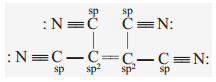
Carbon atoms in $\mathrm{C}_{2}(\mathrm{CN})_{4}$ are:
  1. A sp hybridised.
  2. B $\mathrm{sp}^{2}$ hybridised.
  3. C sp and $\mathrm{sp}^{2}$ hybridised.
  4. D $\mathrm{sp}, \mathrm{sp}^{2}$ and $\mathrm{sp}^{3}$ hybridised.
Show answer & explanation

Correct answer: C

Chemical Bonding and Molecular Structure – NEET-7003 Therefore, option (3) is the correct answer
8
Directions: These questions consist of two statements each, printed as Assertion (A) and Reason (R). While answering these questions, you are required to choose any one of the following four responses.
Assertion (A): The value of dipole moment helps to predict whether a molecule is polar or nonpolar.
Reason (R): The dipole moment helps to calculate the percent ionic character in the molecules.
  1. A If both Assertion (A) and Reason (R) are True and the Reason (R) is a correct explanation of the Assertion (A).
  2. B If both Assertion (A) and Reason (R) are True but Reason (R) is not a correct explanation of the Assertion (A).
  3. C If Assertion (A) is True but the Reason (R) is False.
  4. D Assertion (A) is False but Reason (R) is True.
Show answer

Correct answer: A

9
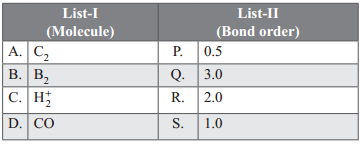
Match the List-I with List-II and find out the correct option.
Chemical Bonding and Molecular Structure – NEET-7612
  1. A A-(R), B-(S), C-(P), D-(Q)
  2. B A-(S), B-(P), C-(Q), D-(R)
  3. C A-(S), B-(R), C-(Q), D-(P)
  4. D A-(R), B-(P), C-(Q), D-(S)
Show answer

Correct answer: A

10
Lattice energy of an ionic compound depends on:
  1. A charge of the ion only.
  2. B size of the ion only.
  3. C packing of the ion only.
  4. D both charge and size of the ion.
Show answer

Correct answer: D

11
Which of the following statement is correct?
  1. A $\mathrm{H}_{2} \mathrm{O}$ and $\mathrm{OF}_{2}$ both are linear in shape.
  2. B $\mathrm{H}_{2} \mathrm{O}$ is linear whereas $\mathrm{OF}_{2}$ has a bent structure.
  3. C Both $\mathrm{H}_{2} \mathrm{O}$ and $\mathrm{OF}_{2}$ have a bent structure.
  4. D $\mathrm{H}_{2} \mathrm{O}$ is bent whereas $\mathrm{OF}_{2}$ has a linear structure.
Show answer & explanation

Correct answer: C

In $\mathrm{H}_{2} \mathrm{O}$ and $\mathrm{OF}_{2}$, the central atom of both molecules contains same hybridisation i.e. $\mathrm{sp}^{3}$ and same number of lone pairs around central atom, hence these both have a bent structure.
Therefore, option (3) is the correct answer.
12
Which of the following pair contains species with the different geometry?
  1. A $\mathrm{PO}_{4}^{3-}$ and $\mathrm{SO}_{4}^{2-}$
  2. B $\mathrm{NH}_{4}^{+}$and $\mathrm{BF}_{4}^{-}$
  3. C $\mathrm{CO}_{2}$ and $\mathrm{C}_{2} \mathrm{H}_{2}$
  4. D $\mathrm{N}_{2} \mathrm{O}$ and $\mathrm{NO}_{2}$
Show answer & explanation

Correct answer: D

$\mathrm{PO}_{4}^{3-}$ and $\mathrm{SO}_{4}^{2-}$ both are isoelectronic and tetrahedral in geometry. Same is in $\mathrm{NH}_{4}^{+}$and $\mathrm{BF}_{4}^{-}$also. In $\mathrm{CO}_{2}$ and $\mathrm{C}_{2} \mathrm{H}_{2}$ each C atom has sp hybridized hence, both are linear. Only in case of $\mathrm{N}_{2} \mathrm{O}$ and $\mathrm{NO}_{2}$ geometry is different as $\mathrm{N}_{2} \mathrm{O}$ is linear whereas $\mathrm{NO}_{2}$ is trigonal planar.
Therefore, option (4) is the correct answer.
13
The compound which does not contain ionic bond is:
  1. A NaOH
  2. B HCl
  3. C $\mathrm { K } _ { 2 } \mathrm {S}$
  4. D LiH
Show answer

Correct answer: B

14
The shape of $\mathrm { XeF } _ { 2 }$ molecule is:
  1. A triangular
  2. B t-shape
  3. C square planar
  4. D linear
Show answer

Correct answer: D

15
Water $\left(\mathrm{H}_{2} \mathrm{O}\right)$ is liquid while hydrogen sulphide $\left(\mathrm{H}_{2} \mathrm{S}\right)$ is a gas because:
  1. A water has higher molecular weight.
  2. B hydrogen sulphide is weak acid.
  3. C water molecular associate through hydrogen bonding.
  4. D None of these
Show answer

Correct answer: C

16
Directions: These questions consist of two statements each, printed as Assertion (A) and Reason (R). While answering these questions, you are required to choose any one of the following four responses.
Assertion (A): Geometry of NH₃ molecule is tetrahedral.
Reason (R): Nitrogen is sp$^{3}$ hybridised in NH₃.
  1. A If both Assertion (A) and Reason (R) are True and the Reason (R) is a correct explanation of the Assertion (A).
  2. B If both Assertion (A) and Reason (R) are True but Reason (R) is not a correct explanation of the Assertion (A).
  3. C If Assertion (A) is True but the Reason (R) is False
  4. D Assertion (A) is False but Reason (R) is True.
Show answer

Correct answer: A

17
Which one in the following is not the resonating structure of $\mathrm { CO } _ { 2 }$ ?
  1. A $\mathrm { O } \equiv \mathrm { C } = \mathrm { O }$
  2. B $\mathrm { O } = \mathrm { C } = \mathrm { O }$
  3. C $- \mathrm { O } - \mathrm { C } \equiv \mathrm { O } ^ { + }$
  4. D ${ } ^ { + } \mathrm { O } \equiv \mathrm { C } - \mathrm { O } ^ { - }$
Show answer

Correct answer: A

18
Potassium forms a highly ionic compound when it combines with:
  1. A chlorine
  2. B fluorine.
  3. C bromine
  4. D iodine
Show answer

Correct answer: B

19
The correct order of bond angle is:
  1. A $\mathrm { sp } ^ { 3 } < \mathrm { sp } < \mathrm { sp } ^ { 2 }$
  2. B $\mathrm { sp } < \mathrm { sp } ^ { 2 } < \mathrm { sp } ^ { 3 }$
  3. C $\mathrm { sp } ^ { 2 } < \mathrm { sp } < \mathrm { sp } ^ { 3 }$
  4. D $\mathrm { sp } ^ { 3 } < \mathrm { sp } ^ { 2 } < \mathrm { sp }$
Show answer

Correct answer: D

20
Amongst $\mathrm{N}_{2} \mathrm{O}, \mathrm{SO}_{2}, \mathrm{I}_{3}^{+}$and $\mathrm{I}_{3}^{-}$, the linear species are $\_\_\_\_$ :
  1. A $\mathrm{N}_{2} \mathrm{O}$ and $\mathrm{SO}_{2}$
  2. B $\mathrm{N}_{2} \mathrm{O}$ and $\mathrm{I}_{3}^{+}$
  3. C $\mathrm{SO}_{2}$ and $\mathrm{I}_{3}^{+}$
  4. D $\mathrm{N}_{2} \mathrm{O}$ and $\mathrm{I}_{3}^{-}$
Show answer & explanation

Correct answer: D

Among the following molecules $\mathrm{SO}_{2}$ and $\mathrm{I}_{3}^{+}$contains bent structure whereas $\mathrm{N}_{2} \mathrm{O}$ and $\mathrm{I}_{3}^{-}$are linear in shape.
Therefore, option (4) is the correct answer.

Attempt this as a timed test

Reading answers is not the same as sitting the paper. Attempt it timed and you get your score, per-question timing, and the mistakes tracked for revision.

Start free

More Chemical Bonding and Molecular Structure tests

All Chemical Bonding and Molecular Structure tests →