Chemical Bonding and Molecular Structure — DPP 3

20 NEET questions from Chemical Bonding and Molecular Structure, with answers and explanations. Attempt it as a timed test to get scoring, accuracy breakdown and mistake tracking.

Attempt this test free 20 questions · 30 minutes · +80 marks
1
Average formal charge on oxygen atom in carbonate ion is:
  1. A - 2
  2. B 3
  3. C - 1
  4. D $\frac { - 2 } { 3 }$
Show answer

Correct answer: D

2
Formal charge on S atom in the most stable structure of $\mathrm{SO}_{3}$ is:
  1. A +2
  2. B +3
  3. C +1
  4. D 0
Show answer & explanation

Correct answer: D

The most stable structure of $\mathrm{SO}_{3}$ is:
Chemical Bonding and Molecular Structure – NEET-7012 Formal charge =
Valence $\mathrm{e}^{-}-\left[\right.$non bonding pair $\left.\mathrm{e}^{-}+\frac{\text { bonding pair } \mathrm{e}^{-}}{2}\right]$
Formal charge of S = $6-\left[0+\frac{12}{2}\right]$
Formal charges of S = 6 - 6 = 0
Therefore, option (4) is the correct answer.
3
The correct order of bond angles in $\mathrm { H } _ { 2 } \mathrm {~S} , \mathrm { NH } _ { 3 } , \mathrm { BF } _ { 3 }$ and $\mathrm { SiH } _ { 4 }$ is:
  1. A $\mathrm { H } _ { 2 } \mathrm {~S} < \mathrm { NH } _ { 3 } < \mathrm { SiH } _ { 4 } < \mathrm { BF } _ { 3 }$
  2. B $\mathrm { NH } _ { 3 } < \mathrm { H } _ { 2 } \mathrm {~S} < \mathrm { SiH } _ { 4 } < \mathrm { BF } _ { 3 }$
  3. C $\mathrm { H } _ { 2 } \mathrm {~S} < \mathrm { SiH } _ { 4 } < \mathrm { NH } _ { 3 } < \mathrm { BF } _ { 3 }$
  4. D $\mathrm { H } _ { 2 } \mathrm {~S} < \mathrm { NH } _ { 3 } < \mathrm { BF } _ { 3 } < \mathrm { SiH } _ { 4 }$
Show answer

Correct answer: A

4
Which of the following species has bond angle less than $98 ^ { \circ }$ ?
  1. A $\mathrm { H } _ { 2 } \mathrm { O }$
  2. B $\mathrm { NH } _ { 3 }$
  3. C $\mathrm { CH } _ { 4 }$
  4. D $\mathrm { PH } _ { 3 }$
Show answer

Correct answer: D

5
Which of the following has greater bond angle?
  1. A $\mathrm { CCl } _ { 4 }$
  2. B $\mathrm { CO } _ { 2 }$
  3. C $\mathrm { CO } _ { 3 } ^ { 2 - }$
  4. D $\mathrm { BF } _ { 3 }$
Show answer

Correct answer: B

6
Which of the following species follows the octet rule for all of its atoms?
  1. A $\mathrm { AlCl } _ { 3 }$
  2. B $\mathrm { BH } _ { 3 }$
  3. C $\mathrm { XeF } _ { 6 }$
  4. D $\mathrm { C } _ { 2 } \mathrm {~F} _ { 6 }$
Show answer

Correct answer: D

7
The molecule that deviates from octet rule is:
  1. A $\mathrm { SiF } _ { 4 }$
  2. B $\mathrm { BeH } _ { 2 }$
  3. C $\mathrm { CCl } _ { 4 }$
  4. D $\mathrm { NH } _ { 3 }$
Show answer

Correct answer: B

8
Which of the following contains both ionic and covalent bonds?
  1. A $\mathrm { H } _ { 2 } \mathrm { O }$
  2. B NaOH
  3. C $\mathrm { C } _ { 6 } \mathrm { H } _ { 5 } \mathrm { Cl }$
  4. D $\mathrm { CO } _ { 2 }$
Show answer

Correct answer: B

9
The formal charge on central oxygen atom in $\mathrm { O } _ { 3 }$ molecule is:
  1. A 0
  2. B + 1
  3. C - 1
  4. D - 2
Show answer

Correct answer: B

10
Expanded octet can be observed in the valence shell of the central atom in:
  1. A $\mathrm { NH } _ { 3 }$
  2. B $\mathrm { CH } _ { 4 }$
  3. C $\mathrm { PCl } _ { 5 }$
  4. D $\mathrm { BeCl } _ { 2 }$
Show answer

Correct answer: C

11
Correct Lewis representation of $\mathrm { O } _ { 3 }$ molecule is:
  1. A
  2. B
  3. C
  4. D
Show answer

Correct answer: C

12
Which of the following has highest ionic character?
  1. A $\mathrm { MgCl } _ { 2 }$
  2. B $\mathrm { CaCl } _ { 2 }$
  3. C $\mathrm { BaCl } _ { 2 }$
  4. D $\mathrm { BeCl } _ { 2 }$
Show answer

Correct answer: C

13
Among the following, the molecule having maximum number of covalent bonds is:
  1. A $\mathrm { NH } _ { 4 } \mathrm { OH }$
  2. B $\mathrm { NH } _ { 4 } \mathrm { Cl }$
  3. C $\mathrm { CO } \left( \mathrm { NH } _ { 2 } \right) _ { 2 }$
  4. D $\mathrm { CH } _ { 3 } \mathrm { OH }$
Show answer

Correct answer: C

14
Hypervalent species among the following is:
  1. A $\mathrm { BF } _ { 3 }$
  2. B $\mathrm { CO } _ { 2 }$
  3. C $\mathrm { SiF } _ { 4 }$
  4. D $\mathrm { XeF } _ { 6 }$
Show answer

Correct answer: D

15
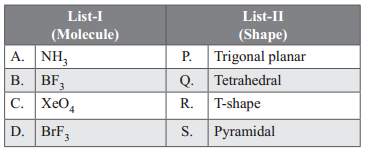
Match the List-I with List-II and find out the correct option
Chemical Bonding and Molecular Structure – NEET-7601
  1. A A-(P), B-(Q), C-(S), D-(R)
  2. B A-(S), B-(P), C-(Q), D-(R)
  3. C A-(S), B-(R), C-(Q), D-(P)
  4. D A-(R), B-(P), C-(Q), D-(S)
Show answer

Correct answer: B

16
In which of the following molecules, the bond angle is maximum?
  1. A $\mathrm{H}_{2} \mathrm{O}$
  2. B $\mathrm{BeCl}_{2}$
  3. C $\mathrm{H}_{2} \mathrm{~S}$
  4. D $\mathrm{CH}_{4}$
Show answer & explanation

Correct answer: B

Out of these molecules, BeCl$_{2}$ is linear. The bond angle is 180°
Chemical Bonding and Molecular Structure – NEET-6999 Therefore, option (2) is the correct answer
17
The smallest bond angle around the central atom will be present in:
  1. A $\mathrm { CS } _ { 2 }$
  2. B $\mathrm { BeF } _ { 2 }$
  3. C $\mathrm { CH } _ { 4 }$
  4. D $\mathrm { NH } _ { 3 }$
Show answer

Correct answer: D

18
In which of the following species, the angle around the central atom is exactly equal to $109 ^ { \circ } 28 ^ { \prime}$ ?
  1. A $\mathrm { SF } _ { 4 }$
  2. B $\mathrm { NH } _ { 3 }$
  3. C $\mathrm { NH } _ { 4 } ^ { + }$
  4. D $\mathrm { CO } _ { 2 }$
Show answer

Correct answer: C

19
Which of following molecule/species is having maximum number of lone pairs in Lewis dot structure?
  1. A $\mathrm { BH } _ { 4 } ^ { - }$
  2. B $\mathrm { BF } _ { 4 } ^ { - }$
  3. C $\mathrm { CN } ^ { - }$
  4. D $\mathrm { COCl } _ { 2 }$
Show answer

Correct answer: B

20
The molecule that deviates from octet rule is:
  1. A NaCl
  2. B $\mathrm { BeCl } _ { 2 }$
  3. C MgO
  4. D $\mathrm { NH } _ { 3 }$
Show answer

Correct answer: B

Attempt this as a timed test

Reading answers is not the same as sitting the paper. Attempt it timed and you get your score, per-question timing, and the mistakes tracked for revision.

Start free

More Chemical Bonding and Molecular Structure tests

All Chemical Bonding and Molecular Structure tests →