Equilibrium — DPP 2

20 NEET questions from Equilibrium, with answers and explanations. Attempt it as a timed test to get scoring, accuracy breakdown and mistake tracking.

Attempt this test free 20 questions · 30 minutes · +80 marks
1
The $\mathrm{K}_{a}$ for formic acid and acetic acid are $2 \times 10^{-4}$ and $2 \times 10^{-5}$ respectively. Calculate the relative strength of acids with the same molar concentration.
  1. A $\sqrt{10}$
  2. B $\sqrt{7}$
  3. C $\sqrt{8}$
  4. D $\sqrt{5}$
Show answer & explanation

Correct answer: A

The relative strength of weak acids $=\sqrt{\left(\frac{\mathrm{K}_{a_{1}}}{\mathrm{~K}_{a_{2}}} \times \frac{\mathrm{C}_{1}}{\mathrm{C}_{2}}\right)}$

Relative strength = $\sqrt{\left(\frac{\mathrm{K}_{a_{1}}}{\mathrm{~K}_{a_{2}}}\right)}\left(\because \mathrm{C}_{1}=\mathrm{C}_{2}\right)$
$=\sqrt{\left(\frac{2 \times 10^{-4}}{2 \times 10^{-5}}\right)}$
Relative strength for HCOOH to $\mathrm{CH}_{3} \mathrm{COOH}=\sqrt{10}: 1$
Therefore, option (1) is the correct answer.
2
Consider the reaction $\mathrm{A}^{-}+\mathrm{H}_{3} \mathrm{O}^{+} \rightleftharpoons \mathrm{HA}+\mathrm{H}_{2} \mathrm{O}$. The Ka value for acid HA is $1.0 \times 10^{-8}$. What is the value of K for this reaction?
  1. A $1.0 \times 10^{6}$
  2. B $1.0 \times 10^{-8}$
  3. C $1.0 \times 10^{8}$
  4. D $1.0 \times 10^{-6}$
Show answer & explanation

Correct answer: C

$\mathrm{K}=\frac{[\mathrm{HA}]}{\left[\mathrm{A}^{-}\right]\left[\mathrm{H}^{+}\right]}=\frac{1}{\mathrm{~K}_{\mathrm{a}}}=\frac{1}{1.0 \times 10^{-8}}=1.0 \times 10^{8}$
Therefore, option (3) is the correct answer
3
Calculate the pH of a buffer solution prepared by dissolving 10.6 of $\mathrm { Na } _ { 2 } \mathrm { CO } _ { 3 }$ in 500 ml of an aqueous solution containing 80 ml of $1 \mathrm {~M } \mathrm {~HCl } . \mathrm {~K } _ { a }$ for $\mathrm { HCO } _ { 3 } { } ^ { - } = 6 \times 10 ^ { - 11 }$ :
  1. A 8.6
  2. B 9.6
  3. C 11.6
  4. D 12.6
Show answer & explanation

Correct answer: B

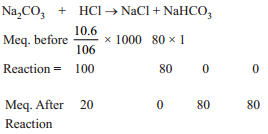
Equilibrium – NEET-9213 The solution Na₂CO₃ and HCO$_{3}$$^{–}$ and thus acts as a buffer
pH = – log K$_{a}$ + log$\frac{\left[\mathrm{CO}_{3}^{-2}\right]}{\left[\mathrm{HCO}_{3}^{-}\right]}$
= – log 6 × 10$^{–11}$ + log $\frac{20}{80}$ = 9.6
Therefore, option (2) is the correct answer.
4
Some inert gas is added at constant volume to the following reaction at equilibrium:
$\mathrm { NH } _ { 4 } \mathrm { HS } ( \mathrm {s} ) \rightleftharpoons \mathrm { NH } _ { 3 } ( \mathrm {g} ) + \mathrm { H } _ { 2 } \mathrm {S} ( \mathrm {g} )$
Predict the effect of addition of the inert gas;
  1. A The equilibrium shifts in the forward direction
  2. B The equilibrium shift in the backward direction
  3. C The equilibrium remains unaffected
  4. D The value of $\mathrm { K } _ { \mathrm { p } }$ is increased
Show answer

Correct answer: C

5
20 ml of 0.2 M NaOH is added to 50 ml , of 0.2 M $\mathrm { CH } _ { 3 } \mathrm { COOH }$ to give 70 ml , of the solution. What is the pH of the solution? The ionization constant of acetic acid is $2 \times 10 ^ { - 5 }$ :
  1. A 4.522
  2. B 5.568
  3. C 6.522
  4. D 7.568
Show answer & explanation

Correct answer: A

The addition of NaOH converts the equivalent amount of acetic acid into sodium acetate.
Hence, concentration of acetic acid after the addition of NaOh = $\frac{6}{70}$M
concentration of CH$_{2}$COONa after the addition of NaOH = $\frac{4}{70}$ M
Hence, Using the expression
pH = pK$_{a}$ + log$\left[\frac{\text { Salt }}{\text { Acid }}\right]$
= –log(2 × 10$^{–5}$) + log$\left(\frac{4}{6}\right)$
= 4.699 – 0.177
= 4.522
Therefore, option (1) is the correct answer
6
The conjugate base of $\mathrm { H } _ { 2 } \mathrm { PO } _ { 4 } ^ { - }$is:
  1. A $\mathrm { PO } _ { 4 } ^ { 3 - }$
  2. B $\mathrm { P } _ { 2 } \mathrm { O } _ { 5 }$
  3. C $\mathrm { H } _ { 3 } \mathrm { PO } _ { 4 }$
  4. D $\mathrm { HPO } _ { 4 } ^ { 2 - }$
Show answer

Correct answer: D

7
0.15 mole of pyridinium chloride has been added to 500 $\mathrm { cm } ^ { 3 }$ of 0.2 M pyridine solution. What is the pH of the resulting assuming no change in volume?
$\left( \mathrm { K } _ { b } \right.$ for pyridine $\left. = 1.5 \times 10 ^ { - 9 } \mathrm { M } \right)$
  1. A 9
  2. B 5
  3. C 6
  4. D 8
Show answer & explanation

Correct answer: B

$\begin{array}{l}\mathrm{pOH}=\mathrm{pK}_{b}+\log \frac{\text { [salt] }}{\text { [base] }} \\ =-\log \left(1.5 \times 10^{-9}\right)+\log \frac{0.15}{500 \times 0.2 \times 10^{-3}}\end{array}$
= 9 – log 1.5 + log 1.5 = 9
pH = 14 – 9 = 5
Therefore, option (2) is the correct answer.
8
A chemical reaction is said to have attained equilibrium when:
  1. A equal amounts of reactants and products are formed
  2. B reactants are completely conv erted to products
  3. C the rate of forward reaction is equal to the rate of backward reaction
  4. D the concentration of the reactants and products are same
Show answer

Correct answer: C

9
A reaction reaches a state of equilibrium only when:
  1. A The reactants and products stop reacting
  2. B The concentration of reactants and products become equal
  3. C The products react together at the same rate at which they are formed
  4. D All the reactants and products are in the same state of matter
Show answer

Correct answer: C

10
Which of the following is a characteristic of a reversible reaction?
  1. A Number of moles of reactants and products are equal
  2. B It can not be influenced by a catalyst
  3. C It can never proceed to completion
  4. D It can be attained in open vessel
Show answer

Correct answer: C

11
Boric acid $\mathrm { H } _ { 3 } \mathrm { BO } _ { 3 }$ is a/an:
  1. A Arrhenius acid.
  2. B Bronsted acid.
  3. C Lewis acid.
  4. D All of these.
Show answer

Correct answer: C

12
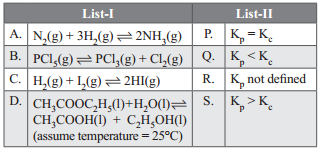
Match the List-I with List-II.
Equilibrium – NEET-9244
  1. A A-(Q); B-(S); C-(P); D-(R)
  2. B A-(P); B-(Q); C-(S); D-(R)
  3. C A-(S); B-(R); C-(P); D-(Q)
  4. D A-(R); B-(R); C-(Q); D-(P)
Show answer

Correct answer: A

13
Freshly prepared $\mathrm { Al } ( \mathrm { OH } ) _ { 3 }$ and $\mathrm { Mg } ( \mathrm { OH } ) _ { 2 }$ are stirred vigorously in a buffer solution containing $0.25 \mathrm {~M } \mathrm {~NH } _ { 4 } \mathrm { Cl }$ and $0.05 \mathrm {~M } \mathrm {~NH } _ { 4 } \mathrm { OH }$. What is the concentration of $\mathrm {~Al } ^ { + 3 }$ ions in solution?
  1. A $0.986 \times 10 ^ { - 15 } \mathrm { M }$
  2. B $1.286 \times 10 ^ { - 15 } \mathrm { M }$
  3. C $2.286 \times 10 ^ { - 15 } \mathrm { M }$
  4. D $3.286 \times 10 ^ { - 15 } \mathrm { M }$
Show answer & explanation

Correct answer: B

Given: [K$_{b}$ NH$_{4}$OH = 1.8 × 10$^{–5}$
K$_{sp}$ Al(OH)$_{3}$ = 6 × 10$^{–32}$]
p(OH) = pK$_{b}$ + log $\frac{\mathrm{[Salt]}}{\mathrm{[Base]}}$ = 4.74 + log$\frac{0.25}{0.05}$
= 5.44
[OH$^{–}$] = 3.6 × 10$^{–6}$ M
K$_{sp}$Al(OH)$_{3}$ = 6×10$^{–32}$ = [Al$^{+3}$][OH$^{–}$]$^{3}$
[Al$^{+3}$] = $\frac{6 \times 10^{-32}}{\left(3.6 \times 10^{-6}\right)^{3}}$
= 1.29 × 10$^{–15}$ M
Therefore, option (2) is the correct answer.
14
In the above reaction, identify the bronsted base of $\mathrm { H } _ { 2 } \mathrm { PO } _ { 4 } ^ { - }$and $\mathrm { H } _ { 2 } \mathrm { CO } _ { 3 }$ :
  1. A $\mathrm { HPO } _ { 4 } ^ { 2 - }$ and $\mathrm { HCO } _ { 3 } ^ { - }$.
  2. B $\mathrm { H } _ { 2 } \mathrm { CO } _ { 3 }$ and $\mathrm { HCO } _ { 3 } { } ^ { - }$.
  3. C $\mathrm { H } _ { 2 } \mathrm { PO } _ { 4 } ^ { - }$and $\mathrm { HCO } _ { 3 } ^ { - }$.
  4. D $\mathrm { H } _ { 2 } \mathrm { PO } _ { 4 } ^ { - }$and $\mathrm { H } _ { 2 } \mathrm { CO } _ { 3 }$.
Show answer

Correct answer: A

15
Consider the reactions
(i) $\mathrm { PCl } _ { 5 } ( \mathrm {~g} ) \rightleftharpoons \mathrm { PCl } _ { 3 } ( \mathrm {~g} ) + \mathrm { Cl } _ { 2 } ( \mathrm {~g} )$.
(ii) $\mathrm { N } _ { 2 } \mathrm { O } _ { 4 } ( \mathrm {~g} ) \rightleftharpoons 2 \mathrm { NO } _ { 2 } ( \mathrm {~g} )$
The addition of an inert gas at constant volume:
  1. A Will increase the dissociation of $\mathrm { PCl } _ { 5 }$ as well as $\mathrm { N } _ { 2 } \mathrm { O } _ { 4 }$
  2. B Will reduce the dissociation of $\mathrm { PCl } _ { 5 }$ as well as $\mathrm { N } _ { 2 } \mathrm { O } _ { 4 }$
  3. C Will increase the dissociation of $\mathrm { PCl } _ { 5 }$ and step up the formation of $\mathrm { NO } _ { 2 }$
  4. D Will not distrub the equilibrium of the reactions
Show answer

Correct answer: D

16
In an experiment, 100 ml of 0.1 M HCOOH solution is titrated with 0.1 M NaOH . What will be the pH after the addition of 50 mL of $\mathrm { NaOH } : \left( \mathrm { K } _ { \mathrm { a } } ( \mathrm { HCOOH } ) \right) = 2 \times 10 ^ { - 4 } \log 2 = 0.3$ )
  1. A 4.7
  2. B 3.7
  3. C 4.3
  4. D 3.3
Show answer

Correct answer: D

17
For the equilibrium,
$\mathrm { CaCO } _ { 3 } ( \mathrm {s} ) \rightleftharpoons \mathrm { CaO } ( \mathrm {s} ) + \mathrm { CO } _ { 2 } ( \mathrm {g} )$
K$_\mathrm{ p }$ is related to K $_\mathrm{ c }$ by the reaction:
  1. A $\mathrm { K } _ { \mathrm { p } } = \mathrm { K } _ { \mathrm { c } } ( \mathrm { RT } )$
  2. B $\mathrm { K } _ { \mathrm { p } } = \mathrm { K } _ { \mathrm { c } } ( \mathrm { RT } ) ^ { 2 }$
  3. C $\mathrm { K } _ { p } = \frac { \mathrm { K } _ { c } } { \mathrm { RT } }$
  4. D $\mathrm { K } _ { p } = \frac { \mathrm { K } _ { c } } { ( \mathrm { RT } ) ^ { 2 } }$
Show answer

Correct answer: A

18
On cooling of following system at equilibrium: $\mathrm { CO } _ { 2 } ( \mathrm {~s} ) \rightleftharpoons \mathrm { CO } _ { 2 } ( \mathrm {~g} )$
  1. A there is no effect on the equilibrium state.
  2. B more gas is formed.
  3. C more gas solidifies.
  4. D None of above.
Show answer

Correct answer: C

19
For the physical equilibrium, $\mathrm { H } _ { 2 } \mathrm { O } ( \mathrm { s } ) \rightleftharpoons \mathrm { H } _ { 2 } \mathrm { O } ( \mathrm { l } )$ which of the following is true?
  1. A The pressure changes do not affect the equilibrium
  2. B More of ice melts if pressure on the system is increased.
  3. C More of liquid freezes if pressure on the system is increased.
  4. D At low pressure, the nature of equilibrium changes to forward direction
Show answer

Correct answer: B

20
Which of the given solution has $\mathrm { pOH } = \mathrm { pK } _ { \mathrm { b } } \left( \mathrm { NH } _ { 3 } \right)$ ?
  1. A 10 ml of $0.1 \mathrm { M } \mathrm {~HCl } + 10 \mathrm {~ml }$ of $0.2 \mathrm {~M } \mathrm {~NH } _ { 3 }$
  2. B 10 ml of $0.1 \mathrm {~M } \mathrm {~HCl } + 20 \mathrm {~ml }$ of $0.1 \mathrm {~M } \mathrm {~NH } _ { 3 }$
  3. C 50 ml of $0.2 \mathrm {~HCl } + 20 \mathrm {~ml }$ of $1 \mathrm {~M } \mathrm {~NH } _ { 3 }$
  4. D All of the above
Show answer

Correct answer: B

Attempt this as a timed test

Reading answers is not the same as sitting the paper. Attempt it timed and you get your score, per-question timing, and the mistakes tracked for revision.

Start free

More Equilibrium tests

All Equilibrium tests →