Equilibrium — DPP 3

20 NEET questions from Equilibrium, with answers and explanations. Attempt it as a timed test to get scoring, accuracy breakdown and mistake tracking.

Attempt this test free 20 questions · 30 minutes · +80 marks
1
Predict the effect of decrease pressure on the following reaction's equilibrium.
$2 \mathrm { SO } _ { 2 } ( \mathrm {~g} ) + \mathrm { O } _ { 2 } ( \mathrm {~g} ) \rightleftharpoons 2 \mathrm { SO } _ { 3 } ( \mathrm {~g} )$
  1. A Equilibrium shift to the right
  2. B Equilibrium shift to the left
  3. C No effect on equilibrium
  4. D Reaction stops
Show answer

Correct answer: B
2
Chemical equilibrium is dynamic because:
  1. A the equilibrium attained quickly
  2. B the concentration of the reactants and products become same at equilibrium
  3. C the concentration of reactants and products are not constant but different
  4. D both forward and backward reactions occur at all time with the same speed
Show answer

Correct answer: D

3
Which one of the following is an example of physical equilibrium?
  1. A Solid ⇌ liquid
  2. B $\mathrm { N } _ { 2 } ( \mathrm {~g} ) + 3 \mathrm { H } _ { 2 } ( \mathrm {~g} ) \rightleftharpoons 2 \mathrm { NH } _ { 3 } ( \mathrm {~g} )$
  3. C $\mathrm{CaCO}_{3}(\mathrm{~s}) \rightleftharpoons \mathrm{CaO}(\mathrm{s})+\mathrm{CO}_{2}(\mathrm{~g})$
  4. D $2 \mathrm{SO}_{2}(\mathrm{~g})+\mathrm{O}_{2}(\mathrm{~g}) \rightleftharpoons 2 \mathrm{SO}_{3}(\mathrm{~g})$
Show answer

Correct answer: A

4
0.5 mole of $\mathrm { H } _ { 2 } ( \mathrm {~g} )$ and 1.0 mole allowed of $\mathrm { HI } ( \mathrm { g } )$ (but no $\mathrm { I } _ { 2 }$ ) are added to a 1.0 L vessel and allowed to reach equilibrium according to the following reaction:
$\mathrm { H } _ { 2 } + \mathrm { I } _ { 2 } \rightleftharpoons 2 \mathrm { HI } ( \mathrm { g } )$. If x is the equilibrium concentration of $\mathrm { I } _ { 2 }$, the correct equilibrium constant expression is:
  1. A $\frac { x ( 0.5 - x ) } { ( 1 + 2 x ) ^ { 2 } }$
  2. B $\frac { ( 2 - x ) ^ { 2 } } { ( 0.5 + x ) ^ { 2 } }$
  3. C $\frac { x ( 2 - x ) ^ { 2 } } { ( 0.5 - x ) ^ { 2 } }$
  4. D $\frac { ( 1 - 2 x ) ^ { 2 } } { ( 0.5 + x ) x }$
Show answer

Correct answer: D

5
Calculate the pH at the equivalence point when a solution of 0.1 M acetic acid is titrated with a solution of 0.1 M NaOH , $\mathrm { K } _ { a }$ for acid $= 2 \times 10 ^ { - 5 }$.
  1. A 5.7
  2. B 6.7
  3. C 7.7
  4. D 8.7
Show answer & explanation

Correct answer: D

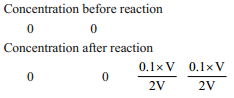
Let V mL of acid and V mL of NaOH be used concentration of both acid and NaOH are same.
$\mathrm{CH}_{3} \mathrm{COOH}+\mathrm{NaOH} \rightarrow \mathrm{CH}_{3} \mathrm{COONa}+\mathrm{H}_{2} \mathrm{O}$
Equilibrium – NEET-9214 $\left[\mathrm{CH}_{3} \mathrm{COONa}\right]=\frac{0.1}{2}=0.05 \mathrm{M}$
Now calculate pH by hydrolysis of $\mathrm{CH}_{3} \mathrm{COONa}$
$\begin{array}{l}\mathrm{CH}_{3} \mathrm{COONa}+\mathrm{H}_{2} \mathrm{O} \rightleftharpoons \mathrm{CH}_{3} \mathrm{COOH}+\mathrm{NaOH} \\ {\left[\mathrm{OH}^{-}\right]=\mathrm{C} . \mathrm{h}=\sqrt{\frac{\mathrm{K}_{\mathrm{w}} \cdot \mathrm{C}}{\mathrm{K}_{a}}}=\sqrt{\frac{10^{-14} \times 0.05}{2 \times 10^{-5}}}=5 \times 10^{-6}} \\ \mathrm{p}[\mathrm{OH}]=6 \times 0.699=5.301 \\ \mathrm{pH}=[14-5.301]=8.699 \approx 8.7\end{array}$
Therefore, option (4) is the correct answer.
6
$\mathrm { A } ( \mathrm { g } ) + \mathrm { B } ( \mathrm { g } ) \rightleftharpoons \mathrm { AB } ( \mathrm { g } )$ is a reversible reaction. At equilibrium 0.4 mole of AB is formed when each A and B are taken one mole. How much of A changes into AB ?
  1. A $20 \%$
  2. B $40 \%$
  3. C $60 \%$
  4. D $4 \%$
Show answer

Correct answer: B

7
Expression of equilibrium constant for the reaction; $2 \mathrm {A} ( \mathrm {g} ) + 2 \mathrm {~B} ( \mathrm { l } ) \rightarrow 4 \mathrm { C } ( \mathrm { s } ) + 2 \mathrm { D } ( \mathrm { g } )$ is;
  1. A $\mathrm { K } _ { \mathrm { c } } = \frac { [ \mathrm { C } ] ^ { 4 } [ \mathrm { D } ] ^ { 2 } } { [ \mathrm {~A} ] ^ { 2 } [ \mathrm {~B} ] ^ { 3 } }$
  2. B $\mathrm { K } _ { \mathrm { c } } = \frac { [ \mathrm { A } ] ^ { 2 } [ \mathrm {~B} ] ^ { 3 } } { [ \mathrm { C } ] ^ { 4 } [ \mathrm { D } ] ^ { 2 } }$
  3. C $\mathrm { K } _ { \mathrm { c } } = \frac { [ \mathrm { D } ] ^ { 2 } } { [ \mathrm {~A} ] ^ { 2 } }$
  4. D $\mathrm { K } _ { \mathrm { c } } = \frac { [ \mathrm { A } ] ^ { 2 } } { [ \mathrm { D } ] ^ { 2 } }$
Show answer

Correct answer: C

8
In the reaction $\mathrm { H } _ { 2 } ( \mathrm {g} ) + \mathrm { I } _ { 2 } ( \mathrm {g} ) \rightarrow 2 \mathrm { HI } ( \mathrm { g } )$
  1. A $\mathrm { K } _ { \mathrm { p } } = \mathrm { K } _ { \mathrm { c } }$
  2. B $\mathrm { K } _ { \mathrm { p } } \neq \mathrm { K } _ { \mathrm { c } }$
  3. C $\mathrm { K } _ { \mathrm { p } } > \mathrm { K } _ { \mathrm { c } }$
  4. D $\mathrm { K } _ { \mathrm { p } } < \mathrm { K } _ { \mathrm { c } }$
Show answer

Correct answer: A

9
In the reaction $\mathrm { NH } _ { 3 } + \mathrm { H } _ { 2 } \mathrm { O } \rightleftharpoons \mathrm { NH } _ { 4 } ^ { + } + \mathrm { OH } ^ { - }$, the conjugate acid-base pair is:
  1. A $\mathrm { NH } _ { 3 }$ and $\mathrm { H } _ { 2 } \mathrm { O }$
  2. B $\mathrm { H } _ { 2 } \mathrm { O }$ and $\mathrm { OH } ^ { - }$
  3. C $\mathrm { H } _ { 2 } \mathrm { O }$ and $\mathrm { NH } _ { 4 } ^ { + }$
  4. D $\mathrm { NH } _ { 4 } ^ { + }$and $\mathrm { OH } ^ { - }$
Show answer

Correct answer: B

10
$\mathrm { K } _ { \mathrm { p } }$ for the reaction
$\mathrm { CaCO } _ { 3 } ( \mathrm {s} ) \rightleftharpoons \mathrm { CaO } ( \mathrm { s } ) + \mathrm { CO } _ { 2 } ( \mathrm {g} )$ is correctly expressed as:
  1. A $\mathrm{K}_{\mathrm{P}}=\frac{\mathrm{P}_{\mathrm{CaO}} \times \mathrm{P}_{\mathrm{CO}_{2}}}{\mathrm{P}_{\mathrm{CaCO}_{3}}}$
  2. B $\mathrm{K}_{\mathrm{P}}=\frac{\mathrm{P}_{\mathrm{CaCO}_{3}}}{\mathrm{P}_{\mathrm{CaO}} \cdot \mathrm{P}_{\mathrm{CO}_{2}}}$
  3. C $\mathrm{K}_{\mathrm{P}}=\mathrm{P}_{\mathrm{CO}_{2}}$
  4. D $\mathrm{K}_{\mathrm{P}}=\frac{\mathrm{P}_{\mathrm{CO}_{2}}}{\mathrm{P}_{\mathrm{CaCO}_{3}}}$
Show answer

Correct answer: C

11
Equilibrium constant for the reaction:
$2 \mathrm { NO } ( \mathrm { g } ) + \mathrm { Cl } _ { 2 } ( \mathrm {g} ) \rightleftharpoons 2 \mathrm { NOCl } ( \mathrm { g } )$
is correctly given by the expression:
  1. A $\mathrm { K } = \frac { [ 2 \mathrm { NOCl } ] } { [ 2 \mathrm { NO } ] \left[ \mathrm { Cl } _ { 2 } \right] }$
  2. B $\mathrm { K } = \frac { [ 2 \mathrm { NOCl } ] ^ { 2 } } { [ \mathrm { NO } ] ^ { 2 } \left[ \mathrm { Cl } _ { 2 } \right] }$
  3. C $\mathrm { K } = \frac { [ \mathrm { NOCl } ] ^ { 2 } } { [ 2 \mathrm { NO } ] ^ { 2 } \left[ \mathrm { Cl } _ { 2 } \right] }$
  4. D $\mathrm { K } = \frac { [ \mathrm { NOCl } ] ^ { 2 } } { \left[ \mathrm { NO } ^ { 2 } \left[ \mathrm { Cl } _ { 2 } \right] \right. }$
Show answer

Correct answer: D

12
The unit of equilibrium constant $\left( \mathrm { K } _ { \mathrm { c } } \right)$ in general is:
  1. A (Mole / L)
  2. B (L/ Mole)
  3. C $( \text { Mole } / \mathrm { L } ) ^ { \Delta n }$
  4. D $( \mathrm { L } / \mathrm { Mol } ) ^ { \mathrm { An } }$
Show answer

Correct answer: C

13
The reaction $\mathrm { CaCO } _ { 3 } ( \mathrm {s} ) \rightleftharpoons \mathrm { CaO } ( \mathrm { s } ) + \mathrm { CO } _ { 2 } ( \mathrm {g} )$ goes to completion in lime kiln because of the:
  1. A high temperature
  2. B CaO is more stable than the $\mathrm { CaCO } _ { 3 }$
  3. C CaO is not dissociated
  4. D $\mathrm { CO } _ { 2 }$ escapes continuously
Show answer

Correct answer: D

14
The following statement is incorrect about chemical equilibrium:
  1. A there is no change in the concentrations of reactants and products with time
  2. B equilibrium can be attained by starting with either reactants or products
  3. C equilibrium is dynamic
  4. D position of equilibrium cannot be disturbed by changing the concentrations of reactants or products
Show answer

Correct answer: D

15
At constant temperature, the equilibrium constant $\left( \mathrm { K } _ { \mathrm { p } } \right)$ for the decomposition $\mathrm { N } _ { 2 } \mathrm { O } _ { 4 } ( \mathrm {~g} ) \rightleftharpoons 2 \mathrm { NO } _ { 2 } ( \mathrm {~g} )$ is expressed by,
$K _ { p } = \frac { \left( 4 x ^ { 2 } P \right) } { \left( 1 - x ^ { 2 } \right) }$
where $\mathrm { P } =$ pressure, $\mathrm { x } =$ extent of decomposition. Which of the following statements is true?
  1. A $\mathrm { K } _ { \mathrm { p } }$ increases with increase of P
  2. B $\mathrm { K } _ { p }$ increases with increase of $x$
  3. C $\mathrm { K } _ { p }$ increase with decrease of $x$
  4. D $\mathrm { K } _ { \mathrm { p } }$ remains constant with change in P or x
Show answer

Correct answer: D

16
The value of $\mathrm { K } _ { \mathrm { c } }$ for the reaction $\mathrm { N } _ { 2 } ( \mathrm {g} ) + 3 \mathrm { H } _ { 2 } ( \mathrm {g} ) \rightleftharpoons 2 \mathrm { NH } _ { 3 } ( \mathrm {g} )$ depends on:
  1. A temperature
  2. B pressure
  3. C collision
  4. D atomic number
Show answer

Correct answer: A

17
For reactions involving gaseous reactants and products the equilibrium constant $\mathrm { K } _ { \mathrm { p } }$ is written in terms of:
  1. A the mass gases.
  2. B the molar volumes of the gases.
  3. C the partial pressures of the gases.
  4. D the mole fraction of the gases.
Show answer

Correct answer: C

18
At $600 ^ { \circ } \mathrm { C } , \mathrm { K } _ { \mathrm { p } }$ for the following reaction is 1 atm , $\mathrm { X } ( \mathrm { g } ) \rightleftharpoons \mathrm { Y } ( \mathrm { g } ) + \mathrm { Z } ( \mathrm { g } )$ at equilibrium, $50 \%$ of $\mathrm { X } ( \mathrm { g } )$ is dissociate(d) The total pressure of the equilibrium system is P atm . What is the partial pressure (in atm ) of $\mathrm { X } ( \mathrm { g } )$ at equilibrium?
  1. A 1
  2. B 4
  3. C 2
  4. D 0.5
Show answer

Correct answer: A

19
Directions: These questions consist of two statements each, printed as Assertion (A) and Reason (R). While answering these questions, you are required to choose any one of the following four responses.

Assertion (A): For any chemical reaction at a particular temperature, the equilibrium constant is fixed and is a characteristic property.
Reason (R): Equilibrium constant is independent of temperature
  1. A If both Assertion (A) and Reason (R) are True and the Reason (R) is a correct explanation of the Assertion (A).
  2. B If both Assertion (A) and Reason (R) are True but Reason (R) is not a correct explanation of the Assertion (A).
  3. C If Assertion (A) is True but the Reason (R) is False.
  4. D If Assertion (A) is False but Reason (R) is True.
Show answer

Correct answer: C

20
The equilibrium constant $\left( \mathrm { K } _ { \mathrm { c } } \right)$ of the reaction:
$2 \mathrm { SO } _ { 2 } ( \mathrm {g} ) + \mathrm { O } _ { 2 } ( \mathrm {g} ) \rightleftharpoons 2 \mathrm { SO } _ { 3 } ( \mathrm {g} )$
when the reaction is conducted in a 1 L vessel was found to be $2.5 \times 10 ^ { - 3 }$. If the reaction is conducted at the same temperature in a 2 L vessel then the value of $\mathrm { K } _ { \mathrm { c } }$ is:
  1. A $6.25 \times 10 ^ { - 4 }$
  2. B $1.25 \times 10 ^ { - 3 }$
  3. C 2.5 × 10$^{–3}$
  4. D 5 × 10$^{–3}$
Show answer

Correct answer: C

Attempt this as a timed test

Reading answers is not the same as sitting the paper. Attempt it timed and you get your score, per-question timing, and the mistakes tracked for revision.

Start free

More Equilibrium tests

All Equilibrium tests →