Hydrocarbons — DPP 2

20 NEET questions from Hydrocarbons, with answers and explanations. Attempt it as a timed test to get scoring, accuracy breakdown and mistake tracking.

Attempt this test free 20 questions · 30 minutes · +80 marks
1
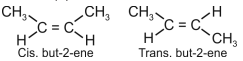
Which of the following shows geometrical isomerism?
  1. A But-1-ene
  2. B But-2-ene
  3. C Prop-1-ene
  4. D Pent-1-ene
Show answer & explanation

Correct answer: B
Hydrocarbons – NEET-14563
2
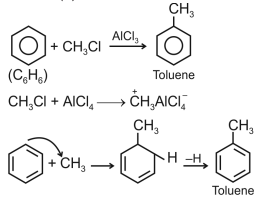
$\mathrm { C } _ { 6 } \mathrm { H } _ { 6 } + \mathrm { Z } \xrightarrow { \mathrm { AlCl } _ { 3 } }$ Toluene, Z is
  1. A Acetic acid
  2. B Acetic anhydride
  3. C Acetone
  4. D Chloromethane
Show answer & explanation

Correct answer: D

Hydrocarbons – NEET-14614
3
$\mathrm { CH } _ { 3 } - \mathrm { CH } = \mathrm { CH } - \mathrm { CH } _ { 2 } - \mathrm { CH } _ { 3 } \xrightarrow { \mathrm { HI } } ( \mathrm { A } )$; Major Compound (A) is
  1. A
  2. B
  3. C
  4. D
Show answer & explanation

Correct answer: B

Hydrocarbons – NEET-14562 Carbocation (I) is more stable than carbocation II because I has more number of hyperconjugating structures.

4
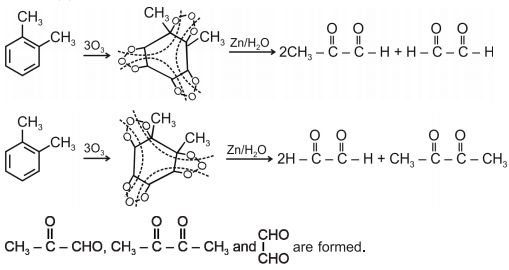
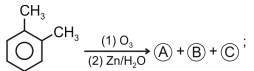
Hydrocarbons – NEET-14496 Which one is not (A), (B), (C)?
  1. A
  2. B CH$_{2}$O
  3. C
  4. D CH$_{3}$CHO
Show answer & explanation

Correct answer: D

Ozonolysis of alkene results in oxidative cleavage
Hydrocarbons – NEET-14496 Hence $\mathrm{CH}_{3} \mathrm{CHO}$ is not formed.

5
In an attempt to prepare propane by Wurtz reaction 1 mole of methyl bromide and 1 mole of ethyl bromide are treated with sodium. Assuming equal probability for all possible reaction. How many grams of propane will be obtained?
  1. A 44 g
  2. B 22 g
  3. C 33 g
  4. D 14.67 g
Show answer & explanation

Correct answer: D

The possible reactions are
(i) $\mathrm{CH}_{3} \mathrm{Br}+2 \mathrm{Na}+\mathrm{CH}_{3} \mathrm{Br} \rightarrow \mathrm{CH}_{3}-\mathrm{CH}_{3}+2 \mathrm{NaBr}$
(ii) $\mathrm{CH}_{3} \mathrm{Br}+2 \mathrm{Na}+\mathrm{CH}_{3} \mathrm{CH}_{2} \mathrm{Br} \rightarrow \mathrm{CH}_{3} \mathrm{CH}_{2} \mathrm{CH}_{3}+2 \mathrm{NaBr}$
(iii) $\mathrm{CH}_{3} \mathrm{CH}_{2} \mathrm{Br}+2 \mathrm{Na}+\mathrm{CH}_{3} \mathrm{CH}_{2} \mathrm{Br} \rightarrow \mathrm{CH}_{3}-\mathrm{CH}_{2}-\mathrm{CH}_{2}-\mathrm{CH}_{3}+2 \mathrm{NaBr}$
1 mol of $\mathrm{CH}_{3} \mathrm{CH}_{2} \mathrm{CH}_{3}$ weight $=44 \mathrm{~g}$
Grams of $\mathrm{CH}_{3} \mathrm{CH}_{2} \mathrm{CH}_{3}$ obtained $=\frac{44}{3}$
$=14.67 \mathrm{~g}$
Since 3 reactions of possible, the probability of formation of propane is $\frac{1}{3}$ and mass of propane obtained is $\frac{1}{3}$ of mass of mass of 1 mol of propane i.e, 14.67 g
6
The catalyst used to reduce an alkyne to alkene is
  1. A Raney Nickel
  2. B Palladium
  3. C Lindlar's catalyst
  4. D Iron
Show answer & explanation

Correct answer: C

Lindlar's catalyst is palladium deposited on $\mathrm{CaCO}_{3} / \mathrm{BaSO}_{4}$ which is poisoned with lead or sulpher compounds. It is used for the hydrogenation of alkyne to alkene in suitable solvent.
$\underset{\text { Alkyne }}{\mathrm{R}-\mathrm{C} \equiv \mathrm{CH}} \xrightarrow[\text { Lindlar's catalyst }]{\mathrm{H}, \mathrm{Pd}-\mathrm{BaSO}} \mathrm{R}-\underset{\text { Alkene }}{\mathrm{CH}}=\mathrm{CH}_{2}$
7
Baeyer's reagent is
  1. A 1% Alkaline $\mathrm { KMnO } _ { 4 }$
  2. B Acidic $\mathrm { KMnO } _ { 4 }$
  3. C Neutral $\mathrm { KMnO } _ { 4 }$
  4. D Aq. $\mathrm { Br } _ { 2 }$, solution
Show answer & explanation

Correct answer: A

$1 \%$ alkaline solution of $\mathrm{KMnO}_{4}$ is known as Baeyer's reagent.
8
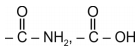
Which one is not prepared by Wurtz reaction?
  1. A $\mathrm { C } _ { 2 } \mathrm { H } _ { 6 }$
  2. B $n - \mathrm { C } _ { 4 } \mathrm { H } _ { 10 }$
  3. C $\mathrm { CH } _ { 4 }$
  4. D
Show answer & explanation

Correct answer: C

In Wurtz reaction the simplest alkane which can be prepared is $\mathrm{C}_{2} \mathrm{H}_{6}$, and it gives product with even number of carbon atoms
$\mathrm{CH}_{3} \mathrm{Br}+2 \mathrm{Na}+\mathrm{BrCH}_{3} \xrightarrow{\text { dryether }} \underset{\text { ethane }}{\mathrm{CH}_{3}-\mathrm{CH}_{3}+2 \mathrm{NaBr}}$
9
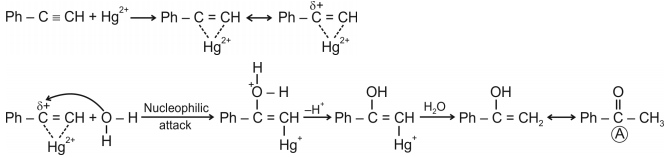
Hydrocarbons – NEET-14579 Addition of $\mathrm { H } _ { 2 } \mathrm { O }$ in the reaction is an example of
  1. A Electrophilic addition
  2. B Nucleophilic addition
  3. C Free radical addition
  4. D Electrophilic substitution
Show answer & explanation

Correct answer: B

Hydrocarbons – NEET-14579
10
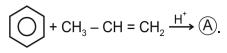
Hydrocarbons – NEET-14630
Compound " A " is
  1. A Isopropyl benzene
  2. B Cumene
  3. C An alkyl derivative of benzene
  4. D All of these
Show answer & explanation

Correct answer: D

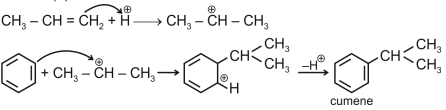
Hydrocarbons – NEET-14630 cumene is also known as isopropyl benzene which is an alkyl benzene.
11
Hydrocarbons – NEET-14529 (A), (B) and (C) can be
  1. A
  2. B
  3. C
  4. D All of these
Show answer & explanation

Correct answer: D

Hydrocarbons – NEET-14529
12
The incorrect match is
  1. A
  2. B
  3. C
  4. D
Show answer & explanation

Correct answer: B

This compound is aromatic because it satisfies all the necessary conditions for aromaticity. These are $6 \pi$ electrons $(4 \pi+2 \pi$ electrons $)$ planar structure, all carbons are sp$^{2}$ hybridized and also the B atom is sp$^{2}$ hybrid and shows cyclic delocalization of electrons.
13
Which one is o, p-directing group for electrophilic substitution reaction?
  1. A
  2. B
  3. C
  4. D $- \mathrm { NO } _ { 2 }$
Show answer & explanation

Correct answer: C

$-\mathrm{N}\left(\mathrm{CH}_{3}\right)_{2}$ is an electron donation group. It is an ortho and para directing group for electrophilic substitution reaction.
Hydrocarbons – NEET-14654 and $-\mathrm{NO}_{2}$ are electron withdrawing group. They are meta directing group for electrophilic substitution reaction.
14
A mixture of $\mathrm{C}_{2} \mathrm{H}_{6}, \mathrm{C}_{2} \mathrm{H}_{4}$ and $\mathrm{C}_{2} \mathrm{H}_{2}$ is bubbled through alkaline solution of copper(I)chloride, contained in Woulf's bottle.The gas coming out is
  1. A Original mixture
  2. B $\mathrm{C}_{2} \mathrm{H}_{6}$
  3. C $\mathrm{C}_{2} \mathrm{H}_{6}$ and $\mathrm{C}_{2} \mathrm{H}_{4}$ mixture
  4. D $\mathrm{C}_{2} \mathrm{H}_{4}$ and $\mathrm{C}_{2} \mathrm{H}_{2}$
Show answer & explanation

Correct answer: C

Out of $\mathrm{C}_{2} \mathrm{H}_{6}, \mathrm{C}_{2} \mathrm{H}_{4}$ and $\mathrm{C}_{2} \mathrm{H}_{2}, \mathrm{C}_{2} \mathrm{H}_{2}$ will react with alkaline $\mathrm{Cu}_{2} \mathrm{Cl}_{2}$. Therefore only $\mathrm{C}_{2} \mathrm{H}_{6}$ and $\mathrm{C}_{2} \mathrm{H}_{4}$ will come out of the bottle.
$\mathrm{CH} \equiv \mathrm{CH}+\mathrm{Cu}_{2} \mathrm{Cl}_{2} \xrightarrow[\mathrm{NH}_{4} \mathrm{OH}]{\text { alkaline }} \mathrm{C}_{2} \mathrm{Cu}_{2}+2 \mathrm{NH}_{4} \mathrm{Cl}+2 \mathrm{H}_{2} \mathrm{O}$
15
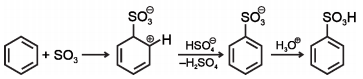
In sulphonation of benzene; electrophilic reagent used is
  1. A $\stackrel { \oplus } { \mathrm { S O} } _ { 3 } \mathrm { H }$
  2. B $\mathrm { SO } _ { 3 }$
  3. C
  4. D
Show answer & explanation

Correct answer: B

$\mathrm{H}_{2} \mathrm{SO}_{4}+\mathrm{H}_{2} \mathrm{SO}_{4} \rightarrow \mathrm{H}_{3}^{\oplus} \mathrm{O}+\mathrm{HSO}_{4}^{\ominus}+\mathrm{SO}_{3}$
Hydrocarbons – NEET-14631
16
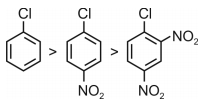
In chlorobenzene, 2,4-dinitrochlorobenzene p-nitrochlorobenzene. The decreasing order of reactivity towards electrophilic substitution reaction is
(I) chlorobenzene
(II) 2,4-dinitrochlorobenzene
(III) p-nitrochlorobenzene
  1. A (I) $>$ (II) $>$ (III)
  2. B (I) $>$ (III) $>$ (II)
  3. C (II) $>$ (I) $>$ (III)
  4. D (III) $> ($ I $) > ($ II $)$
Show answer & explanation

Correct answer: B

Reactivity
Hydrocarbons – NEET-14659 $-\mathrm{NO}_{2}$ group is an electron withdrawing group and its decreases the electron density on benzene ring due to its -R and -I effect. Since chlorobenzene does not contain nitro group it is most reactive towards electrophilic substitution, since p-nitrochlorobenzene contains only one nitro group, it is more reactive towards electrophilic substitution reaction as compared to 2, 4-dinitrochlorobenzene.
17
Which one is not aromatic compound?
  1. A
  2. B
  3. C
  4. D
Show answer & explanation

Correct answer: D

Cyclopentadienyl cation is not aromatic because it contains $4 n \pi$ electron where $n=1$. Infact cyclopentadienyl cation is an anti-aromatic cation.
18
Hydrocarbons – NEET-14566 Compound B is
  1. A C$_{2}$H$_{6}$
  2. B CH₄
  3. C $\mathrm { CH } _ { 3 } \mathrm { COOH }$
  4. D $\mathrm { CH } _ { 3 } \mathrm { COONa }$
Show answer & explanation

Correct answer: B

Hydrocarbons – NEET-14566
19
The difference in potential energy between eclipsed and staggered form of ethane is
  1. A $4 \mathrm {~kJ} / \mathrm { mol }$
  2. B $12.55 \mathrm {~kJ} / \mathrm { mol }$
  3. C $2 \mathrm {~kJ} / \mathrm { mol }$
  4. D $44 \mathrm {~kJ} / \mathrm { mol }$
Show answer & explanation

Correct answer: B

The energy difference between the eclipsed and staggered term of ethane is 12.55 kJ/mol
20
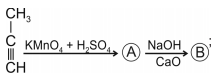
$\mathrm { Mg } _ { 2 } \mathrm { C } _ { 3 } + \mathrm { H } _ { 2 } \mathrm { O } \rightarrow ( \mathrm {~A} ) \xrightarrow { \mathrm { Na } } ( \mathrm {~B} ) \xrightarrow { \mathrm { CH } _ { 3 } \mathrm { Br } } ( \mathrm { C } ) ;$ The incorrect statement for C is
  1. A Compound (C) is $\mathrm { CH } _ { 3 } - \mathrm { C }$
  2. B (C) gives positive Tollens test
  3. C In compound (C) all four carbon are linearly
  4. D Compound (C) on ozonolysis gives diketone
Show answer & explanation

Correct answer: B

Hydrocarbons – NEET-14565 Since compound (C) is not a terminal alkyne and does not contain acidic H.

Attempt this as a timed test

Reading answers is not the same as sitting the paper. Attempt it timed and you get your score, per-question timing, and the mistakes tracked for revision.

Start free

More Hydrocarbons tests

All Hydrocarbons tests →