Hydrocarbons — DPP 3

20 NEET questions from Hydrocarbons, with answers and explanations. Attempt it as a timed test to get scoring, accuracy breakdown and mistake tracking.

Attempt this test free 20 questions · 30 minutes · +80 marks
1
$\mathrm { CH } _ { 2 } = \mathrm { CH } _ { 2 } + \mathrm { Br } _ { 2 } \xrightarrow { \mathrm { CCl } _ { 4 } } \text { Product (A). }$
  1. A 1,2-Dibromoethane
  2. B 1-Bromoethane
  3. C 1,1,2-Tribromoethane
  4. D 1,1,2,2-Tetrabromoethane
Show answer & explanation

Correct answer: A

Vicinal dibromide is obtained.
2
Which of the following does not act as an oxidising agent?
  1. A $\mathrm { Mo } _ { 2 } \mathrm { O } _ { 3 }$
  2. B $\left( \mathrm { CH } _ { 3 } \mathrm { COO } \right) _ { 2 } \mathrm { Mn }$
  3. C $\mathrm { KMnO } _ { 4 }$
  4. D $\mathrm { LiAlH } _ { 4 }$
Show answer & explanation

Correct answer: D

$\mathrm{LiAlH}_{4}$ behaves as reducing agent.
3
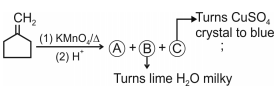
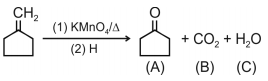
Hydrocarbons – NEET-14480 Compound (A), (B) and (C) are respectivelyCompound (A), (B) and (C) are respectively
  1. A
  2. B
  3. C
  4. D
Show answer & explanation

Correct answer: B

Hydrocarbons – NEET-14480 $\mathrm{CO}_{2}$ turns lime water milky and $\mathrm{H}_{2} \mathrm{O}$ turns $\mathrm{CuSO}_{4}$ crystals to blue due to formation of hydrated salt.

4
Reductive ozonolysis of 2-methylpropene gives
  1. A Acetone and Ethanal
  2. B Ethanal and Ethanol
  3. C Methanal and Acetone
  4. D Methanal and Ethanal
Show answer & explanation

Correct answer: C

Hydrocarbons – NEET-14732
5
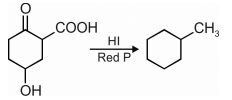
In the given reaction
Hydrocarbons – NEET-14737 The number of moles of HI required for conversion is

  1. A 12
  2. B 8
  3. C 14
  4. D 10
Show answer & explanation

Correct answer: A

$\mathrm{R}-\mathrm{OH}+2 \mathrm{HI} \longrightarrow \mathrm{RH}+\mathrm{I}_{2}+\mathrm{H}_{2} \mathrm{O}$
Hydrocarbons – NEET-14737 $\mathrm{R}-\mathrm{COOH}+6 \mathrm{HI} \longrightarrow \mathrm{R}-\mathrm{CH}_{3}+2 \mathrm{H}_{2} \mathrm{O}+3 \mathrm{I}_{2}$
6
The number of carbon atoms in the alkane obtained by the electrolysis of aqueous solution of sodium salt of ethanoic acid is
  1. A 8
  2. B 2
  3. C 6
  4. D 4
Show answer & explanation

Correct answer: B

$2 \mathrm{CH}_{3} \mathrm{COO}^{-} \mathrm{Na}^{+}+2 \mathrm{H}_{2} \mathrm{O} \xrightarrow{\text { Electrolysis }} \mathrm{CH}_{3}-\mathrm{CH}_{3}+2 \mathrm{CO}_{2}+\mathrm{H}_{2}+2 \mathrm{NaOH}$
7
Which of the following is aromatic in nature?
  1. A
  2. B
  3. C
  4. D All of these
Show answer & explanation

Correct answer: D

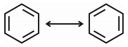
Hydrocarbons – NEET-14663 Contain 4(0) + 2 = 2π electrons

Hydrocarbons – NEET-14663 Contain 4 × 1 + 2 = 6π electrons

Hydrocarbons – NEET-14663 Contain 4 × 1 + 2 = 6π electrons
All are aromatic


8
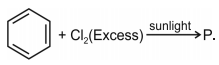
Hydrocarbons – NEET-14716 Product P is
  1. A $\mathrm { C } _ { 6 } \mathrm { H } _ { 5 } \mathrm { Cl }$
  2. B $\mathrm { C } _ { 6 } \mathrm { H } _ { 3 } \mathrm { Cl } _ { 3 }$
  3. C $\mathrm { C } _ { 6 } \mathrm { Cl } _ { 3 }$
  4. D $\mathrm { C } _ { 6 } \mathrm { H } _ { 6 } \mathrm { Cl } _ { 6 }$
Show answer & explanation

Correct answer: D

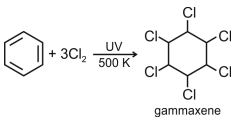
Hydrocarbons – NEET-14716
9
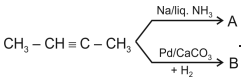
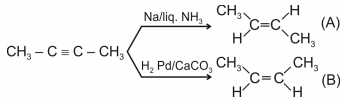
Hydrocarbons – NEET-14713 Products A and B respectively are
  1. A Trans-2-butene and cis-2-butene
  2. B Cis-2-butene and trans-2-butene
  3. C Both cis-2-butene
  4. D Both trans-2-butene
Show answer & explanation

Correct answer: A

Hydrocarbons – NEET-14713
10
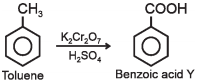
Toluene $\xrightarrow [ \mathrm { H } _ { 2 } \mathrm { SO } _ { 4 } ] { \mathrm { K } _ { 2 } \mathrm { Cr } _ { 2 } \mathrm { O } _ { 7 } } \mathrm { Y }$. Here Y is
  1. A Benzaldehyde
  2. B Toluene
  3. C Benzoic acid
  4. D Ethylbenzene
Show answer & explanation

Correct answer: C

Hydrocarbons – NEET-14593 Acidified $\mathrm{K}_{2} \mathrm{Cr}_{2} \mathrm{O}_{7}$ is an strong oxidizing agent and its oxidizes $-\mathrm{CH}_{3}$ group of toluene to -COOH group
11
The group which is most activating is
  1. A $- \mathrm { NO } _ { 2 }$
  2. B $- \mathrm { OCH } _ { 3 }$
  3. C $- \mathrm { NH } _ { 2 }$
  4. D - OH
Show answer & explanation

Correct answer: C

Among the given +R effect is maximum for $-\mathrm{NH}_{2}$ group
12
Consider the given reaction.
$2 \mathrm{CH}_{3}-\mathrm{CH}_{3}+3 \mathrm{O}_{2} \xrightarrow[\Delta]{\mathrm{Mn}\left(\mathrm{CH}_{3} \mathrm{COO}\right)_{2}} 2 \mathrm{X}+2 \mathrm{H}_{2} \mathrm{O} .$ Product X is
  1. A $\mathrm{CH}_{3} \mathrm{CHO}$
  2. B $\mathrm{CH}_{3} \mathrm{CH}_{2} \mathrm{OH}$
  3. C $\mathrm{CH}_{3} \mathrm{COOH}$
  4. D $\mathrm{CH}_{3}-\mathrm{CH}_{2}-\mathrm{O}-\mathrm{CH}_{2}-\mathrm{CH}_{3}$
Show answer & explanation

Correct answer: C

Higher alkanes are oxidised to carboxylic acid in presence of manganese acetate.
13
The most stable conformation of n-butane is
  1. A
  2. B
  3. C
  4. D
Show answer & explanation

Correct answer: D

Anti conformer is most stable for n-butane.
14
Benzene undergoes substitution reaction more easily than addition because
  1. A It has a cyclic structure
  2. B It has three double bonds
  3. C Of delocalization of $\pi$-electrons
  4. D It has six hydrogen atoms
Show answer & explanation

Correct answer: C

Benzene consist of sp$^{2}$ hybridized carbon atoms whose $\pi$-charge cloud is delocalized over the ring.
Hydrocarbons – NEET-14617 Because of the high stability of benzene due to aromaticity, it does not show addition reaction but since it contain electron charge cloud, it shows electrophilic substitution reaction.
15
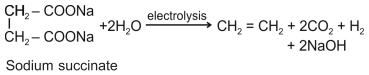
On electrolysis of sodium succinate, the alkene obtained is $\_\_\_\_$ and nature of solution after electrolysis is $\_\_\_\_$ .
  1. A acidic
  2. B basic
  3. C acidic
  4. D basic
Show answer & explanation

Correct answer: B

Hydrocarbons – NEET-14568 The hydrocarbon formed is ethene and solution is basic due to the formation of NaOH.

16
In which of the following reactions Markownikov's rule is not observed?
  1. A $\mathrm{CH}_{3} \mathrm{CH}=\mathrm{CH}_{2}+\mathrm{HCl} \longrightarrow$
  2. B $\mathrm { CH } _ { 3 } \mathrm { CH } = \mathrm { CH } _ { 2 } + \mathrm { HBr } \xrightarrow { \text { organic peroxide, } \mathrm { hv } }$
  3. C $\mathrm { CH } _ { 3 } \mathrm { CH } = \mathrm { CH } _ { 2 } + \mathrm { HBr } \xrightarrow { \mathrm { H } _ { 2 } \mathrm { O } _ { 2 } , \mathrm { hv } }$
  4. D Both (B) & (C)
Show answer & explanation

Correct answer: D

Markovnikov's rule is not followed when free radical addition of HBr takes place to an unsymmetrical alkene
Hydrocarbons – NEET-14530 Both these reactions follow free radical mechanism and hence Markovnikov's addition is not observed.
17
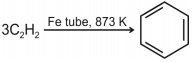
Alkyne $X$ which when passes through hot iron tube at 873 K forms Benzene. Alkyne X is
  1. A Butyne
  2. B Propyne
  3. C Acetylene
  4. D Pentyne
Show answer & explanation

Correct answer: C

Hydrocarbons – NEET-14711
18
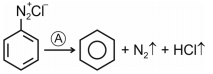
Hydrocarbons – NEET-14628 Compound " A " is
  1. A $\mathrm { H } _ { 3 } \mathrm { PO } _ { 2 }$
  2. B $\mathrm { H } _ { 3 } \mathrm { PO } _ { 3 }$
  3. C $\mathrm { H } _ { 3 } \mathrm { PO } _ { 4 }$
  4. D Both (A) & (B)
Show answer & explanation

Correct answer: D

Both $\mathrm{H}_{3} \mathrm{PO}_{2}$ and $\mathrm{H}_{3} \mathrm{PO}_{3}$ can be used to convert benzene diazonium chloride to benzene.
19
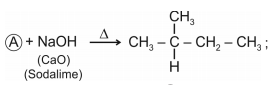
Hydrocarbons – NEET-14198 The possible compound (A) is
  1. A
  2. B
  3. C
  4. D Both (B) & (C)
Show answer & explanation

Correct answer: D

Hydrocarbons – NEET-14198
20
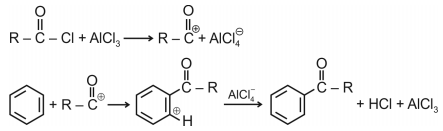
The electrophile which attacks in Friedel-Craft acylation is
  1. A
  2. B
  3. C
  4. D Both (A) and (C)
Show answer & explanation

Correct answer: A

Hydrocarbons – NEET-14660

Attempt this as a timed test

Reading answers is not the same as sitting the paper. Attempt it timed and you get your score, per-question timing, and the mistakes tracked for revision.

Start free

More Hydrocarbons tests

All Hydrocarbons tests →