p- Block Elements — DPP 1

20 NEET questions from p- Block Elements, with answers and explanations. Attempt it as a timed test to get scoring, accuracy breakdown and mistake tracking.

Attempt this test free 20 questions · 30 minutes · +80 marks
1
Alane is chemically -
  1. A $\mathrm { AlH } _ { 3 }$
  2. B $\left( \mathrm { AlH } _ { 3 } \right) _ { \mathrm { n } }$
  3. C LiAlH$ _ { 4 }$
  4. D None
Show answer & explanation

Correct answer: B

Alane is polymer of (AlH$_{3}$) n chemical name of (AlH$_{3}$)$^{n}$
2
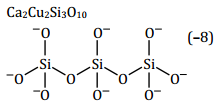
The silicate anion in the mineral kinoite is a chain of three $\mathrm { SiO } _ { 4 } { } ^ { - 4 }$ tetrahedra, that share corners with adjacent tetrahedra. The charge of the silicate anion is
  1. A - 4
  2. B - 8
  3. C - 6
  4. D - 2
Show answer & explanation

Correct answer: B

In Kinonite 3SiO$_{4}$$^{−4}$ is attached
p- Block Elements – NEET-10693
3
Which is partially hydrolysied :
  1. A $\mathrm { PCl } _ { 3 }$
  2. B $\mathrm { NCl } _ { 3 }$
  3. C $\mathrm { AsCl } _ { 3 }$
  4. D $\mathrm { SbCl } _ { 3 }$
Show answer & explanation

Correct answer: D

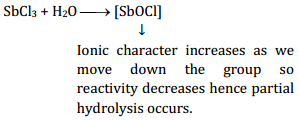
Partial hydrolysis occurs in
p- Block Elements – NEET-10685
4
Aluminium is not acted upon by pure water as-
  1. A Impurities in water are essential for the reaction to occur
  2. B It is light metal
  3. C It is protected by a film of aluminium oxide
  4. D It is not a reactive metal
Show answer & explanation

Correct answer: C

Aluminium is protected by a film of Aluminium oxide (Al$_{2}$O$_{3}$) this layer protect Aluminium from acid attack & water attack.
5
Red and yellow phosphorus are:
  1. A Allotropes
  2. B Isobars
  3. C Isomers
  4. D Isotopes
Show answer & explanation

Correct answer: A

Red & Yellow phosphorous are allotropes of phosphorous.
6
Potash alum is a double salt made up of two salts:
  1. A Salt of a (SA + WB) + Salt of a (WA + WB)
  2. B Salt of a (SA + SB) + Salt of a (SA + WB)
  3. C Salt of a (SA + SB) + Salt of a (WA + WB)
  4. D Salt of a (SA + WB) + Salt of a (WA + WB)
Show answer & explanation

Correct answer: B

Double salt is made up of 2 salts
(SA + SB) + (SA + WB)
7
In which of the following compounds, observed bond angle is found to be greater than expected, but not due to back bonding
  1. A $\mathrm { N } \left( \mathrm { SiH } _ { 3 } \right) _ { 3 }$
  2. B $\mathrm { O } \left( \mathrm { CH } _ { 3 } \right) _ { 2 }$
  3. C $\mathrm { O } \left( \mathrm { SiH } _ { 3 } \right) _ { 2 }$
  4. D All of these
Show answer & explanation

Correct answer: B

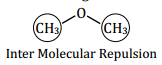
In N(SiH$_{3}$)$_{3}$ back bonding occurs same in O(SiH$_{3}$)$_{2}$ but in O(CH$_{3}$)$_{2}$ No vacant orbital is there so No back bonding and bond angle increases due to large size of side molecule.
p- Block Elements – NEET-10682
8
Which of the following molecule is having complete octet
  1. A $\mathrm { BeCl } _ { 2 }$ (dimer)
  2. B $\mathrm { BeH } _ { 2 }$ (dimer)
  3. C $\mathrm { BeH } _ { 2 } ( \mathrm {~s} )$
  4. D $\mathrm { BeCl } _ { 2 } ( \mathrm {~s} )$
Show answer & explanation

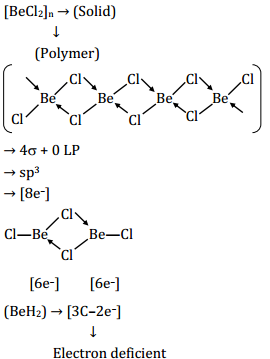
Correct answer: D

p- Block Elements – NEET-10688
9
In which of the following dimer empty atomic orbital of central atom of monomer does not involve in hybridisation?
  1. A $\mathrm { Ga } _ { 2 } \mathrm { H } _ { 6 }$
  2. B $\mathrm { Al } _ { 2 } \mathrm { Br } _ { 6 }$
  3. C $\mathrm { Be } _ { 2 } \mathrm { H } _ { 4 }$
  4. D $\mathrm { Cl } _ { 2 } \mathrm { O } _ { 6 }$
Show answer & explanation

Correct answer: D

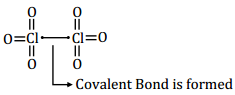
In the formation of Cl$_{2}$O$_{6}$ from ClO$_{3}$
p- Block Elements – NEET-10687 So covalent bond is formed by half-filled orbital no empty atomic orbital in volved.
10
The product formed in the reaction,
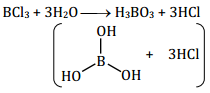
$\mathrm { BCl } _ { 3 } + \mathrm { H } _ { 2 } \mathrm { O } \longrightarrow$ Product is -
  1. A $\mathrm { H } _ { 3 } \mathrm { BO } _ { 3 } + \mathrm { HCl }$
  2. B $\mathrm { B } _ { 2 } \mathrm { O } _ { 3 } + \mathrm { HOCl }$
  3. C $\mathrm { B } _ { 2 } \mathrm { H } _ { 6 } + \mathrm { HCl }$
  4. D No reaction
Show answer & explanation

Correct answer: A

p- Block Elements – NEET-10683
11
Which of the following is an organo silicon polymer?
  1. A Silica
  2. B Silicones
  3. C Silicon carbide
  4. D Silicic acid
Show answer & explanation

Correct answer: B

Organo silicon polymer are silicones
12
Silicate having one monovalent corner oxygen atom in each tetrahedron unit is
  1. A Sheet silicate
  2. B Cyclic silicate
  3. C Single chain silicate
  4. D Double chain silicate
Show answer & explanation

Correct answer: A

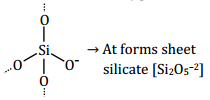
One monovalent corner oxygen atom in each tetrahedron i.e. 3 oxygen atoms are shared.
p- Block Elements – NEET-10692
13
Which of the following halides cannot be hydrolysed?
(i) $\mathrm { TeF } _ { 6 }$
(ii) $\mathrm { SF } _ { 6 }$
(iii) $\mathrm { NCl } _ { 3 }$
(iv) $\mathrm { NF } _ { 3 }$
Choose the correct code
  1. A iii and iv
  2. B i, ii and iii
  3. C i, ii and iv
  4. D ii and iv
Show answer & explanation

Correct answer: D

SF$_{6}$ cannot be hydrolysed because of steric repulsion is much more in SF$_{6}$.
Whereas in NF$_{3}$ No vacant orbital is there.
14
Which one of the following oxy acid of fluorine exists?
  1. A HOF
  2. B $\mathrm { HFO } _ { 3 }$
  3. C $\mathrm { HFO } _ { 4 }$
  4. D $\mathrm { HFO } _ { 2 }$
Show answer & explanation

Correct answer: A

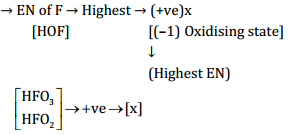
→ HOF → As a (Intermidiate)
p- Block Elements – NEET-10689
15
Graphite conducts electricity because of the -
  1. A Highly polarized nature of $\pi$-electrons.
  2. B Highly delocalized nature of $\pi$-electrons
  3. C Highly localized nature of $\pi$-electrons
  4. D None of these
Show answer & explanation

Correct answer: B

Graphite conduct electricity, due to the presence of Delocalisation of  electrons.
16
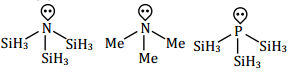
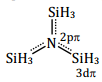
The geometry of the following molecules with respect to central atom is respectively $\mathrm { N } \left( \mathrm { SiH } _ { 3 } \right) _ { 3 } , \mathrm { Me } _ { 3 } \mathrm {~N} , \left( \mathrm { SiH } _ { 3 } \right) _ { 3 } \mathrm { P }$
  1. A planar, pyramidal, planar
  2. B planar, pyramidal, pyramidal
  3. C pyramidal, pyramidal, pyramidal
  4. D pyramidal, planar, pyramidal
Show answer & explanation

Correct answer: B

p- Block Elements – NEET-10681 In N(SiH$_{3}$)$_{3}$ Back bonding is possible whereas in N(Me)$_{3}$ & P(SiH$_{3}$)$_{3}$ No back bonding is there because N(SiH$_{3}$)$_{3}$ 2pπ-3dπ back bonding occurs so shape because trigonal planar.
p- Block Elements – NEET-10681
17
Which of the following statements is correct
  1. A All form $\mathrm { HOXO } _ { 3 }$ type oxy acid
  2. B Only chlorine and bromine form oxyacids
  3. C All halogens form oxyacids
  4. D Only iodine forms oxyacid
Show answer & explanation

Correct answer: C

All Halogens F, Cl, Br, I form oxyacids but not of all type as F only form HOF.
18
The borax bead test is based upon the formation of
  1. A Boron oxide
  2. B Boric acid
  3. C Meta borates
  4. D Elemental boron
Show answer & explanation

Correct answer: C

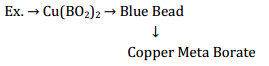
In borax based test different coloured meta borates has been formed from which we can identify metal ions.
p- Block Elements – NEET-10701
19
Which compound does not exist?
  1. A $\mathrm { TlCl } _ { 3 }$
  2. B $\mathrm { TlI } _ { 3 }$
  3. C $\mathrm { BiF } _ { 5 }$
  4. D $\mathrm { PbI } _ { 4 }$
Show answer & explanation

Correct answer: D

PbI$_{4}$ do not exist due to inert pair effect Pb$^{+2}$ is much more stable than Pb$^{+4}$ and EN of I is very less. So Higher Oxidising state of Pb cannot be achieved.
20
Alum is found to contain hydrated monovalent cation $\left[ \mathrm { M } \left( \mathrm { H } _ { 2 } \mathrm { O } \right) _ { 6 } \right] ^ { + }$, trivalent cation $\left[ \mathrm { M } ^ { \prime } \left( \mathrm { H } _ { 2 } \mathrm { O } \right) _ { 6 } \right] ^ { + 3 }$ and $\mathrm { SO } _ { 4 } ^ { 2 - }$ in the ratio of :
  1. A $1 : 1 : 1$
  2. B $1 : 1 : 2$
  3. C $1 : 2 : 2$
  4. D $1 : 2 : 3$
Show answer & explanation

Correct answer: B

M$_{2}$SO$_{4}$.M$_{2}$(SO$_{4}$)$_{3}$. 24H₂O
2M:2M :4 (SO$_{4}$)
[1 : 1 : 2] Ratio for M, M’, SO$_{4}$.

Attempt this as a timed test

Reading answers is not the same as sitting the paper. Attempt it timed and you get your score, per-question timing, and the mistakes tracked for revision.

Start free

More p- Block Elements tests

All p- Block Elements tests →