p- Block Elements — DPP 2

20 NEET questions from p- Block Elements, with answers and explanations. Attempt it as a timed test to get scoring, accuracy breakdown and mistake tracking.

Attempt this test free 20 questions · 30 minutes · +80 marks
1
Correct IE order is -
  1. A $\mathrm { C } > \mathrm { Si } > \mathrm { Ge } > \mathrm { Sn } > \mathrm { Pb }$
  2. B $\mathrm { C } < \mathrm { Si } < \mathrm { Ge } < \mathrm { Sn } > \mathrm { Pb }$
  3. C $\mathrm { C } > \mathrm { Si } > \mathrm { Ge } > \mathrm { Sn } < \mathrm { Pb }$
  4. D $\mathrm { C } < \mathrm { Si } < \mathrm { Ge } < \mathrm { Sn } < \mathrm { Pb }$
Show answer & explanation

Correct answer: C

Correct order of I.E.
C > Si > Ge > Sn < Pb
Sn → Lanthanide contraction → Zeff ↑, IP↑
2
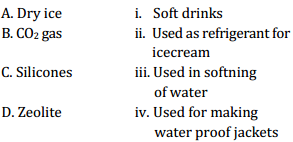
Match the column
p- Block Elements – NEET-10722
  1. A A - ii, B - i, C - iv, D - iii
  2. B A - ii, B - iii, C - iv, D - i
  3. C A - iii, B - i, C - ii, D - iv
  4. D A - iv, B - i, C - ii, D - iii
Show answer & explanation

Correct answer: A

Dry ice → Refrigerant in ice-cream
CO₂ gas → Soft Drinks
Silicones → Polymer it is so used in water proof Jacket
Zeolite → Used in softening of Hard water with impurity of (CaCl₂, MgCl₂)
3
Wrong statement is
  1. A Boric acid is weak monobasic acid
  2. B Boric acid is a protic acid
  3. C Boric acid is a lewis acid
  4. D Boric acid on heating finally form $\mathrm { B } _ { 2 } \mathrm { O } _ { 3 }$
Show answer & explanation

Correct answer: B

B(OH)$_{3}$
H$_{3}$BO$_{3}$ → Lewis acid
Weak mono basic acid.
2(H$_{3}$BO$_{3}$) → (B$_{2}$O$_{3}$)
Protic acid ✗
4
Boric acid polymerizes due to -
  1. A The presence of hydrogen bonds
  2. B Its acidic nature
  3. C Its geometry
  4. D Its monobasic nature
Show answer & explanation

Correct answer: A

Boric acid H$_{3}$BO$_{3}$[B(OH)$_{3}$] Polymerises due to hydrogen bonding.
5
The hydrides of group 14 elements are:
  1. A Ionic
  2. B Oxidising
  3. C Covalent
  4. D None of these
Show answer & explanation

Correct answer: C

Group 14 element
NH$_{3}$, PH$_{3}$ ------ Hydrides are covalent in nature.
6
$2 \mathrm { P } \xrightarrow { - \mathrm { H } _ { 2 } \mathrm { O } } \mathrm { Q } \xrightarrow { - [ \mathrm { O } ] } \mathrm { R }$
If P is phosphoric acid then according to given information the incorrect statement is
  1. A Q is pyro form and R is hypo form of given present oxy acid P
  2. B Number of H -atoms present in each given oxy acid is equal to its basicity
  3. C In P, Q, R oxy acids, oxidation state of central atom remains same
  4. D All given oxy acids have $\mathrm { p } \pi - \mathrm { d } \pi$ bond(s) in their structure
Show answer & explanation

Correct answer: C

It P is H$_{3}$PO$_{4}$
$\underset{\text { ie }}{\mathrm{H}_{3} \mathrm{PO}_{4}} \xrightarrow{-1 \mathrm{H}_{2} \mathrm{O}} \underset{\text { Ous }}{\mathrm{HPO}_{3}} \xrightarrow{-0} \underset{\text { Hypo }}{\mathrm{HPO}_{2}}$
In All these oxyacids we have different oxidation state.
7
Synthesis gas is -
  1. A $\mathrm { CO } + \mathrm { H } _ { 2 }$
  2. B $\mathrm { CO } _ { 2 } + \mathrm { H } _ { 2 } \mathrm { O }$
  3. C $\mathrm { CO } + \mathrm { N } _ { 2 }$
  4. D None
Show answer & explanation

Correct answer: A

Syn gas & Synthesis gas
$\left[\mathrm{CO}+\mathrm{H}_{2}\right] \rightarrow$ formed by $\mathrm{C}+\mathrm{H}_{2} \mathrm{O} \xrightarrow{\Delta}\left[\mathrm{CO}+\mathrm{H}_{2}\right]$
8
$\mathrm { PH } _ { 3 }$ produces smoky rings when it comes in contact with air. This is because :
  1. A It is inflamable
  2. B It combines with water vapours
  3. C It combines with nitrogen
  4. D It contains impurity of $\mathrm { P } _ { 2 } \mathrm { H } _ { 4 }$
Show answer & explanation

Correct answer: D

PH$_{3}$ Produces smoky ring when it has impurity of P$_{2}$H$_{4}$.
9
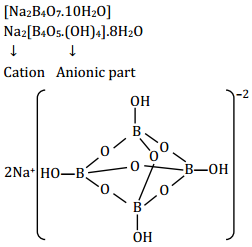
Borax $\mathrm { Na } _ { 2 } \mathrm {~B} _ { 4 } \mathrm { O } _ { 7 } .10 \mathrm { H } _ { 2 } \mathrm { O }$ is actually :-
  1. A $\mathrm { Na } _ { 2 } \left[ \mathrm {~B} _ { 4 } \mathrm { O } _ { 5 } ( \mathrm { OH } ) _ { 4 } \right] \cdot 8 \mathrm { H } _ { 2 } \mathrm { O }$
  2. B $\mathrm { Na } _ { 2 } \left[ \mathrm {~B} _ { 4 } \mathrm { O } _ { 4 } ( \mathrm { OH } ) _ { 6 } \right] \cdot 7 \mathrm { H } _ { 2 } \mathrm { O }$
  3. C $\mathrm { Na } _ { 2 } \left[ \mathrm {~B} _ { 4 } \mathrm { O } _ { 3 } ( \mathrm { OH } ) _ { 8 } \right] \cdot 6 \mathrm { H } _ { 2 } \mathrm { O }$
  4. D $\mathrm { Na } _ { 2 } \left[ \mathrm {~B} _ { 4 } \mathrm { O } _ { 2 } ( \mathrm { OH } ) _ { 10 } \right] .5 \mathrm { H } _ { 2 } \mathrm { O }$
Show answer & explanation

Correct answer: A

p- Block Elements – NEET-10704
10
Orthoboric acid acts as -
  1. A Antiseptic
  2. B Antipyretic
  3. C Antibiotic
  4. D None
Show answer & explanation

Correct answer: A

Orthoboric acid is used as antiseptic.
11
Which reacts rapidly with oxygen in the air at ordinary temperature :
  1. A White P
  2. B Red P
  3. C N$_ { 2 }$
  4. D C
Show answer & explanation

Correct answer: A

White phosphorous reacts with oxygen at ordinary room temperature.
12
Borax and Boric acid are used in manufacturing of-
  1. A Pyrex
  2. B Glass-wool
  3. C Fibre glass
  4. D All of these
Show answer & explanation

Correct answer: D

Borax & Boric Acid is used in the manufacture of all of these Pyrex Glass, Fibre, Glass wool.
13
Which among the following statements is incorrect regarding graphite ?
  1. A Each carbon atom is $\mathrm { sp } ^ { 2 }$ hybridised
  2. B Fourth electron on each carbon atom forms a $\pi$ bond.
  3. C Layers are held by weak van der Waals forces
  4. D Thermodynamically less stable than diamond
Show answer & explanation

Correct answer: D

Graphite is thermodynamically more stable than diamond.
14
Catenation property is mainly exhibited by carbon in its family but it is not shown by its member
  1. A Si
  2. B Ge
  3. C Sn
  4. D Pb
Show answer & explanation

Correct answer: D

As we move from top to bottom in a group catenation property decreases due to large size self-linking tendency decreases.
15
Which does not have dangling bond
  1. A Diamond
  2. B Graphite
  3. C Fullerene
  4. D All of these
Show answer & explanation

Correct answer: C

Diamond & Graphite have dangling bond but due to closed soccer Bucky ball like structure Buck Minister fullerene do not have dangling bond.
16
In Borax bead test, bead of cobalt is-
  1. A $\mathrm { Co } \left( \mathrm { BO } _ { 2 } \right) _ { 2 }$, Pink
  2. B $\mathrm { Co } \left( \mathrm { BO } _ { 2 } \right) _ { 2 }$, Blue
  3. C $\mathrm { Co } \left( \mathrm { BO } _ { 3 } \right) _ { 2 }$, Pink
  4. D $\mathrm { Co } \left( \mathrm { BO } _ { 3 } \right) _ { 2 }$, Blue
Show answer & explanation

Correct answer: B

With cobalt, Borax Bead test bead of cobalt is [CO(BO$_{2}$)$_{ 2}$]
[Blue Bead]
17
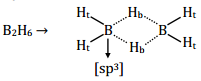
The hybridization of boron in diborane is -
  1. A sp
  2. B $\mathrm { sp } ^ { 2 }$
  3. C $\mathrm { sp } ^ { 3 }$
  4. D $\mathrm { sp } ^ { 3 } \mathrm {d} ^ { 2 }$
Show answer & explanation

Correct answer: C

Hybridisation of diborane
p- Block Elements – NEET-10684
18
Which gas is responsible for green house effect :
  1. A CO$_{2}$
  2. B SO$ _ { 2 }$
  3. C CO
  4. D SO$_ { 3 }$
Show answer & explanation

Correct answer: A

Gas responsible for green house is CO₂
19
Artificial gem used for cutting glass is :
  1. A Graphite
  2. B Diamond
  3. C SiC
  4. D CaCN$_ { 2 }$
Show answer & explanation

Correct answer: C

Artificial Gem used for diamond cutting is SiC
20
Which of the following is the correct statement for $\mathrm { PH } _ { 3 }$
  1. A It is less basic than $\mathrm { NH } _ { 3 }$
  2. B It is less poisonous than $\mathrm { NH } _ { 3 }$
  3. C Bond angle of $\mathrm { PH } _ { 3 } > \mathrm { NH } _ { 3 }$
  4. D It does not show reducing properties
Show answer & explanation

Correct answer: A

PH$_{3}$ is less basic than NH$_{3}$ as Lone Pair donation tendency is less due to larger size.

Attempt this as a timed test

Reading answers is not the same as sitting the paper. Attempt it timed and you get your score, per-question timing, and the mistakes tracked for revision.

Start free

More p- Block Elements tests

All p- Block Elements tests →