Electrostatic Potential and Capacitance — DPP 1

20 NEET questions from Electrostatic Potential and Capacitance, with answers and explanations. Attempt it as a timed test to get scoring, accuracy breakdown and mistake tracking.

Attempt this test free 20 questions · 30 minutes · +80 marks
1
A parallel plate capacitor has rectangular plates of 400 cm$^{2}$ area and are separated by a distance of 2 mm. What charge will appear on the plates if a 200-volt potential difference is applied across the capacitor?
  1. A $3.54 \times 10^{-6} \mathrm{C}$
  2. B $3.54 \times 10^{-8} \mathrm{C}$
  3. C $3.54 \times 10^{-10} \mathrm{C}$
  4. D $1770.8 \times 10^{-13} \mathrm{C}$
Show answer

Correct answer: B
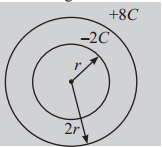
2
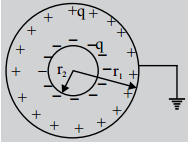
The outer shell is now earthed. What amount of charge will flow from shell to ground on earthing.
Electrostatic Potential and Capacitance – NEET-19811
  1. A 4 C
  2. B 2 C
  3. C 6 C
  4. D 10 C
Show answer

Correct answer: C

3
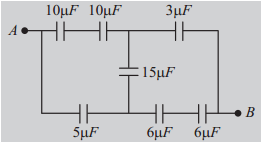
In the figure shown below, the equivalent capacitance between A and B is
Electrostatic Potential and Capacitance – NEET-19827
  1. A 3.75 μF
  2. B 5.25 μF
  3. C 6.5 μF
  4. D 10.5 μF
Show answer

Correct answer: A

4
An electric dipole is placed in a uniform electric field. To have maximum potential energy, angle between dipole moment and electric field is;
  1. A Zero
  2. B $\frac { \pi } { 2 }$
  3. C π
  4. D $\frac { 3 \pi } { 2 }$
Show answer

Correct answer: C

5
If the distance between parallel plates of a capacitor is halved and dielectric constant is doubled then the capacitance
  1. A Decreases two times
  2. B Increases two times
  3. C Increases four times
  4. D Remains the same
Show answer

Correct answer: C

6
A spherical capacitor consists of two concentric spherical conductors, held in position by suitable insulating supports as shown in the figure. The capacitance C, of this spherical capacitor is
Electrostatic Potential and Capacitance – NEET-19835
  1. A $\frac { 4 \pi \varepsilon _ { 0 } r _ { 1 } r _ { 2 } } { r _ { 1 } - r _ { 2 } }$
  2. B $\frac { 4 \pi \varepsilon _ { 0 } \left( \mathrm { r } _ { 2 } - \mathrm { r } _ { 1 } \right) } { \mathrm { r } _ { 1 } \mathrm { r } _ { 2 } }$
  3. C $\frac { r _ { 1 } r _ { 2 } } { 4 \pi \varepsilon _ { 0 } \left( r _ { 2 } - r _ { 1 } \right) }$
  4. D $\frac { \left( r _ { 1 } - r _ { 2 } \right) } { 4 \pi \varepsilon _ { 0 } r _ { 1 } r _ { 2 } }$
Show answer & explanation

Correct answer: A

As shown in figure, +q charge spreads uniformly on inner surface of outer sphere of radius r$_{1}$.
The induced charge –q spreads uniformly on the outer surface of inner sphere of radius r$_{2}$.
The outer surface of outer sphere is earthed.
Due to electrostatic shielding E = 0 for r < r$_{2}$ and E = 0 for r > r$_{1}$.
In the space between the two spheres,
Potential difference between two spheres,
$\begin{array}{l}\mathrm{V}=\frac{\mathrm{q}}{4 \pi \varepsilon_{0} \mathrm{r}_{2}}-\frac{\mathrm{q}}{4 \pi \varepsilon_{0} \mathrm{r}_{1}}=\frac{\mathrm{q}}{4 \pi \varepsilon_{0}}\left[\frac{1}{\mathrm{r}_{2}}-\frac{1}{\mathrm{r}_{1}}\right] ; \\ \mathrm{V}=\frac{\mathrm{q}}{4 \pi \varepsilon_{0}}\left(\frac{\mathrm{r}_{1}-\mathrm{r}_{2}}{\mathrm{r}_{1} \mathrm{r}_{2}}\right) \\ \text { Also } \mathrm{C}=\frac{\mathrm{q}}{\mathrm{V}} \therefore \mathrm{C}=\frac{4 \pi \varepsilon_{0} \mathrm{r}_{1} \mathrm{r}_{2}}{\mathrm{r}_{1}-\mathrm{r}_{2}}(\text { using }(\mathrm{i}))\end{array}$
Therefore, option (A) is the correct answer.
7
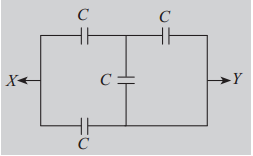
The equivalent capacitance between points X and Y in the circuit is
Electrostatic Potential and Capacitance – NEET-19828
  1. A $\frac { 2 C } { 3 }$
  2. B $\frac { 5 C } { 3 }$
  3. C $\frac { 7 C } { 3 }$
  4. D $\frac { 3 C } { 7 }$
Show answer

Correct answer: B

8
When a positive q charge is taken from a lower potential to a higher potential point, then its potential energy will;
  1. A decrease
  2. B increases
  3. C remain unchanged
  4. D become zero
Show answer

Correct answer: B

9
An electric dipole is placed at some angle in an electric field generated by a point charge
  1. A The net electric force on the dipole must be zero
  2. B The net electric force on the dipole may be zero
  3. C The torque on the dipole due to the field must be zero
  4. D The torque on the dipole due to the field may be zero
Show answer & explanation

Correct answer: D

The electric field produced by a point charge is non-uniform in nature.
Therefore, option (D) is the correct answer.
10
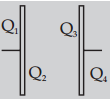
In an isolated parallel-plate capacitor of capacitance C, the four surfaces have charges $Q _ { 1 } , Q _ { 2 } , Q _ { 3 }$ and $Q _ { 4 }$, as shown. The potential difference between the plates is
Electrostatic Potential and Capacitance – NEET-19836
  1. A $\frac { \mathrm { Q } _ { 1 } + \mathrm { Q } _ { 2 } + \mathrm { Q } _ { 3 } + \mathrm { Q } _ { 4 } } { 2 \mathrm { C } }$
  2. B $\frac { Q _ { 2 } + Q _ { 3 } } { 2 C }$
  3. C $\frac { Q _ { 2 } - Q _ { 3 } } { 2 C }$
  4. D $\frac { Q _ { 1 } + Q _ { 4 } } { C }$
Show answer & explanation

Correct answer: C

Plane conducting surfaces facing each other must have equal and opposite charge densities. Here, as the plate areas are equal, Q$_{2}$ = –Q$_{3}$.
The charge on a capacitor means the charge on the inner surface of the positive plate-in this case, Q2.
Potential difference between the plates = charge on the capacitor/capacitance
∴ potential difference = $\frac{Q_{2}}{C}=\frac{2 Q_{2}}{2 C}=\frac{Q_{2}-\left(-Q_{2}\right)}{2 C}=\frac{Q_{2}-Q_{3}}{2 C}$
Therefore, option (C) is the correct answer.
11
A 500 μF capacitor is charged at a rate of 125 μC/sec. The potential difference across the capacitor will be 10 V after an interval of;
  1. A 80 sec
  2. B 50 sec
  3. C 20 sec
  4. D 40 sec
Show answer

Correct answer: D

12
An electric dipole is along a uniform electric field. If it is deflected by $60 ^ { \circ }$, work done by an agent is $2 \times 10 ^ { - 19 } \mathrm {~J}$. Then the work done by an agent if it is deflected by $30 ^ { \circ }$ further is;
  1. A $2.5 \times 10 ^ { - 19 } \mathrm {~J}$
  2. B $2 \times 10 ^ { - 19 } \mathrm {~J}$
  3. C $4 \times 10 ^ { - 19 } \mathrm {~J}$
  4. D $2 \times 10 ^ { - 16 } \mathrm {~J}$
Show answer

Correct answer: B

13
A capacitor is charged by a battery and the energy stored is U. The battery is now removed, and the separation between the plates is doubled. The energy stored now is
  1. A $\frac { U } { 2 }$
  2. B U
  3. C 2U
  4. D 4U
Show answer

Correct answer: C

14
An electric dipole of dipole moment p is lying along a uniform electric field E. The work done in rotating the dipole by $90 ^ { \circ }$ is:
  1. A 2pE
  2. B pE
  3. C $\sqrt { 2 } p E$
  4. D $\frac { p E } { 2 }$
Show answer

Correct answer: B

15
Electric potential at a point P, r distance away due to a point charge q at point A is V. If twice of this charge is distributed uniformly on the surface of a hollow sphere of radius 4r with centre at point A, the potential at point P is now
  1. A V
  2. B $\frac { V } { 2 }$
  3. C $\frac { \mathrm { V } } { 4 }$
  4. D $\frac { \mathrm { V } } { 8 }$
Show answer

Correct answer: B

16
Sixty-four spherical drops each of radius 2 cm and carrying 5 C charge combine to form a bigger drop. Its capacity is;
  1. A $\frac { 8 } { 9 } \times 10 ^ { - 11 } \mathrm {~F}$
  2. B $90 \times 10 ^ { - 11 } \mathrm {~F}$
  3. C $1.1 \times 10 ^ { - 11 } \mathrm {~F}$
  4. D $9 \times 10 ^ { 11 } \mathrm {~F}$
Show answer

Correct answer: A

17
The work done by battery to charge an uncharged parallel plate condenser of plate separation d and plate area of cross section A such that the uniform electric field between the plates is E, is
  1. A $\frac { \frac { 1 } { 2 } \varepsilon _ { 0 } E ^ { 2 } } { \text { Ad } }$
  2. B $\frac { \varepsilon _ { 0 } E ^ { 2 } } { A d }$
  3. C $\varepsilon _ { 0 } E ^ { 2 } A d$
  4. D $\frac { 1 } { 2 } \varepsilon _ { 0 } E ^ { 2 } A d$
Show answer

Correct answer: C

18
An electric dipole of moment p is placed normal to the lines of force of electric intensity E, then the work done in deflecting it through an angle of $180 ^ { \circ }$ is;
  1. A pE
  2. B +2pE
  3. C -2pE
  4. D Zero
Show answer

Correct answer: D

19
The capacity of parallel plate condenser depends on:
  1. A the type of metal used
  2. B the thickness of plates
  3. C the potential difference applied across the plates
  4. D the separation between the plates.
Show answer

Correct answer: D

20
Two unlike charges of magnitude q are separated by a distance 2d. The potential at a point midway between them is
  1. A Zero
  2. B $\frac { 1 } { 4 \pi \varepsilon _ { 0 } } \cdot \frac { q } { 2 d }$
  3. C $\frac { 1 } { 4 \pi \varepsilon _ { 0 } } \cdot \frac { q } { d }$
  4. D $\frac { 1 } { 4 \pi \varepsilon _ { 0 } } \cdot \frac { 2 q } { d }$
Show answer

Correct answer: A

Attempt this as a timed test

Reading answers is not the same as sitting the paper. Attempt it timed and you get your score, per-question timing, and the mistakes tracked for revision.

Start free

More Electrostatic Potential and Capacitance tests

All Electrostatic Potential and Capacitance tests →