Electrostatic Potential and Capacitance — DPP 2

20 NEET questions from Electrostatic Potential and Capacitance, with answers and explanations. Attempt it as a timed test to get scoring, accuracy breakdown and mistake tracking.

Attempt this test free 20 questions · 30 minutes · +80 marks
1
The work done in carrying a charge q once around a circle with a charge Q at its centre is
  1. A $\frac { \mathrm { qQ } } { 4 \pi \varepsilon _ { 0 } \mathrm { a } }$
  2. B $\frac { \mathrm { qQ } } { 4 \pi \varepsilon _ { 0 } \mathrm { a } ^ { 2 } }$
  3. C $\frac { \mathrm { q } } { 4 \pi \varepsilon _ { 0 } \mathrm { a } }$
  4. D Zero
Show answer & explanation

Correct answer: D

Work done = q∆V
∵ The initial and final positions around the circle are the same.
∴ Change in potential, ∆V = 0
∴ W = 0
Therefore, option (D) is the correct answer.
2
A parallel-plate air capacitor has capacity C. A dielectric slab of dielectric constant K, whose thickness is half of the air gap between the plates, is now inserted between the plates. The capacity of the plate will now be
  1. A KC/2
  2. B 2KC/(K + 1)
  3. C 2KC/( K - 1)
  4. D C(K + 1)/(K - 1)
Show answer & explanation

Correct answer: B

$\mathrm{C}=\varepsilon_{0} \mathrm{~A} / \mathrm{d}$
Let capacity with dielectric be $\mathrm{C}^{\prime}$
$\begin{array}{l}\sigma=\frac{Q}{A} \\ V=\frac{\sigma}{\varepsilon_{0}} \cdot \frac{d}{2}+\frac{\sigma}{K \varepsilon_{0}} \cdot \frac{d}{2}=\frac{Q}{A} \frac{d}{2 \varepsilon_{0}}\left(1+\frac{1}{K}\right) \\ C^{\prime}=\frac{\mathrm{Q}}{\mathrm{V}}=\frac{2 \varepsilon_{0} \mathrm{~A}}{\mathrm{~d}\left(1+\frac{1}{\mathrm{~K}}\right)}=\mathrm{C} \cdot \frac{2 \mathrm{~K}}{\mathrm{~K}+1}\end{array}$
Therefore, option (B) is the correct answer.
3
The electrostatic potential on the surface of a charged conducting sphere is 100 V. Two statements are made in this regard
$\mathrm { S } _ { 1 }$ : At any point inside the sphere, electric intensity is zero.
$\mathrm { S } _ { 2 }$ : At any point inside the sphere, the electrostatic potential is 100V.
Which of the following is a correct statement?
  1. A $\mathrm { S } _ { 1 }$ is true but $\mathrm { S } _ { 2 }$ is false
  2. B Both $\mathrm { S } _ { 1 }$ and $\mathrm { S } _ { 2 }$ are false
  3. C $\mathrm { S } _ { 1 }$ is true, $\mathrm { S } _ { 2 }$ is also true and $\mathrm { S } _ { 1 }$ is the cause of $\mathrm { S } _ { 2 }$
  4. D $\mathrm { S } _ { 1 }$ is true, $\mathrm { S } _ { 2 }$ is also true but the statements are independent
Show answer

Correct answer: C

4
The capacity of the parallel plate capacitor increases when
  1. A area of the plates is decreased
  2. B area of the plates is increased
  3. C distance between the plates increases
  4. D does not depend on area of plate
Show answer

Correct answer: B

5
The potential energy of a system of two charges is negative when
  1. A both the charges are positive
  2. B both the charges are negative
  3. C one charge is positive and other is negative
  4. D both the charges are separated by infinite distance
Show answer

Correct answer: C

6
Assertion (A): Electric potential and electric potential energy are different quantities.
Reason (R): For a system of positive charge and point charge, electric potential energy = electric potential
  1. A Both (A) and (R) are true and (R) is the correct explanation of (A)
  2. B Both (A) and (R) are true but (R) is NOT the correct explanation of (A).
  3. C (A) is true but (R) is false
  4. D (A) is false and (R) is true.
Show answer

Correct answer: C

7
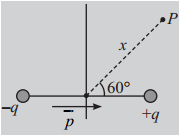
Find electric potential due to dipole at point P as shown in the figure-
Electrostatic Potential and Capacitance – NEET-19809
  1. A $\frac { k p } { 2 x ^ { 2 } }$
  2. B $\frac { k p } { x ^ { 2 } }$
  3. C $\frac { 2 k p } { x ^ { 2 } }$
  4. D $\frac { k p } { 3 x ^ { 2 } }$
Show answer

Correct answer: A

8
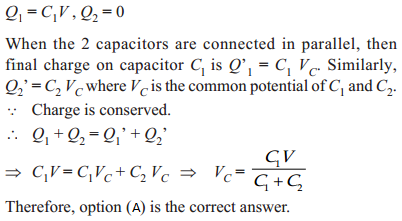
A capacitor of capacitance C$_{1}$ is charged to a potential V and then connected in parallel to an uncharged capacitor of capacitance C$_{2}$. The final potential difference across each capacitor will be
  1. A $\frac{C_{1} V}{C_{1}+C_{2}}$
  2. B $\frac{\mathrm{C}_{2} \mathrm{~V}}{\mathrm{C}_{1}+\mathrm{C}_{2}}$
  3. C $1+\frac{C_{2}}{C_{1}}$
  4. D $1-\frac{\mathrm{C}_{2}}{\mathrm{C}_{1}}$
Show answer & explanation

Correct answer: A

Electrostatic Potential and Capacitance – NEET-19862
9
Two spherical conductors, each of capacity C are charged to potentials V and -V. These are then connected by means of a fine wire. The loss of energy is
  1. A Zero
  2. B $\frac { 1 } { 2 } \mathrm { CV } ^ { 2 }$
  3. C $\mathrm { CV } ^ { 2 }$
  4. D $2 \mathrm { CV } ^ { 2 }$
Show answer & explanation

Correct answer: C

Loss of energy = $\frac{1}{2} \frac{C_{1} C_{2}}{\left(C_{1}+C_{2}\right)} \times\left(V_{1}-V_{2}\right)^{2}$
$=\frac{1}{2} \times \frac{C^{2}}{2 C} \times(2 V)^{2}=C V^{2}$
Therefore, option (C) is the correct answer.
10
When air is replaced by a dielectric medium of constant K, the maximum force of attraction between two charges separated by a distance
  1. A increases K times
  2. B remains unchanged
  3. C decreases K times
  4. D increases K - 1 times
Show answer

Correct answer: C

11
Two point charges of +1.0 μC are kept stationary 2 m apart. How much work is needed to bring them 1 m apart?
  1. A 4.5 mJ
  2. B 9 mJ
  3. C 45 mJ
  4. D 90 mJ
Show answer

Correct answer: A

12
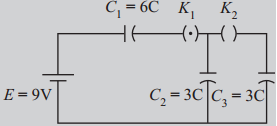
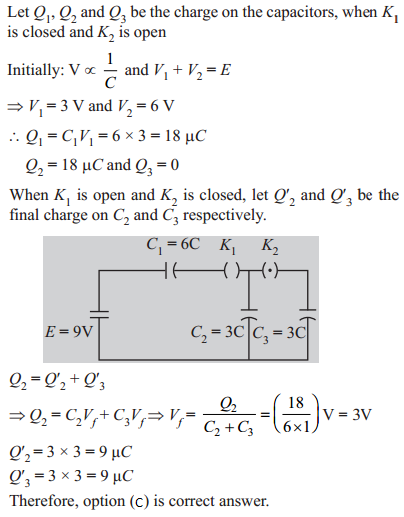
For the circuit shown in the figure, initially key K, is closed and key K$_{1}$ is kept open for a long time. Then K was opened and K$_{2}$ was closed, what will be the charge on capacitors C$_{2}$ & C$_{3}$ finally? [C = 1µF]
Electrostatic Potential and Capacitance – NEET-19866
  1. A 18 μC, 0 μC
  2. B 0 μC, 18 μC
  3. C 9 μC, 9 μC
  4. D 4.5 μC, 4.5 μC
Show answer & explanation

Correct answer: C

Electrostatic Potential and Capacitance – NEET-19866
13
The electric potential inside a conducting sphere
  1. A is zero
  2. B increases from centre to the surface
  3. C decreases from centre to the surface
  4. D remains constant from centre to the surface
Show answer

Correct answer: D

14
The electrostatic potential energy of a charge of 5C at a point in the electrostatic field is 50 J. The potential at that point is
  1. A 0.1 V
  2. B 5 V
  3. C 10 V
  4. D 250 V
Show answer

Correct answer: C

15
Assertion (A): Electric energy resides outside the spherical isolated conductor.
Reason (R): The electric field at any point inside the conductor is zero.
  1. A Both (A) and (R) are true and (R) is the correct explanation of (A).
  2. B Both (A) and (R) are true but (R) is NOT the correct explanation of (A)
  3. C (A) is true but (R) is false.
  4. D (A) is false and (R) is true.
Show answer

Correct answer: A

16
Electric potential is
  1. A Scalar and dimensionless quantity
  2. B Vector and dimensionless quantity
  3. C Scalar and dimensional quantity
  4. D Vector and dimensional quantity
Show answer & explanation

Correct answer: C

Electric potential is a scalar and dimensional quantity.
Therefore, option (C) is the correct answer.
17
Can two equipotential surfaces intersect each other?
  1. A Yes
  2. B No
  3. C Sometimes
  4. D Only when surfaces intersect at $90 ^ { \circ }$
Show answer

Correct answer: B

18
Assertion (A): Work done in moving a charge between any two points in an electric field is independent of the path followed by the charge between these points.
Reason (R): Electrostatic forces are non-conservative.
  1. A Both (A) and (R) are true and (R) is the correct explanation of (A).
  2. B Both (A) and (R) are true but (R) is NOT the correct explanation of (A).
  3. C (A) is true but (R) is false.
  4. D (A) is false and (R) is true.
Show answer

Correct answer: C

19
The electrostatic potential on the perpendicular bisector due to an electric dipole is
  1. A Zero
  2. B 1
  3. C Infinite
  4. D Negative
Show answer

Correct answer: A

20
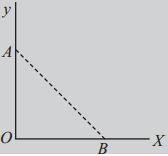
As per this diagram, a point charge +q is placed at the origin O. Work done in taking another point charge -Q from the point A [coordinates (0, a)] to another point [coordinates (a, 0)] along the straight path AB is:
Electrostatic Potential and Capacitance – NEET-19886
  1. A Zero
  2. B $\left( \frac { - q Q } { 4 \pi \varepsilon _ { 0 } } \frac { 1 } { a ^ { 2 } } \right) \sqrt { 2 } a$
  3. C $\left( \frac { q Q } { 4 \pi \varepsilon _ { 0 } } \frac { 1 } { a ^ { 2 } } \right) \frac { a } { \sqrt { 2 } }$
  4. D $\left( \frac { q Q } { 4 \pi \varepsilon _ { 0 } } \frac { 1 } { a ^ { 2 } } \right) a$
Show answer

Correct answer: A

Attempt this as a timed test

Reading answers is not the same as sitting the paper. Attempt it timed and you get your score, per-question timing, and the mistakes tracked for revision.

Start free

More Electrostatic Potential and Capacitance tests

All Electrostatic Potential and Capacitance tests →