Gravitation — DPP 1

20 NEET questions from Gravitation, with answers and explanations. Attempt it as a timed test to get scoring, accuracy breakdown and mistake tracking.

Attempt this test free 20 questions · 30 minutes · +80 marks
1
The value of universal gravitational constant G depends upon :
  1. A Nature of material of two bodies
  2. B Heat constant of two bodies
  3. C Acceleration of two bodies
  4. D None of these
Show answer & explanation

Correct answer: D

It is a universal constant.
2
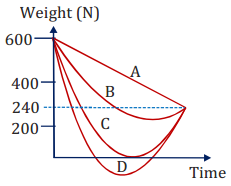
Suppose the acceleration due to gravity at the earth's surface is $10 \mathrm {~m} / \mathrm { s } ^ { 2 }$ and at the surface of mars it is $4.0 \mathrm {~m} / \mathrm { s } ^ { 2 }$. A 60kg passenger goes from the earth to the mars in a spaceship moving with a constant velocity. Neglect all other objects in the sky. Which part of figure best represent the weight (Net gravitational force) of the passenger as a function of time :
Gravitation – NEET-8733
  1. A A
  2. B B
  3. C C
  4. D D
Show answer & explanation

Correct answer: C

Weight is due to gravitational pull of earth which varies with distance as $\frac{1}{\mathrm{r}^{2}}$. Weight becomes zero when gravitational pull of both planets become equal & opposite. After that its weight again increase to 240 N due to mars.
3
Three equal masses of 1 kg each are placed at the vertices of an equilateral triangle PQR and a mass of 2 kg is placed at the centroid O of the triangle which is at a distance of √2 m from each of the vertices of the triangle. The force, in newton, acting on the mass of 2 kg is :-
  1. A 2
  2. B $\sqrt { 2 }$
  3. C 1
  4. D zero
Show answer & explanation

Correct answer: D

By symmetrically all forces will cancel each other and resultant will be zero.
4
Acceleration due to gravity at the centre of the earth is :-
  1. A g
  2. B $\frac { \mathrm { g } } { 2 }$
  3. C zero
  4. D infinite
Show answer & explanation

Correct answer: C

Gravitation – NEET-8738
5
The value of 'g' on earth surface depends :-
  1. A only an earth's structure
  2. B only an earth's rotational motion
  3. C on above both
  4. D on none these and is same
Show answer & explanation

Correct answer: C

The value of 'g' on earth surface depends on both structure and rotational motion.
$\begin{aligned} g & =\frac{G M_{e}}{R_{e}^{2}} \\ g^{\prime} & =g-R_{e} \omega^{2} \cos ^{2} \lambda\end{aligned}$
6
Following curve shows the variation of intensity of gravitational field ( $\overrightarrow { \mathrm { I } }$ ) with distance from the centre of solid sphere(r) :
  1. A
  2. B
  3. C
  4. D
Show answer & explanation

Correct answer: A

$\begin{array}{l}\mathrm{I}_{\mathrm{g}}=\frac{-\mathrm{GMr}}{\mathrm{R}^{3}} ; \mathrm{r}<\mathrm{R} \\ \mathrm{I}_{\mathrm{g}}=\frac{-\mathrm{GM}}{\mathrm{r}^{2}} ; \mathrm{r} \geq \mathrm{R}\end{array}$
7
The tidal waves in the seas are primarily due to :
  1. A The gravitational effect of the sun on the earth
  2. B The gravitational effect of the moon on the earth
  3. C The rotation of the earth
  4. D The atmospheric effect of the earth itself
Show answer & explanation

Correct answer: B

The tidal waves in seas are primarily due to gravitational force of the moon.
8
One can easily "weigh the earth" by calculating the mass of earth using the formula (in usual notation)
  1. A $\frac { G } { g } R _ { E } ^ { 2 }$
  2. B $\frac { g } { G } R _ { E } ^ { 2 }$
  3. C $\frac { g } { G } R _ { E }$
  4. D $\frac { G } { g } R _ { \text {E } } ^ { 3 }$
Show answer & explanation

Correct answer: B

$\mathrm{g}=\frac{\mathrm{GM}_{\mathrm{E}}}{\mathrm{R}_{\mathrm{E}}^{2}}$
where M$_{E}$ and R$_{E}$ is the mass and radius of the earth respectively.
$M_{E}=\frac{g}{G} R_{E}^{2}$
9
An earth's satellite is moving in a circular orbit with a uniform speed v. If the gravitational force of the earth suddenly disappears, the satellite will:-
  1. A vanish into outer space
  2. B continue to move with velocity v in original orbit
  3. C fall down with increasing velocity
  4. D fly off tangentially from the orbit with velocity v
Show answer & explanation

Correct answer: D

By first law of motion i.e. law of inertia, satellite will fly off tangentially from the orbit with speed V.
10
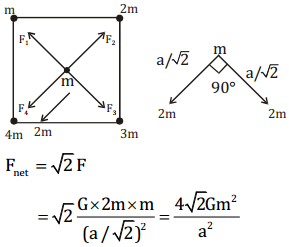
Four particles of masses m, 2m, 3m, and 4m are kept in sequence at the corners of a square of side a. The magnitude of the gravitational force acting on a particle of mass m placed at the centre of the square will be :
  1. A $\frac { 24 m ^ { 2 } G } { a ^ { 2 } }$
  2. B $\frac { 6 m ^ { 2 } G } { a ^ { 2 } }$
  3. C $\frac { 4 \sqrt { 2 } \mathrm { Gm } ^ { 2 } } { \mathrm { a } ^ { 2 } }$
  4. D Zero
Show answer & explanation

Correct answer: C

Gravitation – NEET-8682
11
Gravitational force between two masses at a distance 'd' apart is 6N. If these masses are taken to moon and kept at same separation, then the force between them will become :
  1. A 1 N
  2. B $\frac { 1 } { 6 } \mathrm {~N}$
  3. C 36 N
  4. D 6 N
Show answer & explanation

Correct answer: D

Gravitational force is medium independent
12
During the journey of space ship from earth to moon and back, the maximum fuel is consumed :-
  1. A Against the gravitation of earth in return journey
  2. B Against the gravitation of earth in onward journey
  3. C Against the gravitation of moon while reaching the moon
  4. D None of the above
Show answer & explanation

Correct answer: B

More work is done against the gravitational pull of the earth.
13
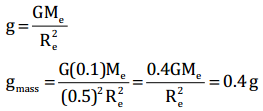
Mars has a diameter of approximately 0.5 of that of earth, and mass of 0.1 of that of earth. The surface gravitational field strength on mars as compared to that on earth is a factor of -
  1. A 0.1
  2. B 0.2
  3. C 2.0
  4. D 0.4
Show answer & explanation

Correct answer: D

Gravitation – NEET-8735
14
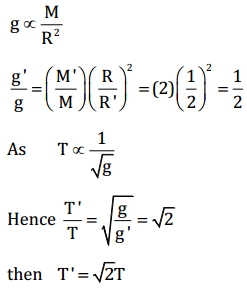
Diameter and mass of a planet is double that earth. Then time period of a pendulum at surface of planet is how much times of time period at earth surface :-
  1. A $\frac { 1 } { \sqrt { 2 } }$ times
  2. B $\sqrt { 2 }$ times
  3. C Equal
  4. D None of these
Show answer & explanation

Correct answer: B

Gravitation – NEET-8743
15
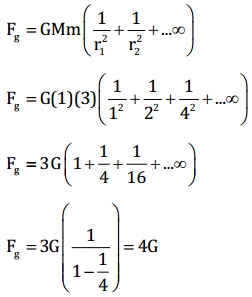
Mass particles of 1 kg each are placed along x -axis at x = 1, 2, 4, 8, .... ∞. Then gravitational force on a mass of 3 kg placed at origin is (G = universal gravitational constant) :-
  1. A 4G
  2. B $\frac { 4 G } { 3 }$
  3. C 2G
  4. D ∞
Show answer & explanation

Correct answer: A

Gravitation – NEET-8678
16
Newton's law of gravitation :
  1. A is not applicable outside the solar system
  2. B is used to govern the motion of satellites only
  3. C control the rotational motion of satellites and planets
  4. D control the rotational motion of electrons in atoms
Show answer & explanation

Correct answer: C

Control the rotational motion of satellites and planets. Explained in Kepler's law.
17
Gravitation on moon is $\frac{1}{6}$th of that on earth. When a balloon filled with hydrogen is released on moon then, this :-
  1. A Will rise with an acceleration less then $\left( \frac { \mathrm { g } } { 6 } \right)$
  2. B Will rise with acceleration $\left( \frac { g } { 6 } \right)$
  3. C Will fall down with an acceleration less than $\left( \frac { 5 \mathrm {~g} } { 6 } \right)$
  4. D Will fall down with acceleration $\left( \frac { g } { 6 } \right)$
Show answer & explanation

Correct answer: D

There is no atmosphere on the moon, means no buoyant force in upward direction so it will fall down with acceleration g/6.
18
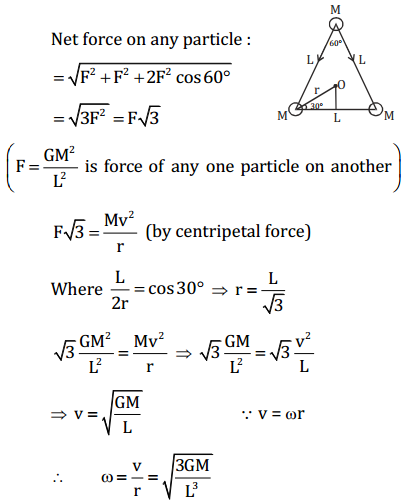
Three identical bodies (each mass M) are placed at vertices of an equilateral triangle of arm L, keeping the triangle as such by which angular speed the bodies should be rotated in their gravitational fields so that the triangle moves along circumference of circular orbit:
  1. A $\sqrt { \frac { 3 \mathrm { GM } } { \mathrm { L } ^ { 3 } } }$
  2. B $\sqrt { \frac { G M } { L ^ { 3 } } }$
  3. C $\sqrt { \frac { \mathrm { GM } } { 3 \mathrm {~L} ^ { 3 } } }$
  4. D $3 \sqrt { \frac { G M } { \mathrm {~L} ^ { 3 } } }$
Show answer & explanation

Correct answer: A

Gravitation – NEET-8681
19
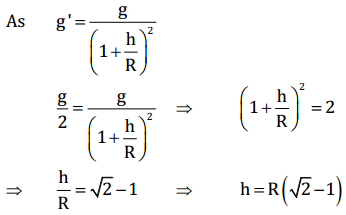
The value of 'g' reduces to half of its value at surface of earth at a height 'h', then :-
  1. A h = R
  2. B h = 2R
  3. C $\mathrm { h } = ( \sqrt { 2 } + 1 ) \mathrm { R }$
  4. D $\mathrm { h } = ( \sqrt { 2 } - 1 ) \mathrm { R }$
Show answer & explanation

Correct answer: D

Gravitation – NEET-8740
20
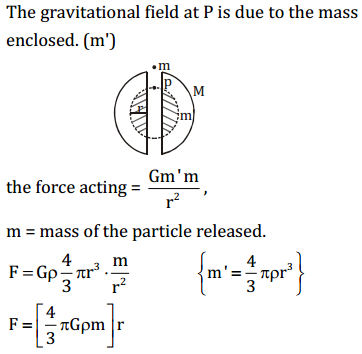
Assume that a tunnel is dug through earth from North pole to south pole and that the earth is a non-rotating, uniform sphere of density ρ. The gravitational force on a particle of mass m dropped into the tunnel when it reaches a distance r from the centre of earth is
  1. A $\left( \frac { 3 } { 4 \pi } \mathrm { mG } \rho \right) \mathrm { r }$
  2. B $\left( \frac { 4 \pi } { 3 } \mathrm { mG } \rho \right) \mathrm { r }$
  3. C $\left( \frac { 4 \pi } { 3 } \mathrm { mG } \rho \right) \mathrm { r } ^ { 2 }$
  4. D $\left( \frac { 4 \pi } { 3 } \mathrm {~m} ^ { 2 } \mathrm { G } \rho \right) \mathrm { r }$
Show answer & explanation

Correct answer: B

Gravitation – NEET-8734

Attempt this as a timed test

Reading answers is not the same as sitting the paper. Attempt it timed and you get your score, per-question timing, and the mistakes tracked for revision.

Start free

More Gravitation tests

All Gravitation tests →