Gravitation — DPP 3

20 NEET questions from Gravitation, with answers and explanations. Attempt it as a timed test to get scoring, accuracy breakdown and mistake tracking.

Attempt this test free 20 questions · 30 minutes · +80 marks
1
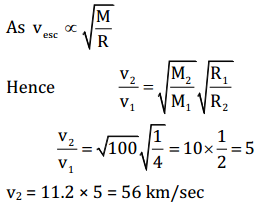
The escape velocity from the earth is 11.2 km/s the mass of another planet is 100 times of mass of earth and its radius is 4 times the radius of earth. The escape velocity for the planet is :-
  1. A 56.0 km/s
  2. B 280 km/s
  3. C 112 km/s
  4. D 11.2 km/s
Show answer & explanation

Correct answer: A
Gravitation – NEET-8899
2
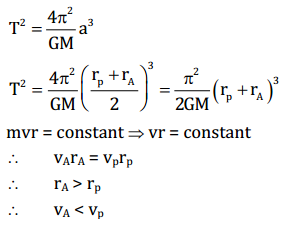
A planet is revolving round the sun. Its distance from the sun at Apogee is $\mathrm { r } _ { \mathrm { A } }$ and that at Perigee is $\mathrm { r } _ { \mathrm { p } }$. The mass of planet and sun is $m$ and $M$ respectively, $v _ { A }$ and $v _ { P }$ is the velocity of planet at Apogee and Perigee respectively and T is the time period of revolution of planet round the sun.
(a) $\mathrm { T } ^ { 2 } = \frac { \pi ^ { 2 } } { 2 \mathrm { Gm } } \left( \mathrm { r } _ { \mathrm { A } } + \mathrm { r } _ { \mathrm { P } } \right) ^ { 2 }$
(b) $\mathrm { T } ^ { 2 } = \frac { \pi ^ { 2 } } { 2 \mathrm { GM } } \left( \mathrm { r } _ { \mathrm { A } } + \mathrm { r } _ { \mathrm { P } } \right) ^ { 3 }$
(c) $\mathrm { V } _ { \mathrm { A } } \mathrm { r } _ { \mathrm { A } } = \mathrm { VPr } _ { \mathrm { P } }$
(d) $v _ { A } < v _ { P } , r _ { A } > r _ { P }$
  1. A a, b, c
  2. B a, b, d
  3. C b, c, d
  4. D all
Show answer & explanation

Correct answer: C

Gravitation – NEET-8927
3
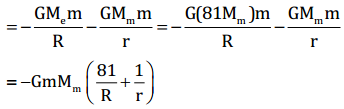
If $M _ { e }$ is the mass of earth and $M _ { m }$ is the mass of moon ( $M _ { e } = 81 M _ { m }$ ). The potential energy of an object of mass $m$ situated at a distance $R$ from the centre of earth and r from the centre of moon, will be :-
  1. A $- \mathrm { GmM } _ { \mathrm { m } } \left( \frac { \mathrm { R } } { 81 } + \mathrm { r } \right)$
  2. B $- \mathrm { GmM } _ { e } \left( \frac { 81 } { r } + \frac { 1 } { R } \right)$
  3. C $- \mathrm { GmM } _ { \mathrm { m } } \left( \frac { 81 } { \mathrm { R } } + \frac { 1 } { \mathrm { r } } \right)$
  4. D $\mathrm { GmM } _ { \mathrm { m } } \left( \frac { 81 } { \mathrm { r } } - \frac { 1 } { \mathrm { R } } \right)$
Show answer & explanation

Correct answer: C

Gravitation – NEET-8822
4
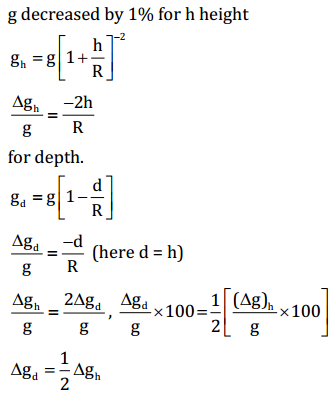
Weight of a body of mass m decreases by 1% when it is raised to height h above the earth's surface. If the body is taken to a depth h in a mine, then in its weight will
  1. A decrease by 0.5%
  2. B decrease by 2%
  3. C increase by 0.5%
  4. D increase by 1%
Show answer & explanation

Correct answer: A
Gravitation – NEET-8749
5
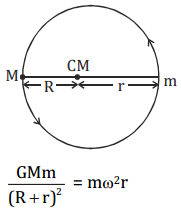
If two bodies of mass M and m are revolving around the centre of mass of the system in circular orbit of radii R and r respectively due to mutual interaction. Which of the following formula is applicable :-
  1. A $\frac { \mathrm { GMm } } { ( \mathrm { R } + \mathrm { r } ) ^ { 2 } } = \mathrm { m } \omega ^ { 2 } \mathrm { r }$
  2. B $\frac { G M m } { R ^ { 2 } } = m \omega ^ { 2 } r$
  3. C $\frac { G M m } { r ^ { 2 } } = m \omega ^ { 2 } r$
  4. D $\frac { \mathrm { GMm } } { \mathrm { R } ^ { 2 } + \mathrm { r } ^ { 2 } } = \mathrm { m } \omega ^ { 2 } \mathrm { r }$
Show answer & explanation

Correct answer: A
Gravitation – NEET-8932
6
The mass of the moon is 1% of mass of the earth. The ratio of gravitational pull of earth on moon to that of moon on earth will be :
  1. A 1 : 1
  2. B 1 : 10
  3. C 1 : 100
  4. D 2 : 1
Show answer & explanation

Correct answer: A
Action and reaction force are equal in magnitude.
7
A body is dropped by a satellite in its geostationary orbit :
  1. A it will burn on entering in to the atmosphere
  2. B it will remain in the same place with respect to the earth
  3. C it will reach the earth is 24 hours
  4. D it will perform uncertain motion
Show answer & explanation

Correct answer: B

For a body in geo-stationary orbit gravitational force is equal to the centripetal force so it will remain stationary with respect to the earth like GSS.
8
A satellite of earth of mass 'm' is taken from orbital radius 2R to 3R, then minimum work done is :-
  1. A $\frac { \mathrm { GMm } } { 6 \mathrm { R } }$
  2. B $\frac { \mathrm { GMm } } { 12 \mathrm { R } }$
  3. C $\frac { \mathrm { GMm } } { 24 \mathrm { R } }$
  4. D $\frac { \mathrm { GMm } } { 3 \mathrm { R } }$
Show answer & explanation

Correct answer: B

$\mathrm{W}=\mathrm{E}_{2}-\mathrm{E}_{1}=\frac{\mathrm{GMm}}{2}\left(\frac{1}{2 \mathrm{R}}-\frac{1}{3 \mathrm{R}}\right)=\frac{\mathrm{GMm}}{12 \mathrm{R}}$
9
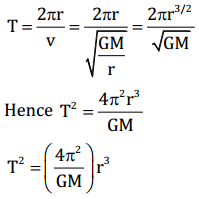
If a graph is plotted between T$^{2}$ and r$^{3}$ for a planet then its slope will be :-
  1. A $\frac { 4 \pi ^ { 2 } } { \mathrm { GM } }$
  2. B $\frac { \mathrm { GM } } { 4 \pi ^ { 2 } }$
  3. C $4 \pi \mathrm { GM }$
  4. D Zero
Show answer & explanation

Correct answer: A
Gravitation – NEET-8926
10
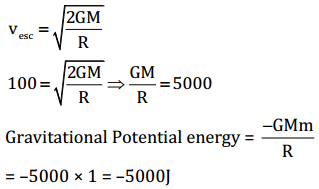
Escape velocity of a 1 kg body on a planet is 100 m/s. Potential energy of body at that planet is:
  1. A -5000 J
  2. B -1000 J
  3. C -2400 J
  4. D -10000 J
Show answer & explanation

Correct answer: A
Gravitation – NEET-8896
11
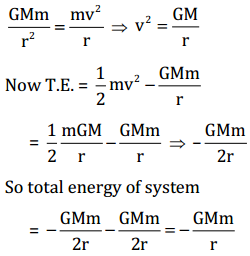
A satellite is moving in a circular orbit around earth with a speed v. If its mass is m, then its total energy will be :
  1. A $\frac { 3 } { 4 } m v ^ { 2 }$
  2. B $m v ^ { 2 }$
  3. C $\frac { 1 } { 2 } m v ^ { 2 }$
  4. D $- \frac { 1 } { 2 } m v ^ { 2 }$
Show answer & explanation

Correct answer: D

$\mathrm{TE}=-\mathrm{KE}=-\frac{1}{2} \mathrm{mv}^{2}$
12
A satellite launching station should be :
  1. A near the equatorial region
  2. B near the polar region
  3. C on the polar axis
  4. D all locations are equally good
Show answer & explanation

Correct answer: A
Near equator 'g' is minimum due to rotation and shape of earth which help to minimize fuel consumption.
13
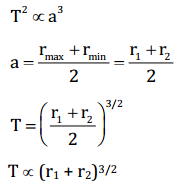
A planet of mass m is moving in an elliptical orbit about the sun (mass of sun = M). The maximum and minimum distances of the planet from the sun are r$_{1}$ and r$_{2}$ respectively. The period of revolution of the planet will be proportional to :
  1. A $r _ { 1 } ^ { 3 / 2 }$
  2. B $r _ { 2 } ^ { 3 / 2 }$
  3. C $\left( r _ { 1 } - r _ { 2 } \right) ^ { 3 / 2 }$
  4. D $\left( \mathrm { r } _ { 1 } + \mathrm { r } _ { 2 } \right) ^ { 3 / 2 }$
Show answer & explanation

Correct answer: D

Gravitation – NEET-8934
14
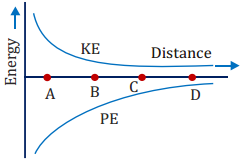
Potential energy and kinetic energy of a two particles system under imaginary force field are shown by curves KE and PE respectively in figure. This system is bound at :
Gravitation – NEET-8924
  1. A only point A
  2. B only point D
  3. C only point A, B, and C
  4. D All points A, B, C and D
Show answer & explanation

Correct answer: C

For system to be bounded
Net energy i.e. (KE + PE) must be negative
TE = KE + PE = -ve at points A,B & C.
15
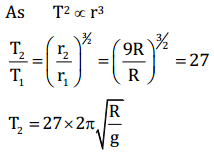
One projectile after deviating from its path starts moving round the earth in a circular path of radius equal to nine times the radius of earth R. Its time period will be :-
  1. A $2 \pi \sqrt { \frac { R } { g } }$
  2. B $27 \times 2 \pi \sqrt { \frac { \mathrm { R } } { \mathrm { g } } }$
  3. C $\pi \sqrt { \frac { R } { g } }$
  4. D $0.8 \times 3 \pi \sqrt { \frac { R } { g } }$
Show answer & explanation

Correct answer: B

Gravitation – NEET-8922
16
Two satellites of same mass m are revolving round of earth (mass M) in the same orbit of radius r. Rotational directions of the two are opposite therefore, they can collide. Total mechanical energy of the system (both satellites and earths) is (m << M) :-
  1. A $- \frac { \mathrm { GMm } } { \mathrm { r } }$
  2. B $- \frac { 2 \mathrm { GMm } } { \mathrm { r } }$
  3. C $- \frac { \mathrm { GMm } } { 2 \mathrm { r } }$
  4. D Zero
Show answer & explanation

Correct answer: A
Gravitation – NEET-8933
17
Binding energy of moon and earth is :-
  1. A $\frac { \mathrm { GM } _ { \mathrm { e } } \mathrm { M } _ { \mathrm { m } } } { \mathrm { r } _ { \mathrm { em } } }$
  2. B $\frac { \mathrm { GM } _ { \mathrm { e } } \mathrm { M } _ { \mathrm { m } } } { 2 \mathrm { r } _ { \mathrm { em } } }$
  3. C $- \frac { \mathrm { GM } _ { \mathrm { e } } \mathrm { M } _ { \mathrm { m } } } { \mathrm { r } _ { \mathrm { em } } }$
  4. D $- \frac { \mathrm { GM } _ { \mathrm { e } } \mathrm { M } _ { \mathrm { m } } } { 2 \mathrm { r } _ { \mathrm { em } } }$
Show answer & explanation

Correct answer: B

Binding energy of moon and earth is $\frac{\mathrm{GM}_{\mathrm{e}} \mathrm{M}_{\mathrm{m}}}{2 \mathrm{r}_{\mathrm{em}}}$
18
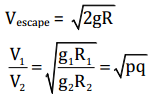
The ratio of radii of two satellites is p and the ratio of their acceleration due to gravity is q. The ratio of their escape velocities will be :
  1. A $\left( \frac { q } { p } \right) ^ { 1 / 2 }$
  2. B $\left( \frac { p } { q } \right) ^ { 1 / 2 }$
  3. C pq
  4. D $\sqrt { p q }$
Show answer & explanation

Correct answer: D

Gravitation – NEET-8897
19
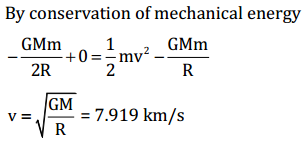
If the satellite is stopped suddenly in its orbit which is at a distance radius of earth from earth's surface and allowed to fall freely into the earth. The speed with which it hits the surface of earth will be :
  1. A 7.919 m/s
  2. B 7.919 km/s
  3. C 11.2 m/s
  4. D 11.2 km/s
Show answer & explanation

Correct answer: B

Gravitation – NEET-8935
20
The average radii of orbits of mercury and earth around the sun are $6 \times 10 ^ { 7 } \mathrm {~km}$ and $1.5 \times 10 ^ { 8 } \mathrm {~km}$ respectively. The ratio of their orbital speeds will be :-
  1. A $\sqrt { 5 } : \sqrt { 2 }$
  2. B $\sqrt { 2 } : \sqrt { 5 }$
  3. C 2.5 : 1
  4. D 1 : 25
Show answer & explanation

Correct answer: A
$\frac{v_{1}}{v_{2}}=\sqrt{\frac{R_{2}}{R_{1}}}=\sqrt{\frac{1.5 \times 10^{8}}{6 \times 10^{7}}}=\frac{\sqrt{5}}{\sqrt{2}}$

Attempt this as a timed test

Reading answers is not the same as sitting the paper. Attempt it timed and you get your score, per-question timing, and the mistakes tracked for revision.

Start free

More Gravitation tests

All Gravitation tests →