Kinetic Theory of Gases — DPP 1

20 NEET questions from Kinetic Theory of Gases, with answers and explanations. Attempt it as a timed test to get scoring, accuracy breakdown and mistake tracking.

Attempt this test free 20 questions · 30 minutes · +80 marks
1
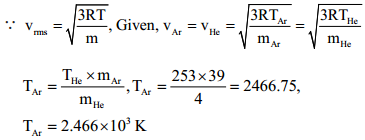
At what temperature is the r.m.s. speed of an atom in an argon gas cylinder is equal to the r.m.s speed of a helium gas atom at –20$^{0}$C? (Atomic mass of Ar = 39 u and He = 4 u)
  1. A $2.52 \times 10^{3} \mathrm{~K}$
  2. B $2.52 \times 10^{2} \mathrm{~K}$
  3. C $4.03 \times 10^{3} \mathrm{~K}$
  4. D $4.03 \times 10^{2} \mathrm{~K}$
Show answer & explanation

Correct answer: A

Kinetic Theory of Gases – NEET-11159 Therefore, option (A) is the correct answer
2
A box contains $n$ molecules of a gas. How will the pressure of the gas be effected, if the number of molecules is made 4n
  1. A Pressure will decrease
  2. B Pressure will remain unchanged
  3. C Pressure will become four times
  4. D Pressure will become three times
Show answer

Correct answer: C

3
At constant pressure, A gas of mass m is filled in a container at $7 ^ { \circ } \mathrm { C }$. If $\mathrm { m } _ { \mathrm { o } }$ fraction of its mass escape out at $27 ^ { \circ } \mathrm { C }$. Find $\mathrm { m } _ { \mathrm { o } }$ (If V is the volume at $7 ^ { \circ } \mathrm { C }$ )
  1. A $\frac { \mathrm { V } } { 14 }$
  2. B $\frac { \mathrm { V } } { 16 }$
  3. C $\frac { \mathrm { V } } { 20 }$
  4. D $\frac { \mathrm { V } } { 28 }$
Show answer

Correct answer: A

4
During an experiment, an ideal gas obeys an additional equation of state P$^{2}$V = constant. The initial temperature and volume of gas are T and V respectively. When it expands to volume 2V, then its temperature will be:
  1. A T
  2. B $\sqrt { 2 } \mathrm {~T}$
  3. C 2T
  4. D $2 \sqrt { 2 } \mathrm {~T}$
Show answer

Correct answer: B

5
The mean K.E per molecule of any ideal gas is always equal to
  1. A $\frac { 2 } { 3 } \mathrm { k } _ { \mathrm { B } } \mathrm { T }$
  2. B $\frac { 3 } { 4 } \mathrm { k } _ { \mathrm { B } } \mathrm { T }$
  3. C $\frac { 3 } { 2 } \mathrm { k } _ { \mathrm { B } } \mathrm { T }$
  4. D $3 \mathrm { k } _ { \mathrm { B } } \mathrm { T }$
Show answer

Correct answer: C

6
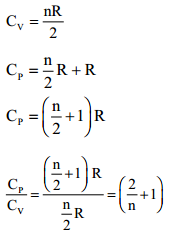
If a gas has n degrees of freedom then ratio of specific heats of gas is:
  1. A $\frac{1+n}{2}$
  2. B $1+\frac{1}{n}$
  3. C $1+\frac{n}{2}$
  4. D $1+\frac{2}{n}$
Show answer & explanation

Correct answer: D

Kinetic Theory of Gases – NEET-11161 Therefore, option (D) is the correct answer.
7
For an ideal gas:
  1. A $C _ { p }$ is less than $C _ { v }$
  2. B $C _ { p }$ is equal $C _ { v }$
  3. C $C _ { p }$ is greater than $C _ { v }$
  4. D $C _ { p } = C _ { v } = 0$
Show answer & explanation

Correct answer: C

For an ideal gas C$_{P}$ is greater than C$_{v}$,
Therefore, option (C) is the correct answer
8
A perfect gas at $27 ^ { \circ } \mathrm { C }$ is heated at constant pressure so as to triple its volume. The temperature of the gas will be
  1. A $81 ^ { \circ } \mathrm { C }$
  2. B $900 ^ { \circ } \mathrm { C }$
  3. C $627 ^ { \circ } \mathrm { C }$
  4. D $450 ^ { \circ } \mathrm { C }$
Show answer

Correct answer: C

9
The number of collisions per second suffered by a molecule in a sample of hydrogen at S.T.P is ( $\lambda = 1.38 \times 10 ^ { - 5 } \mathrm {~cm}$ )
  1. A $10 ^ { 15 }$
  2. B $8.3 \times 10 ^ { 12 }$
  3. C $1.1 \times 10 ^ { 6 }$
  4. D $1.23 \times 10 ^ { 10 }$
Show answer

Correct answer: D

10
RMS speed of oxygen molecule at $0 ^ { \circ } \mathrm { C }$ is 160 m/s find the rms speed of hydrogen molecule at $0 ^ { \circ } \mathrm { C }$
  1. A 40 m/s
  2. B 320 m/s
  3. C 640 m/s
  4. D 332 m/s
Show answer

Correct answer: C

11
The rms speed of oxygen molecules in a gas is v. If the temperature is doubled and the oxygen molecules dissociate into oxygen atoms, the rms speed will become.
  1. A v
  2. B 2v
  3. C $v \sqrt { 2 }$
  4. D 4v
Show answer

Correct answer: B

12
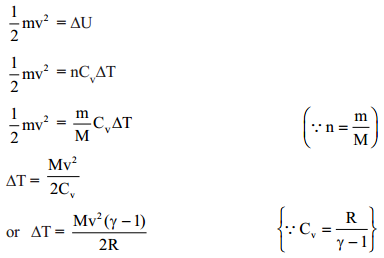
A thermally insulated vessel contains an ideal gas of molecular mass M and ratio of specific heats γ. It is moving with speed v and is suddenly brought to rest. Assuming no heat is lost to the surroundings, its temperature increases by
  1. A $\frac{(\gamma-1)}{2(\gamma+1) \mathrm{R}} \mathrm{Mv}^{2} \mathrm{~K}$
  2. B $\frac{(\gamma-1)}{2 \gamma \mathrm{R}} \mathrm{Mv}^{2} \mathrm{~K}$
  3. C $\frac{\gamma \mathrm{Mv}^{2} \mathrm{~K}}{2 \gamma \mathrm{R}} \mathrm{K}$
  4. D $\frac{(\gamma-1)}{2 \mathrm{R}} \mathrm{Mv}^{2} \mathrm{~K}$
Show answer & explanation

Correct answer: D

K.E of vessel = $\frac{1}{2} \mathrm{mv}^{2}$
Increase in Internal energy DU = nC$_{v}$dT
Where n = no. of mole of gas in vessel.
As the vessel is stopped suddenly, its K.E is used to increase the temperature of the gas.
Kinetic Theory of Gases – NEET-11164 Therefore, option (D) is the correct answer.
13
A gas in a container A is in thermal equilibrium with another gas of the same mass in container B. If we denote the corresponding pressures and volumes by the suffixes A and B, then which of the following statements is most likely to be true:
  1. A P$_{A}$ = P$_{B}$, V$_{A}$ ≠ V$_{B}$
  2. B P$_{A}$ ≠ P$_{B}$, V$_{A}$ = V$_{B}$
  3. C P$_{A}$/V$_{A}$, P$_{B}$, V$_{B}$
  4. D P$_{A}$/V$_{A}$ = P$_{B}$, V$_{B}$
Show answer & explanation

Correct answer: D

∵ PV = nRT and the temperature is constant
∴ PV = Constant
⇒ P$_{A}$ V$_{A}$ = P$_{B}$ V$_{B}$
Therefore, option (D) is the correct answer.
14
Cooking gas containers are kept in a lorry moving with uniform speed. The temperature of the gas molecules inside will:
  1. A Increase
  2. B Decrease
  3. C Remain the same
  4. D Decreases for some, while increases for others
Show answer & explanation

Correct answer: A

As the lorry moves, the temperature increases because of the motion of particles inside the container.
Therefore, option (A) is the correct answer.
15
A gas mixture consists of 2 moles of oxygen and 4 moles of argon at temperature T. Neglecting all vibrational modes, the total internal energy of the system is:
  1. A 4RT
  2. B 9RT
  3. C 11RT
  4. D 15RT
Show answer & explanation

Correct answer: C

Diatomic
$\begin{array}{l}\mathrm{U}=\frac{5}{2} \mathrm{nRT}(\text { diatomic })+\frac{3}{2} \mathrm{nRT}(\text { monoatomic }) \\ \mathrm{U}=\frac{5}{2}(2) \mathrm{RT}+\frac{3}{2}(4) \mathrm{RT}=11 \mathrm{RT}\end{array}$
Therefore, option (C) is the correct answer.
16
Which of the following graphs represents the behaviour of an ideal gas at constant temperature?
  1. A
  2. B
  3. C
  4. D
Show answer

Correct answer: B

17
For Boyle's law to hold, the gas should be
  1. A Perfect and of constant mass and temperature
  2. B Real and of constant mass and temperature
  3. C Perfect and at constant temperature but variable mass
  4. D Real and at constant temperature but variable mass
Show answer

Correct answer: A

18
2 moles each of H, CO₂ and Cl are mixed in a closed container of volume 6 litres and temperature $0 ^ { \circ } \mathrm { C }$. Pressure exerted by mixture is
  1. A $2.3 \times 10 ^ { 6 } \mathrm {~N} / \mathrm { m } ^ { 2 }$
  2. B $3.2 \times 10 ^ { 6 } \mathrm {~N} / \mathrm { m } ^ { 2 }$
  3. C $4.8 \times 10 ^ { 6 } \mathrm {~N} / \mathrm { m } ^ { 2 }$
  4. D $1.8 \times 10 ^ { 6 } \mathrm {~N} / \mathrm { m } ^ { 2 }$
Show answer

Correct answer: A

19
The temperature of a given mass of gas is increased from 27°C to 327°C. The rms velocity of the molecule increases:
  1. A √2 times
  2. B 2 times
  3. C 2√2 times
  4. D 4 times
Show answer & explanation

Correct answer: A

$\because \mathrm{v}_{\mathrm{rms}}=\sqrt{\frac{3 \mathrm{RT}}{\mathrm{M}}}$
Where R is gas constant, M is molecular weight and the temperatures
T1$_{}$ = 27°C = 273 + 27 = 300 K
T$_{2}$ = 327°C = 273 + 327 = 600 K
$\therefore \frac{\left(\mathrm{v}_{\mathrm{rms}}\right)_{1}}{\left(\mathrm{v}_{\mathrm{rms}}\right)_{2}}=\sqrt{\frac{300}{600}}=\sqrt{\frac{1}{2}}$
$\Rightarrow\left(\mathrm{v}_{\mathrm{rms}}\right)_{2}=\sqrt{2}\left(\mathrm{v}_{\mathrm{rms}}\right)_{1}$
Hence, r.m.s speed becomes √2 times.
Faster the motion of the molecules of a gas, higher will be the temperature of the gas. This is the kinetic interpretation of temperature.
Therefore, option (A) is the correct answer.
20
C$_{P}$ and C$_{V}$ denote the specific heats of nitrogen per unit mass at constant pressure and constant volume, respectively, then:
  1. A $\mathrm{C}_{\mathrm{P}}-\mathrm{C}_{\mathrm{V}}=\mathrm{R} / 28$
  2. B $\mathrm{C}_{\mathrm{P}}-\mathrm{C}_{\mathrm{V}}=\mathrm{R} / 14$
  3. C $C_{P}-C_{V}=R$
  4. D $C_{P}-C_{V}=28R$
Show answer & explanation

Correct answer: A

According to Mayer’s solution
$C_{P}-C_{V}=\frac{R}{m}=\frac{R}{28}$
Therefore, option (A) is the correct answer.

Attempt this as a timed test

Reading answers is not the same as sitting the paper. Attempt it timed and you get your score, per-question timing, and the mistakes tracked for revision.

Start free

More Kinetic Theory of Gases tests

All Kinetic Theory of Gases tests →