Kinetic Theory of Gases — DPP 2

20 NEET questions from Kinetic Theory of Gases, with answers and explanations. Attempt it as a timed test to get scoring, accuracy breakdown and mistake tracking.

Attempt this test free 20 questions · 30 minutes · +80 marks
1
V-T curve for 2 moles of a gas is straight line as shown in the graph here. Find the pressure of gas at A.
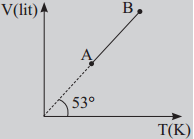
Kinetic Theory of Gases – NEET-11280
  1. A $125 \mathrm {~N} / \mathrm { m } ^ { 2 }$
  2. B $1.25 \times 10 ^ { 4 } \mathrm {~N} / \mathrm { m } ^ { 2 }$
  3. C $225 \mathrm {~N} / \mathrm { m } ^ { 2 }$
  4. D $2.25 \times 10 ^ { 4 } \mathrm {~N} / \mathrm { m } ^ { 2 }$
Show answer

Correct answer: B

2
A mixture of ideal gases has 2 moles of He, 4 moles of oxygen and 1 mole of ozone at absolute temperature T. The internal energy of mixture is
  1. A 13RT
  2. B 11RT
  3. C 16RT
  4. D 14RT
Show answer

Correct answer: C

3
According to kinetic theory of gases the temperature of a perfect gas is:
  1. A Independent of the kinetic energy of the molecules.
  2. B Inversely proportional to kinetic energy of the molecule
  3. C Directly propositional to kinetic energy of the molecules and potential energy of molecules.
  4. D Directly proportional to kinetic energy of the molecule
Show answer & explanation

Correct answer: D

Directly proportional to the kinetic energy of the molecules.
Therefore, option (D) is the correct answer.
4
Molar specific heat at constant volume, for a non-linear triatomic gas is (vibration mode neglected)
  1. A 3R
  2. B 4R
  3. C 2R
  4. D R
Show answer

Correct answer: A

5
A sample of gas in a box is at pressure $P _ { 0 }$ and temperature $T _ { 0 }$. If number of molecules is doubled and total kinetic energy of the gas is kept constant. Then final temperature and pressure will be
  1. A $T _ { 0 } , P _ { 0 }$
  2. B $T _ { 0 } , 2 P _ { 0 }$
  3. C $T _ { 0 } / 2,2 P _ { 0 }$
  4. D $T _ { 0 } / 2 , P _ { 0 }$
Show answer

Correct answer: D

6
One kg of a diatomic gas is at a pressure of 8 × 10$^{4}$ N/m$^{2}$. The density of the gas is 4 kg/m$^{3}$. What is the energy of the gas due to thermal motion?
  1. A $3 \times 10^{4} \mathrm{~J}$
  2. B $6 \times 10^{4} \mathrm{~J}$
  3. C $5 \times 10^{4} \mathrm{~J}$
  4. D $7 \times 10^{4} \mathrm{~J}$
Show answer & explanation

Correct answer: C

Thermal energy corresponds to internal energy given:
m = 1 kg, ρ = 4 kg m$^{–3}$, P = 8 × 10$^{4}$ Nm$^{–2}$
$\begin{array}{l}\because \mathrm{V}=\text { volume }=\frac{\text { Mass }}{\text { density }}=\frac{\mathrm{m}}{\rho}=\frac{1}{4} \mathrm{~m}^{3} \\ \text { Internal energy }=\frac{5}{2} \mathrm{nRT}=\frac{5}{2} \mathrm{PV}\end{array}$
$=\frac{5}{2} \times 8 \times 10^{4} \times \frac{1}{4}=5 \times 10^{4} \mathrm{~J}$
Therefore, option (C) is the correct answer.
7
Which one of the following is a wrong statement in kinetic theory of gases?
  1. A The gas molecules are in random motion
  2. B The gas molecules are perfect elastic spheres
  3. C The volume occupied by the molecules of a gas is negligible
  4. D The collision between molecules is inelastic
Show answer

Correct answer: D

8
What weight of hydrogen at STP could be contained in a vessel that holds 4.8 g of O$_{2}$ gas at STP?
  1. A 0.21 g
  2. B 4.8 g
  3. C 0.30 g
  4. D 3.36 g
Show answer & explanation

Correct answer: C

Molecular mass of O₂ = 32, H₂ = 2
Number of moles = 4.8/32 = 0.15 mole
Mass of H₂ of 0.15 moles = 0.15 × 2 = 0.30 g
Therefore, option (C) is the correct answer.
9
The pressure P of a gas and its mean kinetic energy E per unit volume are related as:
  1. A P = E
  2. B P = (2/3) E
  3. C P = (3/2) E
  4. D P = 1.2 E
Show answer & explanation

Correct answer: B

$\mathrm{P}=(2 / 3) \mathrm{E} \Rightarrow P=\frac{1}{3} \rho \bar{V}^{2}=\frac{2}{3}\left(\frac{1}{2} \rho V^{2}\right)=\frac{2}{3} E$,
Therefore, option (B) is the correct answer.
10
An ant is moving on a plane horizontal surface. The number of degrees of freedom of the ant will be
  1. A 1
  2. B 2
  3. C 3
  4. D 6
Show answer

Correct answer: B

11
Ratio of partial pressure of non-reactive monoatomic and diatomic gas is 5 : 3, what will be the ratio of number of molecules of monoatomic and diatomic.
  1. A 3 : 5
  2. B 3 : 1
  3. C 5 : 3
  4. D 5 : 1
Show answer

Correct answer: C

12
Select the appropriate property of an ideal gas
  1. A its molecules are infinitesimally small
  2. B There are no forces of interaction between its molecules
  3. C It strictly obeys the ideal gas laws
  4. D All of these
Show answer

Correct answer: D

13
Assertion (A): The total translational kinetic energy of all the molecules of a given mass of an ideal gas is 1.5 times the product of its pressure and its volume.
Reason (R): The molecules of a gas collide with each other, and the velocities of the molecules change due to the collision.
  1. A Both Assertion (A) and Reason (R) are True and the Reason (R) is a correct explanation of the Assertion (A).
  2. B BothAssertion (A) andReason (R) are True butReason (R) is not a correct explanation of the Assertion (A).
  3. C Assertion (A) is True but the Reason (R) is False.
  4. D Assertion (A) and Reason (R) are False
Show answer

Correct answer: B

14
The phenomenon of Brownian movement may be taken as evidence of
  1. A kinetic theory of matter
  2. B EMT of radiation
  3. C corpuscular theory of light
  4. D photoelectric phenomenon
Show answer

Correct answer: A

15
The value of universal gas constant is 8.3 J/mole/K, the mean kinetic energy of 32 gm of oxygen at –73°C will be
  1. A 480 J
  2. B 4980 J
  3. C 2490 J
  4. D 100 J
Show answer

Correct answer: C

16
Assertion (A): The total meam square velocity of molecules of a gas having a Maxwellian distribution of velocities is higher than their most probable velocity, at any temperature.
Reason (R): A very small number of molecules of a gas molecules which posses very large velocities.
  1. A Both Assertion (A) and Reason (R) are True and the Reason (R) is a correct explanation of the Assertion (A).
  2. B BothAssertion (A) andReason (R) are True butReason (R) is not a correct explanation of the Assertion (A).
  3. C Assertion (A) is True but the Reason (R) is False.
  4. D Assertion (A) and Reason (R) are False
Show answer

Correct answer: C

17
A balloon contains 500 m$^{3}$ of helium at $27 ^ { \circ } \mathrm { C }$ and 1 atmosphere pressure. The volume of the helium at $- 33 ^ { \circ } \mathrm { C }$ temperature and 0.5 atmosphere pressure will be-
  1. A $500 \mathrm {~m} ^ { 3 }$
  2. B $700 \mathrm {~m} ^ { 3 }$
  3. C $800 \mathrm {~m} ^ { 3 }$
  4. D $1000 \mathrm {~m} ^ { 3 }$
Show answer

Correct answer: C

18
A gas at a pressure $P _ { 0 }$ is contained in a vessel. If the masses of all the molecules are halved and their velocities doubled, then the resulting pressure P will be
  1. A $4 P _ { 0 }$
  2. B $2 P _ { 0 }$
  3. C $P _ { 0 }$
  4. D $P _ { 0 } / 2$
Show answer

Correct answer: B

19
The equation of state for 7 g of oxygen at a pressure P and temperature T occupying a volume V, will be (where R is the gas constant)
  1. A PV = 7RT
  2. B PV = (7/2 )RT
  3. C PV = (7/16) RT
  4. D PV = (7/32)RT
Show answer

Correct answer: D

20
The value of C$_{V}$ for O₂ is $\frac{5R}{2}$ with increase in temperature. It becomes $\frac{7R}{2}$ due to
  1. A translational motion
  2. B rotational motion
  3. C vibrational motion
  4. D translation and rotational motion
Show answer

Correct answer: C

Attempt this as a timed test

Reading answers is not the same as sitting the paper. Attempt it timed and you get your score, per-question timing, and the mistakes tracked for revision.

Start free

More Kinetic Theory of Gases tests

All Kinetic Theory of Gases tests →