Laws of Motion — DPP 1

20 NEET questions from Laws of Motion, with answers and explanations. Attempt it as a timed test to get scoring, accuracy breakdown and mistake tracking.

Attempt this test free 20 questions · 30 minutes · +80 marks
1
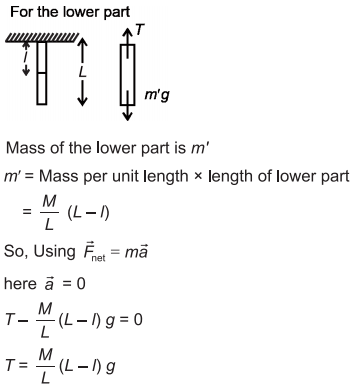
A uniform rope of mass M and length L is fixed at its upper end vertically from a rigid support. Then the tension in the rope at a distance / from the rigid support is
  1. A $M g \frac { L } { L + I }$
  2. B $\frac { M g } { L } ( L - I )$
  3. C Mg
  4. D $\frac { I } { L } M g$
Show answer & explanation

Correct answer: B
Laws of Motion – NEET-12107
2
If a force of constant magnitude acts in direction perpendicular to the motion of a particle, then its
  1. A Speed is uniform
  2. B Momentum is uniform
  3. C Velocity is uniform
  4. D All of these
Show answer & explanation

Correct answer: A

No component of force is in the direction of motion (as $\vec{F} \perp \vec{V}$ ) so it cannot change the speed of particle. But velocity cannot be constant because force will change the direction of motion.
3
When an object is in equilibrium state, then
  1. A It must be at rest
  2. B No force is acting on it
  3. C Its net acceleration must be zero
  4. D All of these
Show answer & explanation

Correct answer: C

Equilibrium $\Rightarrow \vec{F}_{\mathrm{net}}=0$
Using Newton's second law, $\vec{a}=0$
4
When a 4 kg rifle is fired, the 10 g bullet receives an acceleration of $3 \times 10 ^ { 6 } \mathrm {~cm} / \mathrm { s } ^ { 2 }$. The magnitude of the force acting on the rifle (in newton) is
  1. A Zero
  2. B 120
  3. C 300
  4. D 3000
Show answer & explanation

Correct answer: C

Using Newton's third law, bullet will apply the same force in the opposite direction.
So, using $F=m a=\frac{10}{1000} \times 3 \times 10^{6} \times 10^{-2}=300 \mathrm{~N}$
5
A body of mass 2 kg is sliding with a constant velocity of 4 m/s on a frictionless horizontal table. The force required to keep the body moving with the same velocity is
  1. A 8 N
  2. B 0 N
  3. C $2 \times 10 ^ { 4 } \mathrm {~N}$
  4. D $\frac { 1 } { 2 } \mathrm {~N}$
Show answer & explanation

Correct answer: B
For constant velocity, no force is required so $\vec{F}=0$
6
A balloon has 2 g of air. A small hole is pierced into it. The air comes out with a velocity of 4 m/s. If the balloon shrinks completely in 2.5 s. The average force acting on the balloon is
  1. A 0.008 N
  2. B 0.0032 N
  3. C 8 N
  4. D 3.2 N
Show answer & explanation

Correct answer: B
$\begin{aligned} F & =\frac{v d m}{d t} \\ & =4\left(\frac{2}{1000 \times 2.5}\right)=0.0032 \mathrm{~N}\end{aligned}$
7
A 10 g bullet moving at 200 m/s stops after penetrating 5 cm of wooden plank. The average force exerted on the bullet will be
  1. A 2000 N
  2. B - 2000 N
  3. C 4000 N
  4. D - 4000 N
Show answer & explanation

Correct answer: D

m = 10 g, u = 200 m/s, s = 5 cm
final velocity v = 0
Using $v^{2}=u^{2}+2 a s$
$a=\frac{u^{2}}{2 s}$
and for force F = -ma (retarding force)
8
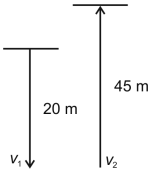
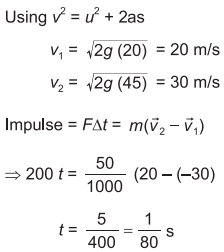
A ball of mass 50 g is dropped from a height of 20 m . A boy on the ground hits the ball vertically upwards with a bat with an average force of 200 N , so that it attains a vertical height of 45 m. The time for which the ball remains in contact with the bat is [Take g = 10 m/s$^{2}$]
  1. A $1 / 20 ^ { \text {th } }$ of a second
  2. B $1 / 40 ^ { \text {th } }$ of a second
  3. C $1 / 80 ^ { \text {th } }$ of a second
  4. D $1 / 120 ^ { \text {th } }$ of a second
Show answer & explanation

Correct answer: C

Laws of Motion – NEET-12070 Laws of Motion – NEET-12070
9
In accordance with Newton's third law of motion
  1. A Action and reaction never balance each other
  2. B For appearance of action and reaction, physical contact is not necessary
  3. C This law is applicable whether the bodies are at rest or they are in motion
  4. D All of these
Show answer & explanation

Correct answer: D

1. Action and reaction act on the different bodies.
2. Example: Gravitational force, coulomb force
3. 3rd law is irrespective of the state of motion
10
In which of the following graphs, the total change in momentum is zero?
  1. A
  2. B
  3. C
  4. D
Show answer & explanation

Correct answer: C

Total change in momentum = ∫F.dt = Area under Ft curve.
Area above t-axis will be positive and below t-axis will be negative in option (3)
$\text { Area }=-\left[\frac{1}{2} \times 5 \times 1\right]+\frac{1}{2} \times 5 \times 1=0$
11
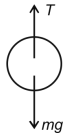
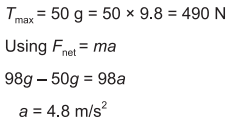
A string tied on a roof can bear a maximum tension of 50 kg wt. The minimum acceleration that can be acquired by a man of 98 kg to descend will be [Take $g = 9.8 \mathrm {~m} / \mathrm { s } ^ { 2 }$ ]
  1. A $9.8 \mathrm {~m} / \mathrm { s } ^ { 2 }$
  2. B $4.9 \mathrm {~m} / \mathrm { s } ^ { 2 }$
  3. C $4.8 \mathrm {~m} / \mathrm { s } ^ { 2 }$
  4. D $5 \mathrm {~m} / \mathrm { s } ^ { 2 }$
Show answer & explanation

Correct answer: C

Laws of Motion – NEET-12071 Laws of Motion – NEET-12071
12
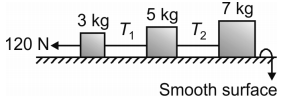
$T _ { 1 }$ and $T _ { 2 }$ in the given figure are
Laws of Motion – NEET-12105
  1. A 28 N, 48 N
  2. B 48 N, 28 N
  3. C 96 N, 56 N
  4. D 56 N, 96 N
Show answer & explanation

Correct answer: C

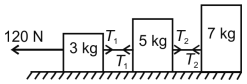
Laws of Motion – NEET-12105 Acceleration of the system
$a=\frac{F_{\text {ext }}}{M_{\text {Total }}}=\frac{120}{3+5+7}=8 \mathrm{~m} / \mathrm{s}^{2}$
Writing equation for 7 kg mass
T$_{2}$ = 7(8) = 56 N
Writing equation for 5 kg mass
T$_{1}$ = T$_{2}$ + 5(a)
= 56 + 5(8)
= 96 N
13
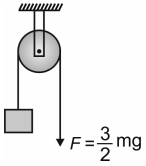
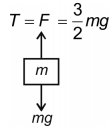
In the arrangement shown, the mass m will ascend with an acceleration (Pulley and rope are massless)
Laws of Motion – NEET-12106
  1. A Zero
  2. B $\frac { g } { 2 }$
  3. C g
  4. D 2g
Show answer & explanation

Correct answer: B
Laws of Motion – NEET-12106 $\begin{aligned} F_{\text {net }} & =m a \\ \frac{3}{2} m g-m g & =m a \\ a & =g / 2\end{aligned}$
14
A machine gun fires a bullet of mass 65 g with a velocity of 1300 m/s. The man holding it can exert a maximum force of 169 N on the gun. The number of bullets he can fire per second will be
  1. A 1
  2. B 2
  3. C 3
  4. D 4
Show answer & explanation

Correct answer: B
nmv = F
n is number of bullets fired per second
$n\left[\frac{65}{1000} \cdot 1300\right]=169$
n = 2
15
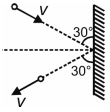
A particle of mass m strikes a wall with speed v at an angle $30 ^ { \circ }$ with the wall elastically as shown in the figure. The magnitude of impulse imparted to the ball by the wall is
Laws of Motion – NEET-12114
  1. A mv
  2. B $\frac { m v } { 2 }$
  3. C 2mv
  4. D $\sqrt { 3 } m v$
Show answer & explanation

Correct answer: A

Impulse = change in momentum
applying equation of change in momentum in horizontal direction
$\begin{aligned} I & =m v \sin 30^{\circ}-\left(-m v \sin 30^{\circ}\right) \\ & =2 m v\left(\frac{1}{2}\right)=m v\end{aligned}$
16
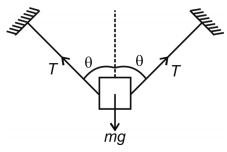
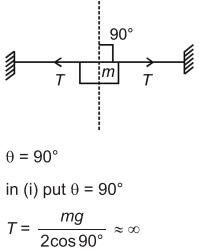
A weight Mg is suspended from the middle of a rope whose ends are at the same level. The rope is no longer horizontal. The minimum tension required to completely straighten the rope is
  1. A $\frac { M g } { 2 }$
  2. B Mg cos θ
  3. C 2Mg cos θ
  4. D Infinitely large
Show answer & explanation

Correct answer: D

Laws of Motion – NEET-12074 2T cos θ = mg
$T=\frac{m g}{2 \cos \theta}$ .......(i)
To make this string completely straight
Laws of Motion – NEET-12074
17
An athlete does not come to rest immediately after crossing the winning line due to the
  1. A Inertia of rest
  2. B Inertia of motion
  3. C Inertia of direction
  4. D None of these
Show answer & explanation

Correct answer: B
While running athlete is in the state of motion. So due to inertia of motion athlete does not come to rest.
18
When a force of constant magnitude and a fixed direction acts on a moving object, then its path is
  1. A Circular
  2. B Parabolic
  3. C Straight line
  4. D Either (B) or (C)
Show answer & explanation

Correct answer: D

1. To move a particle in circular motion centripetal force is required which has variable direction.
2. Parabolic is possible (example projectile motion).
3. If force is in the direction of motion or just opposite to it, path will be straight line.
19
If n balls hit elastically and normally on a surface per unit time and all balls of mass m are moving with same velocity u, then force on surface is
  1. A mun
  2. B 2 mun
  3. C $\frac { 1 } { 2 } m u ^ { 2 } n$
  4. D $m u ^ { 2 } n$
Show answer & explanation

Correct answer: B

Laws of Motion – NEET-12113 As collision is elastic, velocity after the collision will be -u
So using $F=\frac{d p}{d t}$
= n(mu - (-mu)
= 2nmu
20
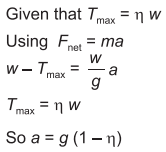
A man slides down a light rope whose breaking strength is η times the weight of man (η < 1). The maximum acceleration of the man so that the rope just breaks is
  1. A g(1 - η)
  2. B g(1 + η)
  3. C gη
  4. D $\frac { g } { \eta }$
Show answer & explanation

Correct answer: A

Laws of Motion – NEET-12108

Attempt this as a timed test

Reading answers is not the same as sitting the paper. Attempt it timed and you get your score, per-question timing, and the mistakes tracked for revision.

Start free

More Laws of Motion tests

All Laws of Motion tests →