Laws of Motion — DPP 3

20 NEET questions from Laws of Motion, with answers and explanations. Attempt it as a timed test to get scoring, accuracy breakdown and mistake tracking.

Attempt this test free 20 questions · 30 minutes · +80 marks
1
In translatory equilibrium
  1. A The net external force acting on particle is zero
  2. B The net external force acting on particle is constant (non-zero)
  3. C Particle is always at rest
  4. D Velocity of particle changes linearly with time
Show answer & explanation

Correct answer: A

ΣF = 0

2
Two blocks of masses 1 kg and 2 kg are connected with massless spring as shown. If the acceleration of 1 kg block is 1 m/s$^{2}$ towards right then the acceleration of 2 kg block is
Laws of Motion – NEET-12201
  1. A $1 \mathrm {~m} / \mathrm { s } ^ { 2 }$
  2. B $3 \mathrm {~m} / \mathrm { s } ^ { 2 }$
  3. C $4 \mathrm {~m} / \mathrm { s } ^ { 2 }$
  4. D $2 \mathrm {~m} / \mathrm { s } ^ { 2 }$
Show answer & explanation

Correct answer: D

$\begin{array}{l}k x=1 \times 1=1 \mathrm{~N} \\ a(2 \mathrm{~kg})=(5-k x)=\frac{5-1}{2}=2 \mathrm{~m} / \mathrm{s}^{2}\end{array}$
3
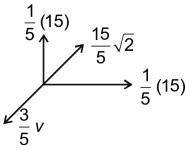
A bomb of mass 1 kg initially at rest, explodes and breaks into three fragments of masses in the ratio 1 : 1 : 3. The two pieces of equal mass fly off perpendicular to each other with a speed 15 m/s each. The speed of heavier fragment is
  1. A 5 m/s
  2. B 15 m/s
  3. C 45 m/s
  4. D $5 \sqrt { 2 } \mathrm {~m} / \mathrm { s }$
Show answer & explanation

Correct answer: D

Laws of Motion – NEET-12118 Momentum of the system will be conserved before explosion and after explosion
Using conservation of momentum equation
$\begin{aligned} \frac{3}{5} V & =\frac{15}{5} \sqrt{2} \\ V & =5 \sqrt{2} \mathrm{~m} / \mathrm{s}\end{aligned}$
4
A bus turns a slippery road having coefficient of friction of 0.5 with a speed of 10 m/s. The minimum radius of the arc in which bus turns is [Take $g = 10 \mathrm {~m} / \mathrm { s } ^ { 2 }$]
  1. A 4 m
  2. B 10 m
  3. C 15 m
  4. D 20 m
Show answer & explanation

Correct answer: D

$\frac{v^{2}}{r}=\mu g$
$\begin{aligned} \frac{10 \times 10}{r} & =0.5 \times 10 \\ r & =20 \mathrm{~m}\end{aligned}$
5
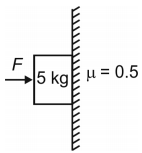
If the coefficient of friction between the block of mass 5 kg and wall is 0.5, then minimum force F required to hold the block with the wall is (g = 10 m/s$^{2}$)
Laws of Motion – NEET-12216
  1. A 10 N
  2. B 100 N
  3. C 40 N
  4. D 50 N
Show answer & explanation

Correct answer: B

$\begin{array}{l}\mu F=50 \\ F=\frac{50}{0.5}=100 \mathrm{~N}\end{array}$
6
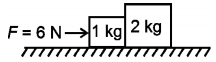
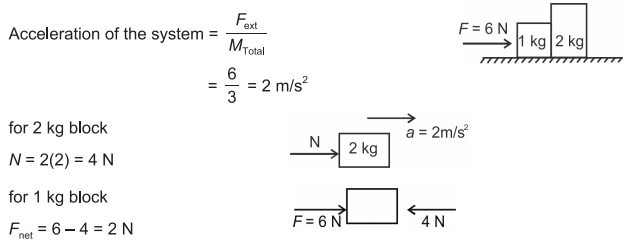
Arrangement of two block system is as shown. The net force acting on 1 kg and 2 kg blocks are (assuming the surfaces to be frictionless) respectively
Laws of Motion – NEET-12305
  1. A 4 N, 8 N
  2. B 1 N, 2 N
  3. C 2 N, 4 N
  4. D 3 N, 6 N
Show answer & explanation

Correct answer: C

Laws of Motion – NEET-12305
7
Sand is poured on a conveyor belt at the rate of 2 kg/s. If belt is moving horizontally with velocity 4 m/s, then additional force required by engine to keep the belt moving with same constant velocity is
  1. A 4 N
  2. B 8 N
  3. C 16 N
  4. D 32 N
Show answer & explanation

Correct answer: B

$F=\frac{v d m}{d t}=4 \times 2=8 \mathrm{~N}$
8
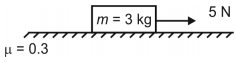
The value of frictional force on block in the given diagram is (Take g = 10 m/s$^{2}$)
Laws of Motion – NEET-12214
  1. A 4 N
  2. B 5 N
  3. C 6 N
  4. D 9 N
Show answer & explanation

Correct answer: B

If F$_{app}$ < f$_{lim}$
then F$_{r}$ = F$_{app}$ = 5 N
9
A car is moving round a curve of radius 20 m without slipping on a banked road with θ = 45$^{0}$. Assuming the coefficient of friction between the road and tyres to be 0.2. What is the maximum speed with which the car can move? (Take g = 10 m/s$^{2}$)
  1. A 10 m/s
  2. B 5 m/s
  3. C 15 m/s
  4. D $10 \sqrt { 3 } \mathrm {~m} / \mathrm { s }$
Show answer & explanation

Correct answer: D

$v_{\max }=\sqrt{R g\left(\frac{\tan \theta+\mu}{1-\mu \tan \theta}\right)}=\sqrt{20 \times 10 \times \frac{(1+0.2)}{(1-0.2)}}=\sqrt{200 \times \frac{12}{8}}=10 \sqrt{3} \mathrm{~m} / \mathrm{s}$
10
Which is a suitable method to decrease friction?
  1. A Polishing
  2. B Lubrication
  3. C Ball bearing
  4. D All of these
Show answer

Correct answer: D

11
A heavy box is slid across a rough floor with an initial speed of 4 m/s. It stops moving after 8 seconds. If the average resisting force of friction is 10 N, the mass of the box (in kg) is
  1. A 40
  2. B 20
  3. C 5
  4. D 2.5
Show answer & explanation

Correct answer: B

$\begin{aligned} \mu & =\frac{4}{80}=0.05 \\ F & =\mu m g \\ 10 & =0.5 m \\ m & =20 \mathrm{~kg}\end{aligned}$
12
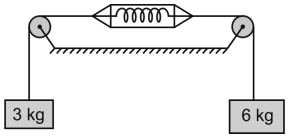
In the given diagram, reading of spring balance will be (g = 10 m/s$^{2}$)
Laws of Motion – NEET-12219
  1. A 30 N
  2. B 40 N
  3. C 60 N
  4. D 80 N
Show answer & explanation

Correct answer: B

$T=\frac{2 m_{1} m_{2} g}{m_{1}+m_{2}}=\frac{2 \times 3 \times 6 \times 10}{(3+6)}=40 \mathrm{~N}$
13
The rate of mass of the gas emitted from rear of a rocket is initially 20 kg/s. If the speed of the gas relative to the rocket is 800 m/s and mass of rocket is 1000 kg, then the initial acceleration of the rocket is (Take g = 10 m/s$^{2}$)
  1. A $4 \mathrm {~m} / \mathrm { s } ^ { 2 }$
  2. B $16 \mathrm {~m} / \mathrm { s } ^ { 2 }$
  3. C $6 \mathrm {~m} / \mathrm { s } ^ { 2 }$
  4. D $12 \mathrm {~m} / \mathrm { s } ^ { 2 }$
Show answer & explanation

Correct answer: C

$\begin{array}{l}F_{\text {thrust }}-m g=m a \\ a=\frac{\left|u \frac{d m}{d t}\right|-m g}{m}=\left(\frac{800 \times 20}{1000}\right)-10=6 \mathrm{~m} / \mathrm{s}^{2}\end{array}$
14
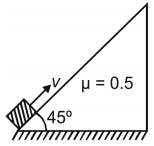
A block of mass 1 kg is projected from the lowest point up along the inclined plane. If $g = 10 \mathrm {~ms} ^ { - 2 }$, the retardation experienced by the block is
Laws of Motion – NEET-12128
  1. A $\frac { 15 } { \sqrt { 2 } } \mathrm {~m} \mathrm {~s} ^ { - 2 }$
  2. B $\frac { 5 } { \sqrt { 2 } } \mathrm {~m} \mathrm {~s} ^ { - 2 }$
  3. C $\frac { 10 } { \sqrt { 2 } } \mathrm {~m} \mathrm {~s} ^ { - 2 }$
  4. D Zero
Show answer & explanation

Correct answer: A

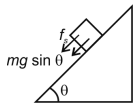
Laws of Motion – NEET-12128 Retarding forces will be friction and gravitational force
$\begin{aligned} a & =-\left(g \sin 45^{\circ}+\mu g \cos 45^{\circ}\right) \\ & =-\left(\frac{10}{\sqrt{2}}+(0.5) \frac{(10)}{\sqrt{2}}\right) \\ & =\frac{15}{\sqrt{2}}\end{aligned}$
15
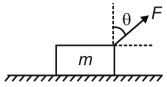
If block is at verge of motion, then select the correct option (where μ is the coefficient of friction)
Laws of Motion – NEET-12217
  1. A $F = \frac { \mu m g } { \sin \theta }$
  2. B $F = \frac { \mu m g } { \sin \theta + \mu \cos \theta }$
  3. C F = mg
  4. D F = μmg
Show answer & explanation

Correct answer: B

N = mg - F cos θ
F sin θ = μN (Al equilibrium)
F sin θ = μ(mg - F cos θ)
F(sin θ + μ cos θ) = μmg
$F=\frac{\mu m g}{(\sin \theta+\mu \cos \theta)}$
16
If linear momentum of particle changes with time t as p = (3t$^{2}$ + 2t + 1) kg m/s, then force acting on particle at t = 3 s will be
  1. A 10 N
  2. B 20 N
  3. C 15 N
  4. D 11 N
Show answer & explanation

Correct answer: B

$\begin{array}{l}p=\left(3 t^{2}+2 t+1\right) \\ F=\frac{d p}{d t}=6 t+2 \\ F(t=3 \mathrm{~s})=(6 \times 3+2)=20 \mathrm{~N}\end{array}$
17
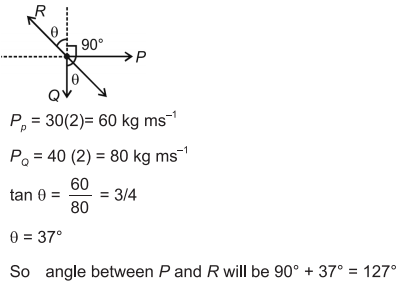
A 6 kg bomb at rest explodes into three equal pieces P, Q, and R. If P flies with speed 30 m/s and Q with speed 40 m/s making an angle $90 ^ { \circ }$ with the direction of P. The angle between the direction of motion of P and R is about
  1. A $143 ^ { \circ }$
  2. B $127 ^ { \circ }$
  3. C $120 ^ { \circ }$
  4. D $150 ^ { \circ }$
Show answer & explanation

Correct answer: B

Laws of Motion – NEET-12119
18
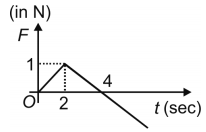
Force acting on a body varies with time as shown below. If initial momentum of the body is $\vec { p }$,then the time taken by the body to retain its momentum $\vec { p }$ again is
Laws of Motion – NEET-12304
  1. A 8 s
  2. B (4 + 2√2) s
  3. C 6 s
  4. D Can never obtain
Show answer & explanation

Correct answer: B

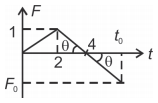
Laws of Motion – NEET-12304 $\begin{array}{l}\tan \theta=\frac{1}{2}=\frac{F_{0}}{t_{0}-4} \\ \Rightarrow \quad F_{0}=\frac{t_{0}-4}{2}\end{array}$
Total change in momentum should be zero, then only it will retain its initial momentum.
So, positive area of F-t curve should be equal to negative area of F-t curve till time $t_{0}$.
$\begin{aligned} \frac{1}{2}(4)(1) & =\frac{1}{2}\left(t_{0}-4\right) F_{0} \\ 8 & =\frac{\left(t_{0}-4\right)}{2} \cdot \frac{\left(t_{0}-4\right)}{2} \\ \left(t_{0}-4\right)^{2} & =32 \\ t_{0} & =4+2 \sqrt{2}\end{aligned}$
19
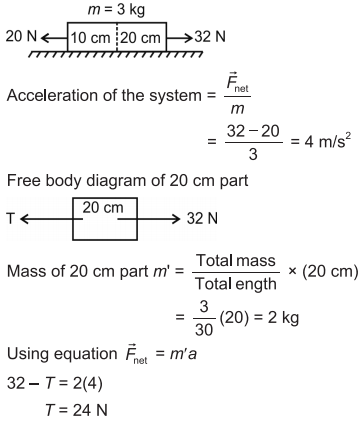
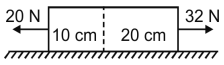
Figure shows a uniform rod of length 30 cm having a mass 3.0 kg. The rod is pulled by constant forces of 20 N and 32 N as shown. Find the force exerted by 20 cm part of the rod on the 10 cm part (all surfaces are smooth) is
Laws of Motion – NEET-12109
  1. A 36 N
  2. B 12 N
  3. C 64 N
  4. D 24 N
Show answer & explanation

Correct answer: D

Laws of Motion – NEET-12109
20
A cyclist paddling at a speed of 10 m/s on a level road takes a sharp circular turn of radius 10 m without reducing the speed. The angle made by cyclist with vertical is
  1. A $\frac { \pi } { 4 }$
  2. B $\frac { \pi } { 3 }$
  3. C $\frac { \pi } { 6 }$
  4. D $\frac { \pi } { 2 }$
Show answer & explanation

Correct answer: A

$\begin{array}{l}\tan \theta=\frac{v^{2}}{R g} \\ \Rightarrow \tan \theta=\frac{10^{2}}{10 \times 10}=1 \\ \Rightarrow \quad \theta=\frac{\pi}{4}\end{array}$

Attempt this as a timed test

Reading answers is not the same as sitting the paper. Attempt it timed and you get your score, per-question timing, and the mistakes tracked for revision.

Start free

More Laws of Motion tests

All Laws of Motion tests →