Rotational Motion — DPP 1

20 NEET questions from Rotational Motion, with answers and explanations. Attempt it as a timed test to get scoring, accuracy breakdown and mistake tracking.

Attempt this test free 20 questions · 30 minutes · +80 marks
1
Three thin uniform rods each of mass M and length L are placed along the three axis of a cartesian coordinate system with one end of each rod at the origin. The M. I. of the system about z -axis is
  1. A $\frac { \mathrm { ML } ^ { 2 } } { 3 }$
  2. B $\frac { 2 M L ^ { 2 } } { 3 }$
  3. C $\frac { M L ^ { 2 } } { 6 }$
  4. D $\mathrm { ML } ^ { 2 }$
Show answer & explanation

Correct answer: B

$\mathrm{I}_{\mathrm{z}}=\frac{\mathrm{ML}^{2}}{3}+\frac{\mathrm{ML}^{2}}{3}+0 \Rightarrow \mathrm{I}_{\mathrm{z}}=\frac{2}{3} \mathrm{ML}^{2}$
2
The axis X and Z in the plane of a disc are mutually perpendicular and Y -axis is perpendicular to the plane of the disc. If the moment of inertia of the body about X and Y axes is respectively 30 kg m$^{2}$ and 40 kg m$^{2}$ then M.I. about Z -axis in kg m$^{2}$ will be :-
  1. A 70
  2. B 50
  3. C 10
  4. D Zero
Show answer & explanation

Correct answer: C

As disc is lying in the x-z plane, so applying perpendicular axis theorem :-
I$_{x}$ + I$_{z}$ = I$_{y}$
30 + I$_{z}$ = 40
⇒ I$_{z}$ = 40 – 30 = 10 kg m$^{2}$
3
Which of the following has the highest moment of inertia when each of them has the same mass and the same radius ?
  1. A a hollow sphere about one of its diameters
  2. B a solid sphere about one of its diameters
  3. C a disc about its central axis perpendicular to the plane of the disc
  4. D a ring about its central axis perpendicular to the plane of the ring.
Show answer & explanation

Correct answer: D

$\mathrm{I}_{(1)}=\frac{2}{3} \mathrm{MR}^{2}, \mathrm{I}_{(2)}=\frac{2}{5} \mathrm{MR}^{2}, \mathrm{I}_{(3)}=\frac{\mathrm{MR}^{2}}{2}, \mathrm{I}_{(4)}=\mathrm{MR}^{2}$
4
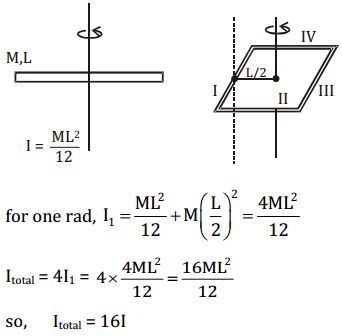
The M.I. of a thin rod of length $\ell$ about the perpendicular axis through its centre is I. The M.I. of the square structure made by four such rods about a perpendicular axis to the plane and through the centre will be :-
  1. A 4I
  2. B 8I
  3. C 12I
  4. D 16I
Show answer & explanation

Correct answer: D

Rotational Motion – NEET-7007
5
The moment of inertia of a rod of mass M and length L about an axis passing through one edge and perpendicular to its length will be :-
  1. A $\frac { \mathrm { ML } ^ { 2 } } { 12 }$
  2. B $\frac { M L ^ { 2 } } { 6 }$
  3. C $\frac { M L ^ { 2 } } { 3 }$
  4. D ML$^{2}$
Show answer & explanation

Correct answer: C

Using parallel axes theorem
$\begin{array}{l}I=I_{C M}+M d^{2} \\ I=\frac{M L^{2}}{12}+M\left(\frac{L}{2}\right)^{2} \\ I=\frac{M L^{2}}{3}\end{array}$
6
If the radius of gyration of a solid disc of mass 10 kg about an axis is 0.40 m , then the moment of inertia of the disc about that axis is
  1. A 1.6 kg m$^{2}$
  2. B 3.2 kg m$^{2}$
  3. C 6.4 kg m$^{2}$
  4. D 9.5 kg m$^{2}$
Show answer & explanation

Correct answer: A

$I=M K^{2} \Rightarrow I=10(0.4)^{2}=1.6 \mathrm{~kg}-\mathrm{m}^{2}$
7
All the particles of a rigid rotating body move in a circular path when the axis of rotation:-
  1. A passes through any point in the body
  2. B is situated outside the body
  3. C situated any where
  4. D passes through the centre of mass
Show answer & explanation

Correct answer: B

Particles present on the axis of rotation are not performing circular motion.
8
Four similar point masses (each of mass m ) are placed on the circumference of a disc of mass M and radius R . The M.I. of the system about the normal axis through the centre O will be:-
Rotational Motion – NEET-6995
  1. A $\mathrm { MR } ^ { 2 } + 4 \mathrm { mR } ^ { 2 }$
  2. B $\frac { 1 } { 2 } \mathrm { MR } ^ { 2 } + 4 \mathrm { mR } ^ { 2 }$
  3. C $\mathrm { MR } ^ { 2 } + \frac { 8 } { 5 } \mathrm { mR } ^ { 2 }$
  4. D none of these
Show answer & explanation

Correct answer: B

$\mathrm{I}=\mathrm{I}_{\mathrm{disc}}+\mathrm{I}_{\text {Masses }}=\frac{\mathrm{MR}^{2}}{2}+4 \mathrm{mR}^{2}$
9
The theorem of perpendicular axes is not applicable for determination of moment of inertia along the diameter, for which of the following body :-
  1. A sphere
  2. B disc
  3. C ring
  4. D blade
Show answer & explanation

Correct answer: A

The theorem of perpendicular axes is applicable only for 2-D objects.
10
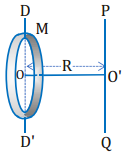
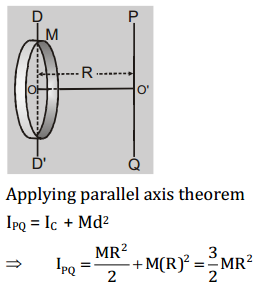
The moment of inertia of a ring of mass M and radius R about PQ axis will be :-
Rotational Motion – NEET-7013
  1. A MR$^{2}$
  2. B $\frac { \mathrm { MR } ^ { 2 } } { 2 }$
  3. C $\frac { 3 } { 2 } \mathrm { MR } ^ { 2 }$
  4. D 2MR$^{2}$
Show answer & explanation

Correct answer: C

Rotational Motion – NEET-7013
11
A solid sphere and a hollow sphere of the same mass have the same M.I. about their respective diameters. The ratio of their radii will be :-
  1. A 1 : 2
  2. B $\sqrt { 3 } : \sqrt { 5 }$
  3. C $\sqrt { 5 } : \sqrt { 3 }$
  4. D 5 : 4
Show answer & explanation

Correct answer: C

given I$_{solid sphere}$ = I$_{hollow sphere}$
$\begin{array}{l}\Rightarrow \quad \frac{2}{5} \mathrm{Mr}_{1}^{2}=\frac{2}{3} \mathrm{Mr}_{2}^{2} \Rightarrow \frac{\mathrm{r}_{1}^{2}}{\mathrm{r}_{2}^{2}}=\frac{5}{3} \\ \Rightarrow \quad \frac{\mathrm{r}_{1}}{\mathrm{r}_{2}}=\sqrt{5}: \sqrt{3}\end{array}$
12
A circular disc is to be made by using iron and aluminium so that it acquired maximum moment of inertia about geometrical axis. It is possible with:
  1. A aluminium at interior and iron surrounded to it.
  2. B iron at interior and aluminium surrounded to it.
  3. C using iron and aluminium layers in alternate order.
  4. D sheet of iron is used at both external surface and aluminium sheet as internal layer.
Show answer & explanation

Correct answer: A

M.I is proportional mass distribution of the body. So, to increase M.I of the disc its heavier mass is concentrated far from the axis of rotation.
13
The moment of inertia in rotational motion is equivalent to :-
  1. A angular velocity of linear motion
  2. B mass of linear motion
  3. C frequency of linear motion
  4. D current
Show answer & explanation

Correct answer: B

The moment of inertia in rotational motion is equivalent to mass of linear motion.
14
On account of the earth rotating about its axis :-
  1. A the linear velocity of objects at equator is greater than at other places.
  2. B the angular velocity of objects at equator is more than that of objects at poles.
  3. C the linear velocity of objects at all places at the earth is equal, but angular velocity is different.
  4. D at all places the angular velocity and linear velocity are uniform.
Show answer & explanation

Correct answer: A

During rotation angular velocity is constant linear velocity will be more if distance from the axis of rotation of earth will be more.
15
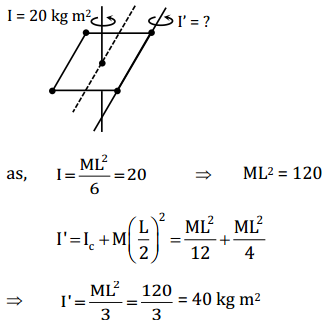
The moment of inertia of a square lamina about the perpendicular axis through its centre of mass is 20 kg-m$^{2}$. Then, its moment of inertia about an axis touching its side and in the plane of the lamina will be :-
  1. A $10 \mathrm {~kg} - \mathrm { m } ^ { 2 }$
  2. B $30 \mathrm {~kg} - \mathrm { m } ^ { 2 }$
  3. C $40 \mathrm {~kg} - \mathrm { m } ^ { 2 }$
  4. D $25 \mathrm {~kg} - \mathrm { m } ^ { 2 }$
Show answer & explanation

Correct answer: C

Rotational Motion – NEET-7006
16
Which of the following pairs do not match :-
  1. A rotational power - Joule/sec
  2. B torque - Newton meter
  3. C angular displacement - radian
  4. D angular acceleration - radian/sec
Show answer & explanation

Correct answer: D

Physical quantity and its units.
17
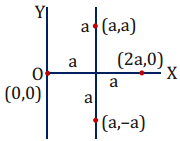
Four point masses (each of mass m) are arranged it the X-Y plane the moment of inertia of this array of masses about Y -axis is
Rotational Motion – NEET-7014
  1. A ma$^{2}$
  2. B 2ma$^{2}$
  3. C 4ma$^{2}$
  4. D 6ma$^{2}$
Show answer & explanation

Correct answer: D

$\begin{array}{l}I=m(a)^{2}+m(a)^{2}+m(0)^{2}+m(2 a)^{2} \\ \Rightarrow \quad I=6 m a^{2}\end{array}$
18
A fly wheel is so constructed that almost whole of its mass is concentrated at its rim, because:-
  1. A it increases the moment of inertia of the fly-wheel
  2. B it decreases the moment of inertia of the fly-wheel
  3. C it increases the speed of the fly-wheel
  4. D it increases the power of the fly-wheel
Show answer & explanation

Correct answer: A

M.I is the proportional mass distribution of the body. So, to increase M.I of a fly wheel its mass is concentrated at its rim.
19
The moment of inertia of a body about a given axis of rotation depends upon :-
  1. A the distribution of mass
  2. B distance of particle of body from the axis of rotation
  3. C shape of the body
  4. D all of the above
Show answer & explanation

Correct answer: D

Moment of inertia depends on:
(a) mass of the body
(b) mass distribution of the body
(c) position of axis of rotation
20
The moment of inertia of a solid cylinder about its own axis is the same as its moment of inertia about an axis passing through its centre of gravity and perpendicular to its length. The relation between its length L and radius R is
  1. A $L = \sqrt { 2 } R$
  2. B $\mathrm { L } = \sqrt { 3 } \mathrm { R }$
  3. C L = 3R
  4. D L = R
Show answer & explanation

Correct answer: B

$\frac{\mathrm{ML}^{2}}{12}+\frac{\mathrm{MR}^{2}}{4}=\frac{\mathrm{MR}^{2}}{2} \Rightarrow \frac{\mathrm{~L}^{2}}{12}=\frac{\mathrm{R}^{2}}{4} \Rightarrow \mathrm{~L}=\sqrt{3} \mathrm{R}$

Attempt this as a timed test

Reading answers is not the same as sitting the paper. Attempt it timed and you get your score, per-question timing, and the mistakes tracked for revision.

Start free

More Rotational Motion tests

All Rotational Motion tests →