Rotational Motion — DPP 2

20 NEET questions from Rotational Motion, with answers and explanations. Attempt it as a timed test to get scoring, accuracy breakdown and mistake tracking.

Attempt this test free 20 questions · 30 minutes · +80 marks
1
The curve for the moment of inertia of a sphere of constant mass M versus distance of axis from its centre ?
  1. A
  2. B
  3. C
  4. D
Show answer & explanation

Correct answer: B

Using parallel axis theorem
$\mathrm{I}=\frac{2}{5} \mathrm{MR}^{2}+\mathrm{MX}^{2}$
Graph is parabola
For X = 0, I = $\frac{2}{5} \mathrm{MR}^{2}$
∴ Correct option (B)
2
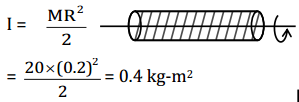
A solid cylinder of mass 20 kg has length 1 m and radius 0.2 m. Then its moment of inertia (in kg-m$^{2}$) about its geometrical axis is :-
  1. A 0.8 kg-m$^{2}$
  2. B 0.4 kg-m$^{2}$
  3. C 0.2 kg-m$^{2}$
  4. D 20.2 kg-m$^{2}$
Show answer & explanation

Correct answer: B

Rotational Motion – NEET-7097
3
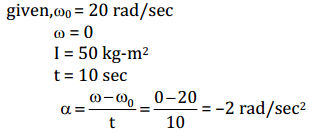
If I = 50 kg-m$^{2}$, then how much torque will be applied to stop it in 10 sec. Its initial angular speed is 20 rad/sec:-
  1. A 100 N-m
  2. B 150 N-m
  3. C 200 N-m
  4. D 250 N-m
Show answer & explanation

Correct answer: A

Rotational Motion – NEET-7140
4
The quantity not involved directly in rotational motion of the body is
  1. A moment of inertia
  2. B torque
  3. C angular velocity
  4. D mass
Show answer & explanation

Correct answer: D

For rotational motion we use moment of inertia.
5
A particle of mass m and radius of gyration K is rotating with an angular acceleration α. The torque acting on the particle is
  1. A $\frac { 1 } { 2 } \mathrm { mK } ^ { 2 } \alpha$
  2. B $\mathrm { mK } ^ { 2 } \alpha$
  3. C $\mathrm { mK } ^ { 2 } / \alpha$
  4. D $\frac { 1 } { 4 } \mathrm { mK } ^ { 2 } \alpha ^ { 2 }$
Show answer & explanation

Correct answer: B

As, torque = Iα
⇒ τ = mK$^{2}$α {where K = radius of gyration}
6
A ring and a solid sphere of same mass and radius are rotating with the same angular velocity about their diametric axes then :-
  1. A it is easier to stop the ring
  2. B it is easier to stop the solid sphere
  3. C it is equally difficult to stop both of them
  4. D it is not possible to stop a rotating body
Show answer & explanation

Correct answer: B

τ = Iα
τ ∝ I i.e, moment of inertia
7
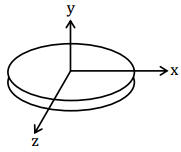
By the theorem of perpendicular axes, if a body be in X-Z-plane then :-
  1. A $I _ { x } - I _ { y } = I _ { z }$
  2. B $I _ { x } + I _ { z } = I _ { y }$
  3. C $I _ { x } + I _ { y } = I _ { z }$
  4. D $\mathrm { I } _ { \mathrm { y } } + \mathrm { I } _ { \mathrm { z } } = \mathrm { I } _ { \mathrm { x } }$
Show answer & explanation

Correct answer: B

For perpendicular axes
I$_{y}$ = I$_{x}$ + I$_{z}$
Rotational Motion – NEET-6996
8
If $I _ { 1 } , I _ { 2 }$ and $I _ { 3 }$ are moments of inertia of solid sphere, hollow sphere and a ring of same mass and radius about geometrical axis, which of the following statement holds good ?
  1. A $I _ { 1 } > I _ { 2 } > I _ { 3 }$
  2. B $\mathrm { I } _ { 3 } > \mathrm { I } _ { 2 } > \mathrm { I } _ { 1 }$
  3. C I $_ { 2 } >$ I $_ { 1 } >$ I $_ { 3 }$
  4. D I $_ { 2 } >$ I $_ { 3 } >$ I $_ { 1 }$
Show answer & explanation

Correct answer: B

$\mathrm{I}_{1}=\frac{2}{5} \mathrm{MR}^{2} ; \mathrm{I}_{2}=\frac{2}{3} \mathrm{MR}^{2} ; \mathrm{I}_{3}=\mathrm{MR}^{2}$
9
The grinding stone of a flour mill is rotating at 600 rad/sec. For this, power of 1.2 k watt is used. the effective torque on stone in N-m will be :-
  1. A 1
  2. B 2
  3. C 3
  4. D 4
Show answer & explanation

Correct answer: B

Power, $P=\tau \times \omega$
so, $\tau=\frac{P}{\omega}=\frac{1200}{600}=2 \mathrm{~N}-\mathrm{m}$
10
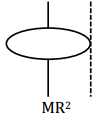
The moment of inertia of a circular ring (radius R, mass M) about an axis which passes through tangentially and perpendicular to its plane will be:-
  1. A $\frac { \mathrm { MR } ^ { 2 } } { 2 }$
  2. B MR$^{2}$
  3. C $\frac { 3 } { 2 } M R ^ { 2 }$
  4. D 2MR$^{2}$
Show answer & explanation

Correct answer: D

Rotational Motion – NEET-7098 Using parallel axis theorem
I = MR$^{2}$ + MR$^{2}$
I = 2MR$^{2}$
11
A constant torque acting on a uniform circular wheel changes its angular momentum from A$_{0}$ to 4A$_{0}$ in 4 seconds. The magnitude of this torque is :-
  1. A $\frac { 3 A _ { 0 } } { 4 }$
  2. B $\mathrm { A } _ { 0 }$
  3. C $4 \mathrm {~A} _ { 0 }$
  4. D $12 A _ { 0 }$
Show answer & explanation

Correct answer: A

$\begin{aligned} \text { Torque } & =\frac{\text { Change in angular momentum }}{\text { time }} \\ \tau & =\frac{L_{2}-L_{1}}{t}=\frac{4 A_{0}-A_{0}}{4} \\ \Rightarrow \quad \tau & =\frac{3 A_{0}}{4}\end{aligned}$
12
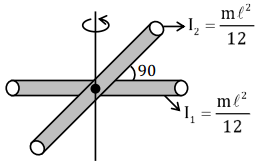
Two rods each of mass m and length $\ell$ are joined at the centre to form a cross. The moment of inertia of this cross about an axis passing through the common centre of the rods and perpendicular to the plane formed by them, is :-
  1. A $\frac { m \ell ^ { 2 } } { 12 }$
  2. B $\frac { m \ell ^ { 2 } } { 6 }$
  3. C $\frac { m \ell ^ { 2 } } { 3 }$
  4. D $\frac { m \ell ^ { 2 } } { 2 }$
Show answer & explanation

Correct answer: B

Rotational Motion – NEET-7094
13
When constant torque is acting on a body then :-
  1. A body maintain its state or moves in straight line with same velocity
  2. B acquire linear acceleration
  3. C acquire angular acceleration
  4. D rotates with a constant angular velocity
Show answer & explanation

Correct answer: C

$\begin{array}{l}\vec{\tau}=I \vec{\alpha} \\ \vec{\tau}=\text { constant } \\ \vec{\alpha}=\text { constant }, \text { if } I=\text { constant }\end{array}$
14
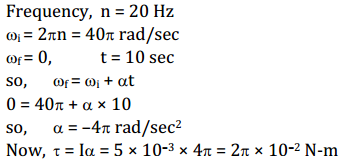
A wheel has moment of inertia $5 \times 10 ^ { - 3 } \mathrm {~kg} \mathrm {~m} ^ { 2 }$ and is making $20 \mathrm { rev } / \mathrm { sec }$. The torque needed to stop it in 10 sec is $\_\_\_\_$ $\times 10 ^ { - 2 } \mathrm {~N} - \mathrm { m } : -$
  1. A 2π
  2. B 2.5π
  3. C 4π
  4. D 4.5π
Show answer & explanation

Correct answer: A

Rotational Motion – NEET-7135
15
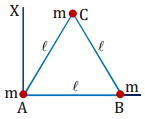
Three particles, each of mass m are situated at the vertices of an equilateral triangle ABC of side $\ell$ (as shown in the figure).
Rotational Motion – NEET-7096 The moment of inertia of the system about a line AX perpendicular to AB and in the plane of ABC, will be :-
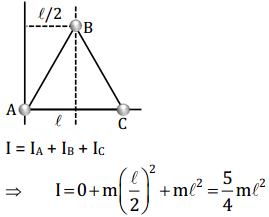
  1. A $2 m \ell ^ { 2 }$
  2. B $\frac { 5 } { 4 } \mathrm {~m} \ell ^ { 2 }$
  3. C $\frac { 3 } { 2 } \mathrm {~m} \ell ^ { 2 }$
  4. D $\frac { 3 } { 4 } \mathrm {~m} \ell ^ { 2 }$
Show answer & explanation

Correct answer: B

Rotational Motion – NEET-7096
16
If torque on a body is zero, then which is conserved:
  1. A force
  2. B linear momentum
  3. C angular momentum
  4. D angular impulse
Show answer & explanation

Correct answer: C

$\begin{array}{l}\vec{\tau}=\mathrm{I} \vec{\alpha}=\frac{\mathrm{d} \overrightarrow{\mathrm{L}}}{\mathrm{dt}} \\ \vec{\tau}=0 \Rightarrow \overrightarrow{\mathrm{~L}}=\text { constant angular momentum }\end{array}$
17
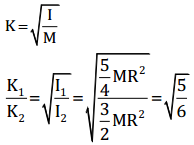
The ratio of the radii of gyration of a circular disc about a tangential axis in the plane of the disc and of a circular ring of the same radius about a tangential axis in the plane of the ring is :-
  1. A 2 : 1
  2. B $\sqrt { 5 } : \sqrt { 6 }$
  3. C 2 : 3
  4. D $1 : \sqrt { 2 }$
Show answer & explanation

Correct answer: B

Rotational Motion – NEET-7095
18
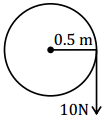
The moment of inertia of a disc of radius 0.5 m about its geometric axis is 2 kg-m$^{2}$. If a string is tied to its circumference and a force of 10 Newton is applied, the value of torque with respect to this axis will be :-
  1. A 2.5 N-m
  2. B 5 N-m
  3. C 10 N-m
  4. D 20 N-m
Show answer & explanation

Correct answer: B

So, torque = 10 × 0.5 = 5 N-m
Rotational Motion – NEET-7127
19
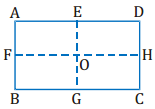
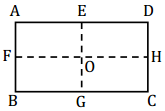
In the rectangular lamina shown in the figure, AB = BC/2. The moment of inertia of the lamina is minimum along the axis passing through :-
Rotational Motion – NEET-7118
  1. A AB
  2. B BC
  3. C EG
  4. D FH
Show answer & explanation

Correct answer: D

The moment of inertia is minimum about FH because mass distribution is at minimum distance from FH.
Rotational Motion – NEET-7118
20
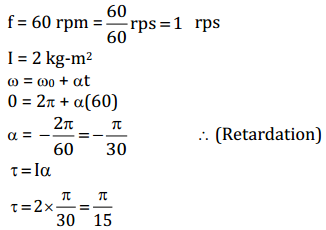
A wheel having moment of inertia 2 kg-m$^{2}$ about its vertical axis, rotates at the rate of 60 rpm about the axis. The torque which can stop the wheel's rotation in one minute would be :-
  1. A $\frac { \pi } { 12 } \mathrm {~N} - \mathrm { m }$
  2. B $\frac { \pi } { 15 } \mathrm {~N} - \mathrm { m }$
  3. C $\frac { \pi } { 30 } \mathrm {~N} - \mathrm { m }$
  4. D $\frac { 2 \pi } { 15 } \mathrm {~N} - \mathrm { m }$
Show answer & explanation

Correct answer: B

Rotational Motion – NEET-7136

Attempt this as a timed test

Reading answers is not the same as sitting the paper. Attempt it timed and you get your score, per-question timing, and the mistakes tracked for revision.

Start free

More Rotational Motion tests

All Rotational Motion tests →