Waves — DPP 1

20 NEET questions from Waves, with answers and explanations. Attempt it as a timed test to get scoring, accuracy breakdown and mistake tracking.

Attempt this test free 20 questions · 30 minutes · +80 marks
1
A uniform wire of length L, diameter d, and density ρ is stretched under a tension T. The correct relation between its fundamental frequency f, the length L and the diameter d is:
  1. A $\mathrm { f } \propto \frac { 1 } { \mathrm { Ld } }$
  2. B $f \propto \frac { 1 } { L \sqrt { d } }$
  3. C $\mathrm { f } \propto \frac { 1 } { \mathrm {~d} _ { 1 } ^ { 2 } }$
  4. D $\mathrm { f } \propto \frac { 1 } { \mathrm { Ld } ^ { 2 } }$
Show answer & explanation

Correct answer: A

$f=\frac{\sqrt{\frac{T}{m / L}}}{2 L}$
T = Tension
M = mass of string
L = Length
d = diameter
$\begin{array}{l}\therefore \rho=\frac{M}{V}=\frac{M}{L \times \pi \frac{d^{2}}{4}} \Rightarrow M=\rho L \pi \frac{d^{2}}{4} \\ f=\frac{\sqrt{\frac{4 T}{\rho L \pi d^{2} / L}}}{2 L} \propto \frac{1}{L d}\end{array}$
Therefore, option (A) is the correct answer.
2
Velocity of sound in air is $320 \mathrm {~ms} ^ { - 1 }$. A pipe closed at one end has length of 1 m. Neglecting end corrections, the air column in the pipe can resonate for sound of frequency
  1. A 80 Hz
  2. B 240 Hz
  3. C 400 Hz
  4. D All of these
Show answer

Correct answer: D

3
Equation wave are represented by $y = 0.8 \operatorname { Sin } ( 0.5 \pi x - 4 \pi t + \frac { \pi } { 4 }$ ). Find the velocity of wave
  1. A 8 m/s
  2. B 2 m/s
  3. C 8π m/s
  4. D 2π m/s
Show answer

Correct answer: A

4
A heavy uniform rope hangs vertically from the ceiling, with its lower end free. A disturbance on the rope travelling upward from the lower end has a velocity v at a distance x from the lower end:
  1. A $\mathrm { v } \propto 1 / x$
  2. B v ∝ x
  3. C $\mathrm { v } \propto \sqrt { \mathrm { x } }$
  4. D $\mathrm { v } \propto 1 / \sqrt { \mathrm { x } }$
Show answer & explanation

Correct answer: C

Let m = mass per unit length of the rope,
T = tension in the rope at a distance x from the lower end.
∴ T = mxg
$\therefore \mathrm{v}=\sqrt{T / m}=\sqrt{m x g / m}=\sqrt{g x} \quad$ or $\mathrm{v} \propto \sqrt{\mathrm{x}}$
Therefore, option (C) is the correct answer.
5
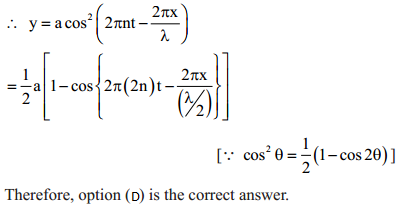
The equation $y = a \cos ^ { 2 } ( 2 \pi n t - 2 \pi x / \lambda )$ represents a wave with:
  1. A Amplitude a, frequency n and wavelength λ
  2. B Amplitude a, frequency 2n and wavelength 2λ
  3. C Amplitude a/2, frequency 2n and wavelength λ
  4. D Amplitude a/2, frequency 2n and wavelength λ/2
Show answer & explanation

Correct answer: D

Waves – NEET-18750
6
A progressive wave moving along x-axis is represented by $y = \mathrm { A } \sin \left[ \frac { 2 \pi } { \lambda } ( \mathrm { vt } - \mathrm { x } ) \right]$. The wavelength at which the maximum particle velocity is 3 times the wave velocity is
  1. A $\frac { \mathrm { A } } { 3 }$
  2. B $\frac { 2 \mathrm {~A} } { 3 \pi }$
  3. C $\frac { 3 } { 4 } \pi \mathrm {~A}$
  4. D $\frac { 2 } { 3 } \pi \mathrm {~A}$
Show answer

Correct answer: D

7
Two waves of same frequency and of intensity $I _ { 0 }$ and $9 I _ { 0 }$ produces interference. If at a certain point the resultant intensity is $7 I _ { 0 }$ then the minimum phase difference between the two sound waves will be
  1. A $90 ^ { \circ }$
  2. B $100 ^ { \circ }$
  3. C $120 ^ { \circ }$
  4. D $110 ^ { \circ }$
Show answer

Correct answer: C

8
An organ pipe closed at one end has fundamental frequency of 1500 Hz. The maximum number of overtones generated by this pipe which a normal person can hear is:
  1. A 4
  2. B 13
  3. C 6
  4. D 9
Show answer & explanation

Correct answer: C

For a closed organ pipe $v^{\prime}=(2 n+1) \frac{v}{4 L}$
$v=\frac{v}{4 L}=1500$ (Fundamental)
Human Audible Range = 20 – 20,000 Hz
∴ (2n + 1)1500 < 20,000
$(2 n+1)<\frac{40}{3}$
2n + 1 < 13.1
n < 6.1
∴ no. of n possible = 6
Therefore, option (C) is the correct answer.
9
If the ratio of amplitude of wave is 2 : 1 then the ratio of maximum and minimum intensity is
  1. A 9 : 1
  2. B 1 : 9
  3. C 4 : 1
  4. D 1 : 4
Show answer

Correct answer: A

10
The resultant amplitude, when two waves of same frequency but with amplitudes $a _ { 1 }$ and $a _ { 2 }$ superimpose at phase difference of $\frac { \pi } { 2 }$ will be
  1. A $a _ { 1 } + a _ { 2 }$
  2. B $a _ { 1 } - a _ { 2 }$
  3. C $\sqrt { a _ { 1 } ^ { 2 } + a _ { 2 } ^ { 2 } }$
  4. D $\mathrm { a } _ { 1 } ^ { 2 } + \mathrm { a } _ { 2 } ^ { 2 }$
Show answer

Correct answer: C

11
In a resonance pipe the first and second resonances are obtained at depths 22.7 cm and 70.2 cm respectively. What will be the end correction?
  1. A 1.05 cm
  2. B 1115.5 cm
  3. C 92.5 cm
  4. D 113.5 cm
Show answer

Correct answer: A

12
Velocity of sound in a gaseous medium is $330 \mathrm {~ms} ^ { - 1 }$. If the pressure is increased by 4 times without change in temperature, the velocity of sound in the gas is:
  1. A $330 \mathrm {~ms} ^ { - 1 }$
  2. B $660 \mathrm {~ms} ^ { - 1 }$
  3. C $156 \mathrm {~ms} ^ { - 1 }$
  4. D $990 \mathrm {~ms} ^ { - 1 }$
Show answer

Correct answer: A

13
When a certain volume of water is subjected to increase of 100 kPa pressure, fractional decrease in volume of water is 0.005% of its original volume. The speed of sound in water must be
  1. A 140 m/s
  2. B 300 m/s
  3. C 1414 m/s
  4. D 5000 m/s
Show answer

Correct answer: C

14
Temperature at which the speed of sound in air becomes doubled its value at $0 ^ { \circ } \mathrm { C }$ is:
  1. A $1092 ^ { \circ } \mathrm { C }$
  2. B $819 ^ { \circ } \mathrm { C }$
  3. C 819 K
  4. D $546 ^ { \circ } \mathrm { C }$
Show answer

Correct answer: C

15
If wavelength of wave λ = 20 m and its frequency 200 Hz. Its velocity becomes
  1. A 2000 m/s
  2. B 4100 m/s
  3. C 4000 m/s
  4. D 4200 m/s
Show answer

Correct answer: C

16
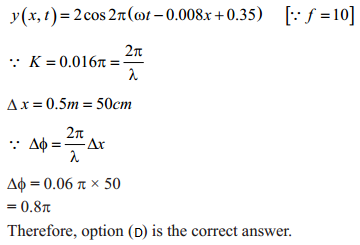
For the travelling harmonic wave: $y ( x , t ) = 2 \cos 2 \pi ( 10 t - 0.008 x + 0.35 )$ where x and y are in cm and t is in s. The phase difference between the oscillatory motion of two points separated by a distance of 0.5 m is:
  1. A 0.2π
  2. B 0.4π
  3. C 0.6π
  4. D 0.8π
Show answer & explanation

Correct answer: D

Waves – NEET-18758
17
The displacement due to a wave moving in the positive x-direction is given by $y = \frac { 1 } { \left( 1 + x ^ { 2 } \right) }$ at time t = 0 and by y = $\frac{1}{\left[1+(x-1)^{2}\right]}$ at t = 2 seconds, where x and y are in metres. The velocity of the wave in m/s is:
  1. A 0.5
  2. B 1
  3. C 2
  4. D 4
Show answer & explanation

Correct answer: A

In a wave equation, x and t must be related in the form (x – vt).
We rewrite the given equation as y = $\frac{1}{1+(x-v t)^{2}}$
For t = 0, this becomes $y=\frac{1}{\left(1+x^{2}\right)}$ as given
For t = 2, this becomes $y=\frac{1}{\left[1+(x-2 v)^{2}\right]}=\frac{1}{\left[1+(x-1)^{2}\right]}$
∴ 2v = 1 or v = 0.5 m/s.
Therefore, option (A) is the correct answer.
18
Fundamental frequency of sonometer wire is n. If the length, tension and diameter of wire are tripled, then new fundamental frequency is
  1. A $\frac { n } { \sqrt { 3 } }$
  2. B $\frac { n } { 3 }$
  3. C $n \sqrt { 3 }$
  4. D $\frac { n } { 3 \sqrt { 3 } }$
Show answer

Correct answer: D

19
A stretched string of length l fixed at both ends can sustain stationary waves of wavelength λ given below:
  1. A $\lambda = \frac { n ^ { 2 } } { 2 l }$
  2. B $\lambda = \frac { \ell ^ { 2 } } { 2 \mathrm { n } }$
  3. C $\lambda = \frac { 2 l } { n }$
  4. D λ = 2ln
Show answer & explanation

Correct answer: C

We know that
$\ell=\frac{\mathrm{n} \lambda_{\mathrm{n}}}{2}$
$\therefore \lambda_{n}=\frac{2 \ell}{n}$
Therefore, option (C) is the correct answer.
20
The equation of a wave travelling on a string is $y=4 \sin \left[\frac{\pi}{2}\left\{4 t+\frac{x}{8}\right\}\right]$ where x , y are in cm and t is in seconds. The velocity of the wave is:
  1. A 64 cm/s in -x direction
  2. B 32 cm/s in -x direction
  3. C 32 cm/s in +x direction
  4. D 64 cm/s in +x direction
Show answer & explanation

Correct answer: B

$\begin{array}{l}y=a \sin \left(\frac{2 \pi}{T} t+\frac{2 \pi}{\lambda} x\right) \\ \frac{2 \pi}{T}=\frac{\pi}{2} \times 4 \Rightarrow T=1 \mathrm{sec} \quad \Rightarrow \quad f=1 \mathrm{~Hz} \\ \frac{2 \pi}{\lambda}=\frac{\pi}{16} \quad \therefore \lambda=32 \mathrm{~cm}\end{array}$
∴ Velocity = λ × f = 32 × 1 = 32 cm/sec in the negative x-direction.
Therefore, option (B) is the correct answer.

Attempt this as a timed test

Reading answers is not the same as sitting the paper. Attempt it timed and you get your score, per-question timing, and the mistakes tracked for revision.

Start free

More Waves tests

All Waves tests →