Waves — DPP 3

20 NEET questions from Waves, with answers and explanations. Attempt it as a timed test to get scoring, accuracy breakdown and mistake tracking.

Attempt this test free 20 questions · 30 minutes · +80 marks
1
A wave equation is given by $y = 4 \sin \left[ \pi \left( \frac { t } { 5 } - \frac { x } { 9 } + \frac { 1 } { 6 } \right) \right]$ Where x is in cm and t in sec. Which is true?
  1. A λ = 18 cm
  2. B v = 4 m/s
  3. C a = 0.4 m
  4. D f = 50 Hz
Show answer & explanation

Correct answer: A

$\begin{aligned} y & =a \sin \left(\frac{2 \pi}{T} t-\frac{2 \pi}{\lambda} x+\phi\right) \\ a & =4 \mathrm{~cm} \\ f & =\frac{1}{T}=\frac{1}{10} \mathrm{~Hz}=0.1 \mathrm{~Hz} \\ \lambda & =2 \times 9=18 \mathrm{~cm} \\ v & =f \times \lambda=0.1 \times 18=1.8 \mathrm{~cm} / \mathrm{s}\end{aligned}$
Therefore, option (A) is the correct answer.
2
A transverse wave is described by the equation $Y = Y _ { 0 } \sin 2 \pi ( f t - x / \lambda )$. The maximum particle velocity is equal to four times the wave velocity if
  1. A $\lambda = \pi Y _ { 0 } / 4$
  2. B $\lambda = \pi Y _ { 0 } / 2$
  3. C $\lambda = \pi Y _ { 0 }$
  4. D $\lambda = 2 \pi Y _ { 0 }$
Show answer

Correct answer: B

3
A sound absorber attenuates the sound level by 20 dB. The intensity decreases by a factor of:
  1. A 100
  2. B 1000
  3. C 10000
  4. D 10
Show answer & explanation

Correct answer: A

$\begin{array}{l}L_{1}=10 \log \frac{I_{1}}{I_{0}}, \quad L_{2}=10 \log \frac{I_{2}}{I_{0}} \\ \therefore \quad L_{1}-L_{2}=10 \log \frac{I_{1}}{I_{2}} \\ \Rightarrow 20 \mathrm{~dB}=10 \log \frac{I_{1}}{I_{2}} \Rightarrow \frac{I_{1}}{I_{2}}=10^{2} \Rightarrow I_{2}=\frac{1}{100} I_{1}\end{array}$
Therefore, option (A) is the correct answer.
4
The wave in which the particles of the medium vibrate in the direction perpendicular to the direction of wave motion is known as
  1. A Transverse wave
  2. B Longitudinal waves
  3. C Propagated waves
  4. D Both (A) and (B)
Show answer

Correct answer: A

5
The equation of a wave travelling on a string $y = 4 \sin \left[ \frac { \pi } { 2 } \left( 8 t - \frac { x } { 8 } \right) \right]$ the velocity of the wave is (where, x and y in cm and t in sec.)
  1. A 64 cm/s in -x direction
  2. B 32 cm/s in -x direction
  3. C 32 cm/s in +x direction
  4. D 64 cm/s in +x direction
Show answer

Correct answer: D

6
A plane progressive wave has frequency 25 Hz and amplitude 2.5 × 10$^{–5}$ m and initial phase zero propagates along the negative x-direction with a velocity of 300 m/s. The phase difference (in S.I. units) between the oscillations at two points 6 m apart along the line of propagation is
  1. A π
  2. B $\frac{\pi}{2}$
  3. C 2π
  4. D $\frac{\pi}{4}$
Show answer

Correct answer: A

7
If at STP, velocity of sound in a gas (γ = 1.5) is 600 m/s, the r.m.s. velocity of the gas molecules at STP will be
  1. A 400 m/s
  2. B 600 m/s
  3. C 600√2 m/s
  4. D 300√2 m/s
Show answer

Correct answer: C

8
Two tuning forks A and B sounded together give 8 beats/s. With an air resonance tube closed at one end, the two forks give resonances when the two air columns are 32 cm and 33 cm respectively is. Then the frequencies of forks are.
  1. A 308 Hz, 300 Hz
  2. B 208 Hz, 200 Hz
  3. C 248 Hz, 240 Hz
  4. D 264 Hz, 256 Hz
Show answer

Correct answer: D

9
In sine wave, minimum distance between 2 particles which always have same speed is
  1. A $\frac { \lambda } { 2 }$
  2. B $\frac { \lambda } { 4 }$
  3. C $\frac { \lambda } { 3 }$
  4. D λ
Show answer

Correct answer: A

10
The property of a medium necessary for mechanical wave propagation is:
  1. A Its inertia
  2. B Its elasticity
  3. C Its low resistance
  4. D All (A), (B), and (C)
Show answer

Correct answer: D

11
A wave motion is described by y(x, t) = A sin(Kx - ωt) then, the ratio of the maximum particle velocity to the wave velocity is
  1. A KA
  2. B $\frac { \omega } { \mathrm { K } }$
  3. C $\frac { \mathrm { d } \omega } { \mathrm { K } }$
  4. D $\frac { x } { 1 }$
Show answer

Correct answer: A

12
A transverse wave along a string is given by $y = 2 \sin \left( 2 \pi ( 3 t - x ) + \frac { \pi } { 4 } \right)$, where x and y are in cm and 't' is in seconds. The acceleration of a particle located at x = 4 cm at t = 1 s is
  1. A $36 \sqrt { 2 } \pi ^ { 2 } \mathrm {~cm} / \mathrm { s } ^ { 2 }$
  2. B $36 \pi ^ { 2 } \mathrm {~cm} / \mathrm { s } ^ { 2 }$
  3. C $- 36 \sqrt { 2 } \pi ^ { 2 } \mathrm {~cm} / \mathrm { s } ^ { 2 }$
  4. D $- 36 \pi ^ { 2 } \mathrm {~cm} / \mathrm { s } ^ { 2 }$
Show answer

Correct answer: C

13
A standing wave set up in a medium is $y = 4 \cos \left( \frac { \pi x } { 3 } \right) \sin 40 \pi t$ where x, y are in cm and t in sec. The velocity of medium particle at x = 6 cm at t = 1/8 sec is
  1. A $40 \pi \mathrm {~cm} / \mathrm { s }$
  2. B $80 \pi \mathrm {~cm} / \mathrm { s }$
  3. C $120 \pi \mathrm {~cm} / \mathrm { s }$
  4. D $- 160 \pi \mathrm {~cm} / \mathrm { s }$
Show answer

Correct answer: D

14
A wave is represented by $y = 3 \sin 2 \pi \left( \frac { t } { 0.04 } - \frac { x } { 0.01 } \right)$ where x, y are in cm and t in s. The frequency of the wave and the maximum acceleration under this frequency are
  1. A $25 \mathrm {~Hz} , 7.5 \times 10 ^ { 4 } \mathrm {~cm} / \mathrm { s } ^ { 2 }$
  2. B $100 \mathrm {~Hz} , 4.7 \times 10 ^ { 3 } \mathrm {~cm} / \mathrm { s } ^ { 2 }$
  3. C $50 \mathrm {~Hz} , 7.5 \times 10 ^ { 3 } \mathrm {~cm} / \mathrm { s } ^ { 2 }$
  4. D $25 \mathrm {~Hz} , 4.7 \times 10 ^ { 4 } \mathrm {~cm} / \mathrm { s } ^ { 2 }$
Show answer

Correct answer: A

15
If two waves of wavelengths 50 cm and 51 cm produced 12 beats/s, the velocity of sound is:
  1. A $360 \mathrm {~ms} ^ { - 1 }$
  2. B $306 \mathrm {~ms} ^ { - 1 }$
  3. C $331 \mathrm {~ms} ^ { - 1 }$
  4. D $340 \mathrm {~ms} ^ { - 1 }$
Show answer & explanation

Correct answer: B

$\begin{array}{l}\text { Given, } \quad n_{1}-n_{2}=12 \\ \frac{V}{\lambda_{1}}-\frac{V}{\lambda_{2}}=12 \\ \frac{V}{\frac{50}{100}}-\frac{V}{\frac{51}{100}}=2 V-\frac{100 V}{51}\end{array}$
$\Rightarrow \frac{2 V}{51}=12 \Rightarrow V=306 \mathrm{~ms}^{-1}$
Therefore, option (B) is the correct answer.
16
The plane wave is described by the equation $y = 3 \cos \left( \frac { x } { 4 } - 10 t - \frac { \pi } { 4 } \right)$, where x and y are in meters and t in seconds. The maximum velocity of the particles of the medium due to this wave is
  1. A 30 m/s
  2. B $\left(\frac{3 \pi}{2}\right) \mathrm{m} / \mathrm{s}$
  3. C 3/4 m/s
  4. D 40 m/s
Show answer

Correct answer: A

17
Which of the following equations represents a wave travelling along y-axis?
  1. A $\mathrm { y } = \mathrm { A } \sin ( \mathrm { kx } + \omega \mathrm { t } )$
  2. B $y = A \sin k y \cos \pi t$
  3. C $x = A \sin ( k y - \omega t )$
  4. D $y = A \cos k x \sin \omega t$
Show answer

Correct answer: C

18
The displacement equation of a progressive wave along the Y-axis is: y = 5 sin(60t + 2x), here x, y are in metre and t is in seconds. The wave expressed by this equation:
  1. A Has wavelength equal to 2π meter
  2. B Has time period equal to π/15 second
  3. C Moves with a velocity of 30 m per second along negative x-axis.
  4. D Has frequency equal to (151π) Hz
Show answer

Correct answer: C

19
When two waves of almost equal frequencies $v _ { 1 }$ and $v _ { 2 }$ reach at a point simultaneously, the time interval between successive maxima is:
  1. A $v _ { 1 } + v _ { 2 }$
  2. B $v _ { 1 } - v _ { 2 }$
  3. C $\frac { 1 } { v _ { 1 } + v _ { 2 } }$
  4. D $\frac { 1 } { v _ { 1 } - v _ { 2 } }$
Show answer & explanation

Correct answer: D

Since $\bar{v}=\frac{1}{T}=\frac{1}{v_{1}-v_{2}}$
Therefore, option (D) is the correct answer.
20
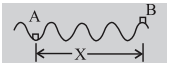
The phase difference between two corks A and B on the water wave is:
Waves – NEET-18851
  1. A Zero
  2. B 3π
  3. C 6π
  4. D 7π
Show answer

Correct answer: D

Attempt this as a timed test

Reading answers is not the same as sitting the paper. Attempt it timed and you get your score, per-question timing, and the mistakes tracked for revision.

Start free

More Waves tests

All Waves tests →