Chemical Thermodynamics — DPP 1

20 NEET questions from Chemical Thermodynamics, with answers and explanations. Attempt it as a timed test to get scoring, accuracy breakdown and mistake tracking.

Attempt this test free 20 questions · 30 minutes · +80 marks
1
When ethyne is passed through a red hot tube, then formation of benzene takes place:
$\begin{aligned} \Delta_{\mathrm{f}} \mathrm{H}^{\ominus}\left(\mathrm{C}_{2} \mathrm{H}_{2}\right)(\mathrm{g}) & =230 \mathrm{~kJ} \mathrm{~mol}^{-1} \end{aligned}$
$\Delta_{\mathrm{f}} \mathrm{H}^{\ominus}{ }_{\left(\mathrm{C}_{6} \mathrm{H}_{6}\right)(\mathrm{g})}=85 \mathrm{~kJ} \mathrm{~mol}^{-1}$
Calculate the standard heat of trimerisation of ethyne to benzene.
$3 \mathrm { C } _ { 2 } \mathrm { H } _ { 2 } ( \mathrm {~g} ) \rightarrow \mathrm { C } _ { 6 } \mathrm { H } _ { 6 } ( \mathrm {~g} )$
  1. A $205 \mathrm {~kJ} \mathrm {~mol} ^ { - 1 }$
  2. B $605 \mathrm {~kJ} \mathrm {~mol} ^ { - 1 }$
  3. C $- 605 \mathrm {~kJ} \mathrm {~mol} ^ { - 1 }$
  4. D $- 205 \mathrm {~kJ} \mathrm {~mol} ^ { - 1 }$
Show answer & explanation

Correct answer: C

$\begin{array}{l}\Delta \mathrm{H}_{\text {reaction }}^{\ominus}=\Delta_{\mathrm{f}} \mathrm{H}^{\ominus}{ }_{\left(\mathrm{C}_{6} \mathrm{H}_{6}\right)}-3 \Delta_{\mathrm{f}} \mathrm{H}^{\ominus}{ }_{\left(\mathrm{C}_{2} \mathrm{H}_{2}\right)} \\\end{array}$
= 85 - 3(230)
= -605 kJ
Therefore, option (3) is the correct answer.
2
Given the reaction at 1240 K and 1 atm ,
$\mathrm { CaCO } _ { 3 } ( \mathrm {~s} ) \rightarrow \mathrm { CaO } ( \mathrm { s } ) + \mathrm { CO } _ { 2 } ( \mathrm {~g} ) , \Delta \mathrm { H } = 176 \mathrm {~kJ} / \mathrm { mol }$.
The value of $\Delta \mathrm { U }$ is equal to;
  1. A 160.0 kJ
  2. B 165.7 kJ
  3. C 186.4 kJ
  4. D 180.0 kJ
Show answer

Correct answer: B

3
When 1 mole gas is heated at constant volume, temperature is raised from 298 K to 308 K . Heat supplied to the gas is 500 J . Then, which option is correct?
  1. A $\mathrm { q } = \mathrm { w } = 500 \mathrm {~J} , \Delta \mathrm { U } = 0$
  2. B $\mathrm { q } = \Delta \mathrm { U } = 500 \mathrm {~J} , \mathrm { w } = 0$
  3. C $\mathrm { q } = - \mathrm { w } = 500 \mathrm {~J} , \Delta \mathrm { U } = 0$
  4. D $\Delta \mathrm { U } = 0 , \mathrm { q } = \mathrm { w } = - 500 \mathrm {~J}$
Show answer

Correct answer: B

4
Which of the following equations represents the standard heat of formation $\mathrm { C } _ { 2 } \mathrm { H } _ { 4 }$ ?
  1. A 2 C (diamond) $+ 2 \mathrm { H } _ { 2 } ( \mathrm {~g} ) \rightarrow \mathrm { C } _ { 2 } \mathrm { H } _ { 4 } ( \mathrm {~g} )$
  2. B 2 C (graphite) $+ 2 \mathrm { H } _ { 2 } ( \mathrm {~g} ) \rightarrow \mathrm { C } _ { 2 } \mathrm { H } _ { 4 } ( \mathrm {~g} )$
  3. C 2 C (diamond) $+ 4 \mathrm { H } ( \mathrm { g } ) \rightarrow \mathrm { C } _ { 2 } \mathrm { H } _ { 4 } ( \mathrm {~g} )$
  4. D 2 C (graphite) $+ 4 \mathrm { H } ( \mathrm { g } ) \rightarrow \mathrm { C } _ { 2 } \mathrm { H } _ { 4 } ( \mathrm {~g} )$
Show answer & explanation

Correct answer: B

The standard heat of formation of C₂H₄ is the heat change when 1 mole of C₂H₄ is formed from its elements in the standard state (carbon as graphite and hydrogen as H₂).
Therefore, option (2) is the correct answer
5
Which of the following conditions regarding a chemical process ensures its spontaneity at all temperatures?
  1. A $\Delta \mathrm { H } > 0 , \Delta \mathrm {~S} > 0$
  2. B $\Delta \mathrm { H } < 0 , \Delta \mathrm {~S} > 0$
  3. C $\Delta \mathrm { H } < 0 , \Delta \mathrm {~S} < 0$
  4. D $\Delta \mathrm { H } > 0 , \Delta \mathrm {~S} < 0$
Show answer

Correct answer: B

6
The enthalpy of combustion of $\mathrm { C } _ { 6 } \mathrm { H } _ { 6 }$ is - 3250 kJ . When 0.39 g of $\mathrm { C } _ { 6 } \mathrm { H } _ { 6 }$ is burnt in excess of oxygen in an open vessel, the amount of heat liberated is:
  1. A 8.32 kJ
  2. B 12.36 kJ
  3. C 16.25 kJ
  4. D 20.74 kJ
Show answer

Correct answer: C

7
The heat of formation for $\mathrm { CO } _ { 2 } ( \mathrm {~g} ) , \mathrm { CO } ( \mathrm { g } )$ and $\mathrm { H } _ { 2 } \mathrm { O } ( \mathrm { g } )$ are $- 393.5 , - 110.5$ and $- 241.8 \mathrm {~kJ} \mathrm {~mol} ^ { - 1 }$ respectively. The standard enthalpy change (in $\mathrm { kJ } \mathrm { mol } ^ { - 1 }$ ) for the reaction $\mathrm { CO } _ { 2 } ( \mathrm {~g} ) + \mathrm { H } _ { 2 } ( \mathrm {~g} ) \rightarrow \mathrm { CO } ( \mathrm { g } ) + \mathrm { H } _ { 2 } \mathrm { O } ( \mathrm { g } )$ is:
  1. A 524.1
  2. B 41.2
  3. C - 262.5
  4. D - 41.2
Show answer & explanation

Correct answer: B

$\begin{array}{l}\Delta \mathrm{H}_{\text {reaction }}^{\ominus}=\Sigma \Delta \mathrm{H}_{\mathrm{f}}^{\ominus}(\text { products })-\Sigma \Delta \mathrm{H}_{\mathrm{f}}^{\ominus}(\text { reactants }) \\ =\left[\Delta \mathrm{H}_{\mathrm{f}}^{\ominus}(\mathrm{CO})+\Delta \mathrm{H}_{\mathrm{f}}^{\ominus}\left(\mathrm{H}_{2} \mathrm{O}\right)\right]-\left[\Delta \mathrm{H}_{\mathrm{f}}^{\ominus}\left(\mathrm{CO}_{2}\right)+\Delta \mathrm{H}_{\mathrm{f}}^{\ominus}\left(\mathrm{H}_{2}\right)\right]\end{array}$
= [–110.5 – 241.8] – [–393.5 + 0]
= – 352.3 + 393.5
= + 41.2 kJ mol$^{–1}$
Therefore, option (2) is the correct answer.
8
The first law of thermodynamics is represented by the equation:
  1. A $\Delta \mathrm { U } = \mathrm { q } - \mathrm { w }$
  2. B $\Delta \mathrm { U } = \mathrm { q } + \mathrm { w }$
  3. C $\mathrm { w } = \mathrm { q } + \Delta \mathrm { U }$
  4. D $\mathrm { q } = \mathrm { w } + \Delta \mathrm { U }$
Show answer

Correct answer: B

9
The latent heat of vapourisation of a liquid at 500 K and 1 atm pressure is $30 \mathrm { ~kcal } \mathrm {~mol } ^ { - 1 }$. What will be the change in internal energy of 3 mol of liquid at same temperature?
  1. A 13.0 kcal
  2. B - 13.0 kcal
  3. C 27.0 kcal
  4. D - 27.0 kcal
Show answer & explanation

Correct answer: C

$\Delta \mathrm{H}=\Delta \mathrm{U}+\Delta \mathrm{n}_{\mathrm{g}} \mathrm{RT}$
ΔΗ = 30 kcal
3H₂O(l) → 3H₂O(g)
Δn$_{g}$ = 3 – 0 = 3
ΔH = ΔU + Δn
30 = ΔU + 3 × 2 × 500 × 10$^{–3}$
ΔU = 27 kcal
Therefore, option (3) is the correct answer.
10
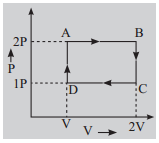
An ideal monoatomic gas follows the path ABCD . The work done during the complete cycle is;
Chemical Thermodynamics – NEET-8156
  1. A - PV
  2. B - 2 PV
  3. C $- \frac { 1 } { 2 } \mathrm { pV }$
  4. D zero
Show answer & explanation

Correct answer: A

Net work done during the complete cycle is equal to area under the cycle (–ve if the cycle is clockwise, i.e., work done by the gas and +ve when cycle is anticlockwise, i.e., work done on the gas) w = –P × V = – (2P – P) × (2V – V) = – PV
Therefore, option (1) is the correct answer.
11
When two moles of an ideal monoatomic gas heated from 300 K to 600 K at constant pressure. Calculate $\Delta \mathrm { S }$ if process is carried out at constant volume.
  1. A $5 \mathrm { R } \ln 2$
  2. B $\frac { 3 } { 2 } R \ln 2$
  3. C $3 R \ln 2$
  4. D $- 3 R \ln 2$
Show answer

Correct answer: C

12
A sample of liquid in a thermally insulated container is stirred for 2 hr by a mechanical linkage to a motor in the sorrounding, for this process:
  1. A $\mathrm { w } < 0 ; \mathrm { q } = 0 ; \Delta \mathrm { U } = 0$
  2. B $\mathrm { w } > 0 ; \mathrm { q } > 0 ; \Delta \mathrm { U } > 0$
  3. C $\mathrm { w } < 0 ; \mathrm { q } > 0 ; \Delta \mathrm { U } = 0$
  4. D $\mathrm { w } > 0 ; \mathrm { q } = 0 ; \Delta \mathrm { U } > 0$
Show answer

Correct answer: D

13
The difference between the heat of reaction at constant pressure and constant volume for the reaction at $25 ^ { \circ } \mathrm { C }$ in kJ $\mathrm { mol } ^ { - 1 }$ is;
$2 \mathrm { C } _ { 6 } \mathrm { H } _ { 6 } ( \mathrm { l } ) + 15 \mathrm { O } _ { 2 } ( \mathrm {~g} ) \rightarrow 12 \mathrm { CO } _ { 2 } ( \mathrm {~g} ) + 6 \mathrm { H } _ { 2 } \mathrm { O } ( \mathrm { l } )$
  1. A - 7.43
  2. B + 3.72
  3. C - 3.72
  4. D 7.43
Show answer & explanation

Correct answer: A

ΔH = ΔU + Δn$_{g}$RT
ΔH – ΔU = Δn$_{g}$RT
ΔH – ΔU = (12 – 15) × $\frac{8.314}{1000}$ × 298 = – 7.433 kJ mol$^{–1}$
Therefore, option (1) is the correct answer
14
Identify the state function among the following.
  1. A q
  2. B q – w
  3. C q/w
  4. D q + w
Show answer & explanation

Correct answer: D

ΔU = q + w (first law of thermodynamics)
Now, q + w is a state function because it is equal to DU and

ΔU is a state function.
Therefore, option (4) is the correct answer
15
If one mole of an ideal gas $\left( \mathrm { C } _ { \mathrm { p } . \mathrm { m } } = \frac { 5 } { 2 } \mathrm { R } \right)$ is expanded isothermally at 300 K until its volume is tripled, then the change in entropy of the gas is:
  1. A zero
  2. B infinity
  3. C $\frac { 5 } { 2 } R \ln 3$
  4. D $\mathrm { R } \ln 3$
Show answer

Correct answer: D

16
Choose the reaction in which $\Delta \mathrm { H }$ is not equal to $\Delta \mathrm { U }$.
  1. A C (graphite) $+ \mathrm { O } _ { 2 } ( \mathrm {~g} ) \rightarrow \mathrm { CO } _ { 2 } ( \mathrm {~g} )$
  2. B $2 \mathrm { C } _ { 2 } \mathrm { H } _ { 4 } ( \mathrm {~g} ) + \mathrm { H } _ { 2 } ( \mathrm {~g} ) \rightarrow \mathrm { C } _ { 2 } \mathrm { H } _ { 6 } ( \mathrm {~g} )$
  3. C 2 C (graphite) $+ \mathrm { H } _ { 2 } ( \mathrm {~g} ) \rightarrow \mathrm { C } _ { 2 } \mathrm { H } _ { 2 } ( \mathrm {~g} )$
  4. D $\mathrm { H } _ { 2 } ( \mathrm {~g} ) + \mathrm { I } _ { 2 } ( \mathrm {~g} ) \rightarrow 2 \mathrm { HI } ( \mathrm { g } )$
Show answer

Correct answer: B

17
The enthalpy of the formation of ammonia is $- 46.0 \mathrm {~kJ} \mathrm {~mol} ^ { - 1 }$. The enthalpy change for the following reaction is:
$2 \mathrm { NH } _ { 3 } ( \mathrm {~g} ) \longrightarrow \mathrm { N } _ { 2 } ( \mathrm {~g} ) + 3 \mathrm { H } _ { 2 } ( \mathrm {~g} )$
  1. A $42.0 \mathrm {~kJ} \mathrm {~mol} ^ { - 1 }$.
  2. B $64.0 \mathrm {~kJ} \mathrm {~mol} ^ { - 1 }$.
  3. C $86.0 \mathrm {~kJ} \mathrm {~mol} ^ { - 1 }$.
  4. D $92.0 \mathrm {~kJ} \mathrm {~mol} ^ { - 1 }$.
Show answer

Correct answer: D

18
The enthalpy of combustion of $\mathrm { C } _ { 6 } \mathrm { H } _ { 6 }$ is - 3250 kJ . When 0.39 g of $\mathrm { C } _ { 6 } \mathrm { H } _ { 6 }$ is bumt in excess of oxygen in an open vessel, the amount of heat liberated is;
  1. A 8.32 kJ
  2. B 16.25 kJ
  3. C 12.36 kJ
  4. D 20.74 kJ
Show answer

Correct answer: B

19
The standard molar enthalpy of the formation of $\mathrm { CO } _ { 2 }$ is equal to:
  1. A zero.
  2. B the standard molar enthalpy of combustion of gaseous carbon.
  3. C the sum of standard molar enthalpy of the formation of CO and $\mathrm { O } _ { 2 }$.
  4. D the standard molar enthalpy of combustion of carbon (graphite).
Show answer & explanation

Correct answer: D

C(graphite) + O₂(g) → CO₂(g)
The standard molar enthalpy of the formation of CO₂ is equal to the standard molar enthalpy of the combustion of carbon (graphite).
Therefore, option (4) is the correct answer.
20
For isothermal expansion in case of an ideal gas:
  1. A $\Delta \mathrm { G } = \Delta \mathrm { S }$
  2. B $\Delta \mathrm { G } = \Delta \mathrm { H }$
  3. C $\Delta \mathrm { G } = - \mathrm { T } \Delta \mathrm { S }$
  4. D None of these
Show answer

Correct answer: C

Attempt this as a timed test

Reading answers is not the same as sitting the paper. Attempt it timed and you get your score, per-question timing, and the mistakes tracked for revision.

Start free

More Chemical Thermodynamics tests

All Chemical Thermodynamics tests →