Chemical Thermodynamics — DPP 2

20 NEET questions from Chemical Thermodynamics, with answers and explanations. Attempt it as a timed test to get scoring, accuracy breakdown and mistake tracking.

Attempt this test free 20 questions · 30 minutes · +80 marks
1
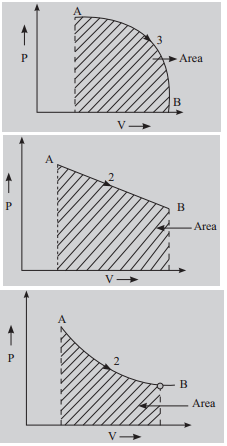
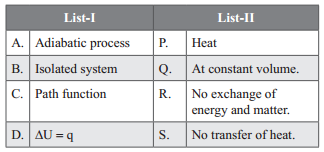
A given mass of gas expands from state A to state B by three paths 1,2 , and 3 as shown in the figure below. If $\mathrm { w } _ { 1 } , \mathrm { w } _ { 2 }$ and $\mathrm { w } _ { 3 }$ respectively, be the work done by the gas along three paths, then;
  1. A $\mathrm { w } _ { 1 } > \mathrm { w } _ { 2 } > \mathrm { w } _ { 3 }$
  2. B $\mathrm { w } _ { 1 } < \mathrm { w } _ { 2 } < \mathrm { w } _ { 3 }$
  3. C $\mathrm { w } _ { 1 } = \mathrm { w } _ { 2 } = \mathrm { w } _ { 3 }$
  4. D $\mathrm{w} _ { 2 } > \mathrm{w} _ { 3 } > \mathrm{w} _ { 1 }$
Show answer & explanation

Correct answer: B

Work is equal to area under PV graph (when P is plotted along y-axis). As area under graph 3 is maximum and area under graph 1 is minimum. So w$_{3}$ is maximum and w$_{1}$ is minimum.
∴ w$_{1}$ < w$_{2}$ < w$_{3}$
Chemical Thermodynamics – NEET-8157 Therefore, option (2) is the correct answer.
2
A process in which volume remains constant is called;
  1. A isochoric process.
  2. B isothermal process.
  3. C adiabatic process.
  4. D isobaric process.
Show answer

Correct answer: A

3
Which of the following sets contains only extensive properties?
  1. A Mole, volume and pressure
  2. B Enthalpy, internal energy and volume
  3. C Temperature, pressure and volume
  4. D Density, entropy, heat and capacity
Show answer

Correct answer: B

4
Which of the following is an extensive property?
  1. A Enthalpy
  2. B Concentration
  3. C Density
  4. D Viscosity
Show answer

Correct answer: A

5
Standard entropies of $X _ { 2 } , Y _ { 2 }$ and $X Y _ { 3 }$ are 60,40 and $50 \mathrm {~J} \mathrm {~K} ^ { - 1 } \mathrm {~mol} ^ { - 1 }$ respectively. For the reaction
$\frac { 1 } { 2 } \mathrm { X } _ { 2 } + \frac { 3 } { 2 } \mathrm { Y } _ { 2 } \rightleftharpoons \mathrm { XY } _ { 3 } , \Delta \mathrm { H } = - 30 \mathrm {~kJ} / \mathrm { mole }$, to be at equilibrium, the temperature should be:
  1. A 500 K
  2. B 750 K
  3. C 1000 K
  4. D 1250 K
Show answer

Correct answer: B

6
A thermodynamic quantity is that;
  1. A which is used in thermochemistry.
  2. B which obeys all laws of thermodynamics.
  3. C quantity whose value depends only upon the state of the system.
  4. D quantity which is used in measuring thermal change.
Show answer

Correct answer: C

7
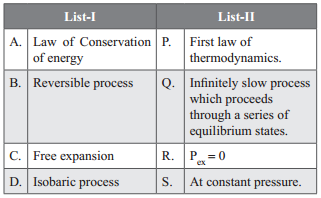
Match the List-I with List-II and fid out the correct option.
Chemical Thermodynamics – NEET-8225
  1. A A-(S); B-(R); C-(P); D-(Q)
  2. B A-(P); B-(R); C-(S); D-(Q)
  3. C A-(P); B-(Q); C-(S); D-(R)
  4. D A-(Q); B-(R); C-(S); D-(P)
Show answer

Correct answer: A

8
Under the same conditions, how many mL of 1 M KOH and $0.5 \mathrm { M } \mathrm {~H } _ { 2 } \mathrm { SO } _ { 4 }$ solutions respectively, when mixed to form a total volume of 100 mL produces the highest rise in temperature?
  1. A 67,33
  2. B 33,67
  3. C 40,60
  4. D 50,50
Show answer & explanation

Correct answer: D

50 mL of 0.5 M H₂SO₄ and 50 mL 1 M of KOH gives the neutralization of 1 mole H⁺ and 1 mole of OH$^{–}$ ions. So, they neutralise completely and produce the highest rise in temperature.
Therefore, option (4) is the correct answer.
9
The enthalpy of neutralisation of a strong acid by a strong base is $- 57.32 \mathrm {~kJ} \mathrm {~mol} ^ { - 1 }$. The enthalpy of formation of water and hydrogen ions are is $- 285.84 \mathrm {~kJ} \mathrm {~mol} ^ { - 1 }$ and $0 \mathrm {~kJ} \mathrm {~mol} ^ { - 1 }$ respectively. The enthalpy of formation of hydroxyl ion is;
  1. A $+ 228.52 \mathrm {~kJ} \mathrm {~mol} ^ { - 1 }$
  2. B $- 114.26 \mathrm {~kJ} \mathrm {~mol} ^ { - 1 }$
  3. C $- 228.52 \mathrm {~kJ} \mathrm {~mol} ^ { - 1 }$
  4. D $+ 114.2 \mathrm {~kJ} \mathrm {~mol} ^ { - 1 }$
Show answer & explanation

Correct answer: C

The process of neutralisation is:
$\begin{array}{l} \mathrm{H}^{+}(\mathrm{aq})+\mathrm{OH}^{-}(\mathrm{aq}) \rightarrow \mathrm{H}_{2} \mathrm{O}(1) ; \Delta \mathrm{H}^{\ominus}=-57.32 \mathrm{~kJ} \mathrm{~mol}^{-1} \\ \Delta \mathrm{H}_{\text {reaction }}^{\ominus}= \Sigma \text { Heat of formation of products } \ -\Sigma \text { Heat of formation of reactants } \\ \Delta \mathrm{H}_{\text {reaction }}^{\ominus}= \Delta_{\mathrm{f}} \mathrm{H}^{\ominus}{ }_{\mathrm{H}_{2} \mathrm{O}(1)}-\left(\Delta_{\mathrm{f}} \mathrm{H}^{\ominus}{ }_{\mathrm{H}(\mathrm{aq})}^{+}+\Delta_{\mathrm{f}} \mathrm{H}^{\ominus}{ }_{\mathrm{OH}^{-}(\mathrm{aq})}\right)\end{array}$
-57.32 = (-285.84) - (0 + x)
x = -285.84 + 57.32 - 228.52 kJ
Thus, the enthalpy of formation of hydroxyl ion is -228.52 kJ.
Therefore, option (3) is the correct answer.
10
Which of the following is not a state function?
  1. A Internal energy
  2. B Gibbs free energy
  3. C Work
  4. D Enthalpy
Show answer

Correct answer: C

11
Which of the following option is incorrect for the given thermodynamic changes?
  1. A $\Delta \mathrm { U } = \mathrm { w }$ (adiabatic process)
  2. B $\Delta \mathrm { U } = \mathrm { q }$ (isochoric process)
  3. C $w = q$ (cyclic process)
  4. D $\mathrm { w } = - \mathrm { P } _ { \mathrm { ex } } \mathrm { dV }$ (isobaric process)
Show answer

Correct answer: C

12
The $\Delta \mathrm { H } ^ { \ominus }$ for the reaction,
$4 \mathrm {~S} ( \mathrm {~s} ) + 6 \mathrm { O } _ { 2 } ( \mathrm {g} ) \longrightarrow 4 \mathrm { SO } _ { 3 } (\mathrm {g} ) \text { is } - 1583.2 \mathrm {~kJ}$
Standard enthalpy of formation of sulphur trioxide is;
  1. A - 3166.4 kJ
  2. B 3166.4 kJ
  3. C - 395.8 kJ
  4. D 395.8 kJ
Show answer

Correct answer: C

13
Identify intensive property from the following.
  1. A Volume
  2. B Mass
  3. C Enthalpy
  4. D Temperature
Show answer

Correct answer: D

14
Match the List-I with List-II and fid out the correct option.
Chemical Thermodynamics – NEET-8228
  1. A A-(S); B-(P); C-(Q); D-(R)
  2. B A-(R); B-(P); C-(S); D-(Q)
  3. C A-(P); B-(Q); C-(R); D-(S)
  4. D A-(S); B-(P); C-(R); D-(Q)
Show answer

Correct answer: C

15
Thermodynamic equilibrium involves;
  1. A chemical equilibrium.
  2. B thermal equilibrium.
  3. C mechanical equilibrium.
  4. D All of these
Show answer

Correct answer: D

16
Which one of the following is a state function?
  1. A Heat
  2. B Work
  3. C Internal energy
  4. D None of these
Show answer

Correct answer: C

17
A well stoppered thermos flask contains some ice cubes. This is an example of;
  1. A closed system.
  2. B open system.
  3. C isolated system.
  4. D non-thermodynamics system.
Show answer

Correct answer: C

18
One mole of an ideal gas at 450 K is expanded isothermally and reversibly from an initial volume of 5 L to 20 L . Then, $\Delta \mathrm { U }$ for the process is:
  1. A 263.7 cal
  2. B 538.1 cal
  3. C zero.
  4. D 92.5 cal
Show answer

Correct answer: C

19
A process in which pressure remains constant is called;
  1. A isochoric process.
  2. B isothermal process.
  3. C adiabatic process.
  4. D isobaric process.
Show answer

Correct answer: D

20
A cup of tea placed in the room eventually acquires room temperature by losing heat. The process may be considered close to;
  1. A cyclic process.
  2. B reversible process.
  3. C isothermal process.
  4. D None of these
Show answer

Correct answer: B

Attempt this as a timed test

Reading answers is not the same as sitting the paper. Attempt it timed and you get your score, per-question timing, and the mistakes tracked for revision.

Start free

More Chemical Thermodynamics tests

All Chemical Thermodynamics tests →