Chemical Thermodynamics — DPP 3

20 NEET questions from Chemical Thermodynamics, with answers and explanations. Attempt it as a timed test to get scoring, accuracy breakdown and mistake tracking.

Attempt this test free 20 questions · 30 minutes · +80 marks
1
This graph express the various steps of the system containing 1 mole of gas. Which type of process system has when it moves from C to A ?
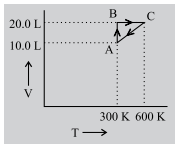
Chemical Thermodynamics – NEET-8264
  1. A Isothermal
  2. B Adiabatic
  3. C Isobaric
  4. D Isochoric
Show answer

Correct answer: C

2
What is correct about isothermal expansion of ideal gas?
  1. A $\mathrm { w } _ { \mathrm { rev } } = \mathrm { w } _ { \mathrm { irr } }$
  2. B $\mathrm { w } _ { \text {rev } } + \mathrm { w } _ { \text {irr } } = 0$
  3. C $\mathrm { w } _ { \text {rev } } > \mathrm { w } _ { \text {irr } }$
  4. D $\mathrm {q} _ { \text {rev } } = \mathrm {q} _ { \text {irr } }$
Show answer

Correct answer: C

3
Thermodynamics is concerned with;
  1. A total energy of a system.
  2. B energy changes in a system.
  3. C rate of a chemical change.
  4. D mass changes in nuclear reactions.
Show answer

Correct answer: B

4
A gas expands isothermally and reversibly the work done by a gas is;
  1. A zero.
  2. B maximum.
  3. C minimum.
  4. D cannot be determined.
Show answer

Correct answer: B

5
The intensive property among these quantities is;
  1. A enthalpy.
  2. B mass/volume.
  3. C mass.
  4. D volume.
Show answer

Correct answer: B

6
Out of the given following properties, boiling point (I), entropy (II), pH (III) and EMF of a cell (IV), intensive properties are:
  1. A I and II only.
  2. B I, II and III only.
  3. C I, III and IV only.
  4. D I, II, III and IV.
Show answer

Correct answer: C

7
Assertion (A): A process is called adiabatic in which the system does not exchange energy with its surroundings.
Reason (R): It does not involve any change in temperature of the system.
  1. A Both Assertion (A) and Reason (R) are True and the Reason (R) is a correct explanation of the Assertion (A).
  2. B Both Assertion (A) and Reason (R) are True but Reason (R) is not a correct explanation of the Assertion (A)
  3. C Assertion (A) is True but the Reason (R) is False.
  4. D Assertion (A) is False but Reason (R) is True
Show answer

Correct answer: C

8
System that cannot exchange energy and matter both with the surroundings is called:
  1. A open system.
  2. B closed system.
  3. C isolated system.
  4. D None of these.
Show answer

Correct answer: C

9
The volume of a gas decreases from $500 \mathrm {~cm} ^ { 3 }$ to $300 \mathrm {~cm} ^ { 3 }$. When a sample of gas is compressed by an average pressure of 0.6 atm . During this process 10 J of heat is liberated. The change in internal energy is;
  1. A - 2.16 J
  2. B 12.156 J
  3. C 2.16 J
  4. D 101.3 J
Show answer

Correct answer: C

10
16 g of oxygen of gas expands isothermally and reversibly at 300 K from $10 \mathrm {~dm } ^ { 3 }$ to $100 \mathrm {~dm } ^ { 3 }$. The work done is; (in J)
  1. A zero.
  2. B - 2872 J
  3. C + 2875 J
  4. D infinite.
Show answer

Correct answer: B

11
Two moles of an ideal monoatomic gas is allowed to expand adiabatically and reversibly from 300 K to 200 K . The work done in the system is; $\left( \mathrm { C } _ { \mathrm { v } } = 12.5 \mathrm {~J} / \mathrm { K } \mathrm {~mol } \right)$
  1. A - 12.5 kJ
  2. B - 2.5 kJ
  3. C - 625 kJ
  4. D 500 kJ
Show answer

Correct answer: B

12
Which of the following is an extensive property of the system?
  1. A Refractive index
  2. B Viscosity
  3. C Temperature
  4. D Volume
Show answer

Correct answer: D

13
In a change from state $\mathrm{A}$ to state $\mathrm{B}$;
  1. A "q" depends only on the initial and final state.
  2. B " $\mathrm{w}$ " depends only on the initial and final state.
  3. C $\Delta \mathrm { U }$ depends only on the initial and final state.
  4. D $\Delta \mathrm { U }$ depends upon the path adopted by "A" to change into "B".
Show answer

Correct answer: C

14
Based on the first law of thermodynamics, which of the following is correct?
  1. A For an isothermal process, $\mathrm { q } = + \mathrm { w }$.
  2. B For an isochoric process, $\Delta \mathrm { U } = - \mathrm { q }$.
  3. C For an adiabatic process, $\Delta U = - w$.
  4. D For a cyclic process, $\mathrm { q } = - \mathrm { w }$.
Show answer

Correct answer: D

15
A system absorb 600 J of heat and work equivalent to 300 J on its surroundings. The change in internal energy is;
  1. A 300 J
  2. B 400 J
  3. C 500 J
  4. D 600 J
Show answer

Correct answer: A

16
The standard enthalpy of combustion at $25 ^ { \circ } \mathrm { C }$ of hydrogen $\left( \mathrm { H } _ { 2 } \right)$, cyclohexene $\left( \mathrm { C } _ { 6 } \mathrm { H } _ { 10 } \right)$ and cyclohexane $\left( \mathrm { C } _ { 6 } \mathrm { H } _ { 12 } \right)$ are $- 241 , - 3800$ and $- 3920 \mathrm {~kJ} \mathrm {~mol} ^ { - 1 }$ respectively. Calculate the heat of hydrogenation of cyclohexene $\left( \mathrm { C } _ { 6 } \mathrm { H } _ { 10 } \right)$.
  1. A $- 161 \mathrm {~kJ} \mathrm {~mol} ^ { - 1 }$
  2. B $- 131 \mathrm {~kJ} \mathrm {~mol} ^ { - 1 }$
  3. C $- 121 \mathrm {~kJ} \mathrm {~mol} ^ { - 1 }$
  4. D $- 141 \mathrm {~kJ} \mathrm {~mol} ^ { - 1 }$
Show answer & explanation

Correct answer: C

Given that,
(i) H₂(g) + $\frac{1}{2}$O₂(g) → H₂O(l) : ΔH = – 241 kJ mol$^{–1}$

(ii) C$_{6}$H$_{10}$(g) + $\frac{17}{2}$O₂(g) → 6CO₂(g) + 5H₂O(l)
ΔH = – 3800 kJ mol$^{–1}$

(iii) C$_{6}$H$_{12}$(g) + 9O₂(g) → 6CO₂(g) + 6H₂O(l)
ΔH = – 3920 kJ mol$^{–1}$

Heat of hydrogenation of cyclohexene is;
C$_{6}$H$_{10}$(g) + H₂(g) → C$_{6}$H$_{12}$ (g); ΔH = ?
Add (i) and (ii) and then subtract (iii), we get
ΔH = [–241 – 3800] – [–3920]
ΔH = –121 kJ mol$^{–1}$
Therefore, option (3) is the correct answer
17
Which of the following is correct for adiabatic expansion of ideal gas?
  1. A $\mathrm { PV } =$ constant
  2. B $\mathrm { PV } \gamma =$ constant
  3. C $\mathrm { PT } =$ constant
  4. D TV = constant
Show answer

Correct answer: B

18
Change in internal energy, when 4 kJ of work is done on the system and 1 kJ heat is given out by the system, is;
  1. A + 1 kJ
  2. B - 5 kJ
  3. C + 5 kJ
  4. D + 3 kJ
Show answer

Correct answer: D

19
One mole of an ideal gas at 300 K is expanded isothermally from an initial volume of 1 L to 10 L . The change in internal energy for this process is; $\left( \mathrm { R } = 2 \mathrm { ~cal } \mathrm {~mol } ^ { - 1 } \mathrm {~K} ^ { - 1 } \right)$
  1. A 163.7 cal
  2. B 850.2 cal
  3. C 1381.1 cal
  4. D zero
Show answer

Correct answer: D

20
Which reaction, with the following value of $\Delta \mathrm { H } , \Delta \mathrm { S }$ at 400 K is spontaneous and endothermic?
  1. A $\Delta \mathrm { H } = - 48 \mathrm {~kJ} , \Delta \mathrm {~S} = + 135 \mathrm {~J} / \mathrm { K }$
  2. B $\Delta \mathrm { H } = - 48 \mathrm {~kJ} , \Delta \mathrm {~S} = - 135 \mathrm {~J} / \mathrm { K }$
  3. C $\Delta \mathrm { H } = + 48 \mathrm {~kJ} , \Delta \mathrm {~S} = + 135 \mathrm {~J} / \mathrm { K }$
  4. D $\Delta \mathrm { H } = + 48 \mathrm {~kJ} , \Delta \mathrm {~S} = - 135 \mathrm {~J} / \mathrm { K }$
Show answer

Correct answer: C

Attempt this as a timed test

Reading answers is not the same as sitting the paper. Attempt it timed and you get your score, per-question timing, and the mistakes tracked for revision.

Start free

More Chemical Thermodynamics tests

All Chemical Thermodynamics tests →