Co-Ordination Compounds — DPP 1

20 NEET questions from Co-Ordination Compounds, with answers and explanations. Attempt it as a timed test to get scoring, accuracy breakdown and mistake tracking.

Attempt this test free 20 questions · 30 minutes · +80 marks
1
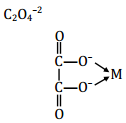
Select bidentate or didentate ligand from the following.
  1. A CO
  2. B SCN$^ { - }$
  3. C $\mathrm { CH } _ { 3 } \mathrm { COO } ^ { - }$
  4. D $\mathrm { C } _ { 2 } \mathrm { O } _ { 4 } { } ^ { 2 - }$
Show answer & explanation

Correct answer: D

Bidentate or didentate means, ligands have 2 donor atoms.
Co-Ordination Compounds – NEET-11960
2
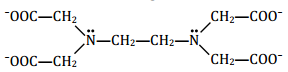
In the complex ion $[ \mathrm { Fe } ( \mathrm { EDTA } ) ] ^ { - }$the coordination number and oxidation state of central metal ion is :-
  1. A C.N. = $6 \quad$ O.N. = +3
  2. B C.N. $= 1 \quad$ O.N. $= - 1$
  3. C C.N. $= 4 \quad$ O.N. $= + 2$
  4. D C.N. $= 3 \quad$ O.N. $= + 3$
Show answer & explanation

Correct answer: A

[Fe(EDTA)]$^{-}$$^{}$
x – 4(i) = –
x = +4
Oxidation state of Fe = +3
EDTA is hexadentate ligand hence CN = 6
Co-Ordination Compounds – NEET-11958
3
The CN and ON of X in the complex compound $\left[ \mathrm { X } \left( \mathrm { SO } _ { 4 } \right) \left( \mathrm { NH } _ { 3 } \right) _ { 5 } \right]$ will be respectively :-
  1. A 10 and + 3
  2. B 1 and +6
  3. C 6 and +4
  4. D 6 and +2
Show answer & explanation

Correct answer: D

[x(SO$_{4}$)(NH₃)$_{5}$]
x + 1(–2) + 5(0) = 0
x = + Oxidation state of x = +2
SO$_{4}$$^{–2}$ is behaving as monodentate ligand
NH₃ is also monodentate.
Hence CN = 6
4
Which of the following ligands will not show chelation?
  1. A EDTA
  2. B DMG
  3. C Ethane-1, 2 diamine
  4. D $\mathrm { SCN } ^ { - }$
Show answer & explanation

Correct answer: D

Chelation means formation of ring, which can be done by bidented or polydented ligands while SCN$^{–}$ is monodentate.
5
The oxidation and coordination number of Pt in $\left[ \mathrm { Pt } \left( \mathrm { C } _ { 2 } \mathrm { H } _ { 4 } \right) \mathrm { Cl } _ { 3 } \right] ^ { - }$is respectively :-
  1. A $+ 1,3$
  2. B $+ 2,4$
  3. C + 3, 6 $
  4. D + 2,5$
Show answer & explanation

Correct answer: B

[Pt(C₂H₄)Cl$_{3}$]$^{–}$
x + 0 + 3(–1) = –1
x = +2 Oxidation state of Pt = +2
All ligands are monodentate.
Hence CN = 4
6
$\mathrm { K } _ { 3 } \left[ \mathrm { Fe } ( \mathrm { CN } ) _ { 6 } \right]$ is :-
  1. A Potassium hexacyano ferrate (II)
  2. B Potassium hexacyano ferrate (III)
  3. C Potassium ferri-cyanide
  4. D Hexacyano ferrate (III) potassium Correct answer is :- (1) Only
Show answer & explanation

Correct answer: B

K$_{3}$[Fe(CN)$_{6}$]
K$_{+}$[Fe(CN)$_{6}$]$^{–3}$
X + 6(–1) = –3
x = +3 Fe(III)
Potassium hexacynate ferrate(III)-IUPAC
Potassium ferri-cyanide → Common name.
7
The IUPAC name for $\left[ \mathrm { Co } \left( \mathrm { NH } _ { 3 } \right) _ { 6 } \right] \left[ \mathrm { Cr } ( \mathrm { CN } ) _ { 6 } \right]$ is :-
  1. A Hexaammine cobalt (III) hexacyanochromate (III)
  2. B Hexacyanochromium cobalt hexaammine (VI)
  3. C Hexaammine cobalt (III) hexacyanochromium (VI)
  4. D Hexacyanochromium (III) hexaammine cobalt (III)
Show answer & explanation

Correct answer: A

[Co(NH₃)$_{6}$] [Cr(CN)$_{6}$] Co$^{+3}$ CN = 6
Cr$^{+3}$ CN = 6
Hexaamminocobalt(III)
hexacyanochromate(III)
8
The IUPAC name for $\left[ \mathrm { Co } ( \mathrm { NCS } ) \left( \mathrm { NH } _ { 3 } \right) _ { 5 } \right] \mathrm { Cl } _ { 2 }$ is :-
  1. A Pentaammine (thiocyanato-N) cobalt (III) chloride
  2. B Pentaammine (thiocyanato-S) cobalt (III) chloride
  3. C Pentaammine (isothiocyanato-N,S)cobalt (III) chloride
  4. D Pentaammine (mercapto-N) cobalt (III) chloride
Show answer & explanation

Correct answer: A

[Co(NCS) (NH₃)$_{5}$]Cl₂ → [Co(NCS)(NH₃)$_{5}$]$^{+2}$Cl
x + 1(–1) + 5(0) = +2
x = +3 Co in +3 oxidation state
NCS → thicyanato-N
NH₃ → ammine
Pentaammine (thiocyanato-N) cobalt(III) chloride
9
Which of the following species is not expected to be ligand :-
  1. A NO
  2. B $\mathrm { NH } _ { 4 } { } ^ { + }$
  3. C $\mathrm { NH } _ { 2 } \mathrm { CH } _ { 2 } \mathrm { CH } _ { 2 } \mathrm { NH } _ { 2 }$
  4. D CO
Show answer & explanation

Correct answer: B

Ligand donate lone pair to CMA in NH₄$^{+}$ species does not have lone pair to donate.
10
The IUPAC name of $\mathrm { K } _ { 2 } \left[ \mathrm { Cr } ( \mathrm { CN } ) _ { 2 } \mathrm { O } _ { 2 } ( \mathrm { O } ) _ { 2 } \left( \mathrm { NH } _ { 3 } \right) \right]$ is:-
  1. A Potassiumamminedicyano dioxoperoxochromate(VI)
  2. B Potassium-ammine-cyano-peroxodioxo chromium (VI)
  3. C Potassiumamminecyanoperoxodioxo chromium (VI)
  4. D Potassiumamminecyanoperoxodioxo chromate (IV)
Show answer & explanation

Correct answer: A

K$_{2}$[Cr(CN) 2O₂(NH₃]
K$^{+}$[Cr(CN) 2O₂(O) 2(NH₃)]$^{–2}$
x + (2)(–1) + (1)(–2) + (2)(–2) + 1(0) = 2
x–2–2–4 = –2
x = +6
Cr in +6 oxidation state
CN → Cyano
O₂$^{–2}$ → Peroxo
O$^{–2}$ → OXO
NH₃ → Ammine
Hence, Potassium ammine
dicyanodioxoperoxochromate(VI)
11
Which rule is incorrect regarding IUPAC nomenclature of complex ions?
  1. A Cation is named first and than anion is named
  2. B In the coordination sphere, the ligands are named alphabetically.
  3. C Positively charged ligands have suffix-ate.
  4. D More than one same type of ligands are indicated by di, tri, tetra etc.
Show answer & explanation

Correct answer: C

Positively changed ligands have suffix as-iumnot-ate.
–ate is used for negatively changed
12
Identify the statement which is not correct :-
  1. A Coordination compounds are mainly known for transition metals.
  2. B Coordination number and oxidation state of central metal atom in a complex is same.
  3. C Ligand donates at least one electron pair to CMA
  4. D $\left[ \mathrm { Co } \left( \mathrm { NH } _ { 3 } \right) _ { 4 } \mathrm { Cl } _ { 2 } \right] ^ { + }$is a heteroleptic complex.
Show answer & explanation

Correct answer: B

CN is no. of co-ordinate bonds are formed by ligands with CMA. → i.e. secondary valenes. While oxidation state is the amount of change on CMA:- i.e. primary valency.
13
Give the IUPAC name of the complex compound $\left[ \mathrm { Co } \left( \mathrm { NH } _ { 3 } \right) _ { 4 } \left( \mathrm { H } _ { 2 } \mathrm { O } \right) \mathrm { Br } \right] \left( \mathrm { NO } _ { 3 } \right) _ { 2 }$.
  1. A Bromoaquotetraamine Cobalt (III) nitrate
  2. B Bromoaquotetraaminocobalt (III) nitrate
  3. C Bromoaquatetraammine cobaltate (III) nitrate
  4. D Tetraammineaquabromido cobalt (III) nitrate
Show answer & explanation

Correct answer: D

[Co(NH₃) 4(H₂O)Br](NO₃)$_{2}$
[Co(NH₃) 4(H₂O)Br]$^{+2}$
X + 4(0) + 1(0) + 1(–1) = +2
x = +3 Co in +3 oxidation state
NH₃ → ammine
H₂O → aqua
Br– → Bromido
Hence IUPAC Name –
tetrammineaquabromido cobalt(III) nitrate.
14
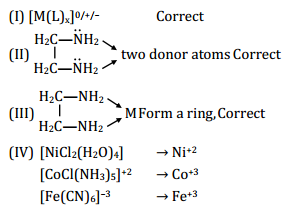
Select the set representing correct statements only.
(I) A coordination entity constitutes a central metal atom or ion bonded to a fixed number of ions or molecules.
(II) Ligand having two different or similar donor atoms in the complex is called bidentate ligand.
(III)All bidentate ligands are chelating ligands.
(IV) $\mathrm { Ni } ^ { + 2 } , \mathrm { Co } ^ { + 3 }$ and $\mathrm { Fe } ^ { + 3 }$ are acting as Lewis acids in $\left[ \mathrm { NiCl } _ { 2 } \left( \mathrm { H } _ { 2 } \mathrm { O } \right) _ { 4 } \right] , \left[ \mathrm { CoCl } \left( \mathrm { NH } _ { 3 } \right) _ { 5 } \right] ^ { + 2 } \text { and } \left[ \mathrm { Fe } ( \mathrm { CN } ) _ { 6 } \right] ^ { - 3 } .$
  1. A I, II, III and IV
  2. B II and III
  3. C I, III and IV
  4. D I, II and IV
Show answer & explanation

Correct answer: A

Statement
Co-Ordination Compounds – NEET-11965 All are e$^{–}$ deficient and accepting $\ell \mathrm{p}$ from ligands. (correct)
15
Which of the following complex is anion :-
  1. A Fluoro pentaammine cobalt(III)
  2. B Trioxalato ferrate(III)
  3. C Penta Carbonyl iron(0)
  4. D Dichloro diammine platinum(II)
Show answer & explanation

Correct answer: B

Trioxalato ferrate (III) – (C$_{2}$O$_{4}$$^{–2}$)
[Fe(C$_{2}$O$_{4}$)$_{3}$]$^{–3}$ Fe = +3
16
The correct name of $\left[ \mathrm { Pt } \left( \mathrm { NH } _ { 3 } \right) _ { 4 } \mathrm { Cl } _ { 2 } \right] \left[ \mathrm { PtCl } _ { 4 } \right]$ is :-
  1. A Tetraammine dichloro platinum (IV) tetrachloro platinate (II)
  2. B Dichloro tetra ammine platinum (IV) tetrachloro platinate (II)
  3. C Tetrachloro platinum (II) tetraammine platinate(IV)
  4. D Tetrachloro platinum (II) dichloro tetraamine platinate (IV)
Show answer & explanation

Correct answer: A

[Pt(NH₃)4Cl₂]
Pt = +4

[PtCl$_{4}$]
Pt = +2
CN 6 in +4 oxidation
CN 4 in +2 oxidation (state)
Tetramminedichloro platinum (IV)
tetrachloroplatenate(II)
17
Which of the following complexes is not a chelate
  1. A Bis (dimethylglyoximato) nickel(II)
  2. B Potassium ethylenediaminetetra thiocyanatochromate(III)
  3. C Tetrammine dichlorocobalt(III) nitrate
  4. D Trans-diglycinatoplatinum(II)
Show answer & explanation

Correct answer: C

Complex which does not have bi or polydented ligands will not have ring formation or chelate.
Tetraamine dichloro cobalt (III) nitrate (NH₃)
Cl both are monodentate ligands.
[Co(NH₃)4Cl₂]NO₃
18
Which one is a heteroleptic complex?
  1. A Ferrocene
  2. B Chromocene
  3. C Prussian blue
  4. D Zeise's salt
Show answer & explanation

Correct answer: D

Zeise’s salt K[Pt(C₂H₄)Cl$_{3}$] has more than one type of ligands, hence it’s hetroleptic.
(1) (C$_{5}$H$_{5}$)Fe
(2) (C$_{5}$H$_{5}$)$_{2}$Cr
(3) Fe$_{4}$[Fe(CN)$_{6}$]$_{3}$
19
Oxidation number of Cobalt in $\mathrm { K } \left[ \mathrm { Co } ( \mathrm { CO } ) _ { 4 } \right]$ is :-
  1. A + 1
  2. B - 1
  3. C 0
  4. D + 2
Show answer & explanation

Correct answer: B

K[Co(CO$_{4}$)] - CO is a neutral ligand.
K⁺[Co(CO)$_{4}$]$^{–1}$
x + (4)(0) = –1
x = –1 Oxidation state & Co
20
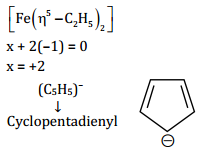
The correct IUPAC name of the complex $\left[ \mathrm { Fe } \left( \eta ^ { 5 } - \mathrm { C } _ { 5 } \mathrm { H } _ { 5 } \right) _ { 2 } \right]$ is
  1. A Cyclopentadienyl iron (II)
  2. B Bis (cyclopentadienyl) iron (II)
  3. C Dicyclopentadienyl ferrate (II)
  4. D Ferrocene
Show answer & explanation

Correct answer: B

Co-Ordination Compounds – NEET-11975 hence Bis(Cyclopentadienyl iron (II)

Attempt this as a timed test

Reading answers is not the same as sitting the paper. Attempt it timed and you get your score, per-question timing, and the mistakes tracked for revision.

Start free

More Co-Ordination Compounds tests

All Co-Ordination Compounds tests →