Co-Ordination Compounds — DPP 2

20 NEET questions from Co-Ordination Compounds, with answers and explanations. Attempt it as a timed test to get scoring, accuracy breakdown and mistake tracking.

Attempt this test free 20 questions · 30 minutes · +80 marks
1
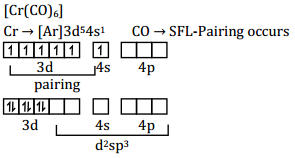
Which of the following statements about $\left[ \mathrm { Cr } ( \mathrm { CO } ) _ { 6 } \right]$ is correct ?
  1. A It is paramagnetic and inner orbital complex
  2. B It is diamagnetic and inner orbital complex
  3. C It is diamagnetic and outer orbital complex
  4. D It is paramagnetic and outer orbital complex
Show answer & explanation

Correct answer: B

Co-Ordination Compounds – NEET-12006 → Inner orbital complex
→ Zero unpaired e⁻ SO, diamagnetic.
2
Which of the following compound is paramagnetic
  1. A Tetracyanonickelate (II) ion
  2. B Tetraamminezinc (II) ion
  3. C Hexaamine chromium (III) ion
  4. D Diammine silver (I) ion
Show answer & explanation

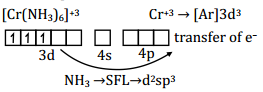
Correct answer: C

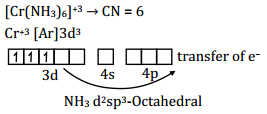
In Hexaammine chromium(III) ion [Cr(NH₃)$_{6}$]$^{+3}$ Cr$^{+3}$ hence 3d$^{3}$ configuration and will have 3 unpaired e⁻ so paramagnetic.
3
If EAN of a central metal ion $\mathrm { X } ^ { + 2 }$ in a complex is 34 . and atomic number of $\mathrm { X }$ is 28 . The number of monodentate ligands present in complex are:-
  1. A 3
  2. B 4
  3. C 6
  4. D 2
Show answer & explanation

Correct answer: B

Given EAN = 34
Oxidation state = +2 (X$^{+2}$)
Z = 28
EAN = Z–O.S + 2(CN)
34 = 28–(2) + 2(CN)
CN = 4
4
In which of the following molecules, central atom used orbitals of different principle quantum number in the hybridisation :-
  1. A $\left[ \mathrm { Fe } ( \mathrm { CO } ) _ { 5 } \right]$
  2. B $\left[ \mathrm { Zn } \left( \mathrm { NH } _ { 3 } \right) _ { 6 } \right] ^ { + 2 }$
  3. C $\left[ \mathrm { Ni } ( \mathrm { CO } ) _ { 4 } \right]$
  4. D $\left[ \mathrm { Ni } \left( \mathrm { NH } _ { 3 } \right) _ { 6 } \right] ^ { + 2 }$
Show answer & explanation

Correct answer: A

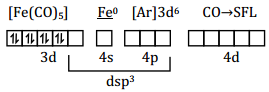
Co-Ordination Compounds – NEET-12001 3d 4s 4p are used with different Q.N.
[Fe(CO)$_{5}$$_{}$]
5
Which of the following complexes is an inner orbital complex?
  1. A $\left[ \mathrm { CoF } _ { 6 } \right] ^ { 3 - }$
  2. B $\left[ \mathrm { FeF } _ { 6 } \right] ^ { 3 - }$
  3. C $\left[ \mathrm { Cr } \left( \mathrm { NH } _ { 3 } \right) _ { 6 } \right] ^ { 3 + }$
  4. D $\left[ \mathrm { Fe } \left( \mathrm { H } _ { 2 } \mathrm { O } \right) _ { 6 } \right] ^ { 2 + }$
Show answer & explanation

Correct answer: C

Inner orbital complex means inner d orbital is used.
It occurs in presence of SFL or (n-1) as pairing will take place
Co-Ordination Compounds – NEET-11998
6
The EAN of cobalt in the complex ion $\left[ \mathrm { Co } ( \mathrm { en } ) _ { 2 } \mathrm { Cl } _ { 2 } \right] ^ { + }$is :-
  1. A 27
  2. B 36
  3. C 33
  4. D 35
Show answer & explanation

Correct answer: B

[Co(en)$_{2}$Cl$_{2}$]$^{+}$ Z of W = 27
x + (2)(0) + 2(–1) = +1 CN
x – 2 = +1
x = +3
EAN = Z–OS + 2(CN)
= 27–(3) + 2(6)
= 27 – 3 + 12
EAN = 36
7
Which of the following contains one unpaired electron in the 4p orbitals :-
  1. A $\left[ \mathrm { Cu } \left( \mathrm { NH } _ { 3 } \right) _ { 2 } \right] ^ { + }$
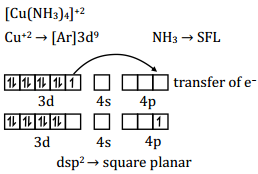
  2. B $\left[ \mathrm { Cu } \left( \mathrm { NH } _ { 3 } \right) _ { 4 } \right] ^ { 2 + }$
  3. C $\left[ \mathrm { Cu } ( \mathrm { CN } ) _ { 4 } \right] ^ { 3 - }$
  4. D $\left[ \mathrm { Ni } ( \mathrm { CN } ) _ { 4 } \right] ^ { 2 - }$
Show answer & explanation

Correct answer: B

Co-Ordination Compounds – NEET-12004
8
The effective atomic number of Cr (atomic no. 24) in $\left[ \mathrm { Cr } \left( \mathrm { NH } _ { 3 } \right) _ { 6 } \right] \mathrm { Cl } _ { 3 }$ is
  1. A 35
  2. B 27
  3. C 33
  4. D 36
Show answer & explanation

Correct answer: C

[Cr(NH₃)$_{6}$]Cl$_{3}$ [Cr(NH₃)$_{6}$]$^{+3}$ Cl$^{–}$
Cr = +3 oxidation state Z of Cr = 24
EAN = Z–O.S. + 2(CN)
EAN = 24 – (+3) + 2(6)
EAN = 24 – 3 + 12
EAN = 33
9
In the metal carbonyls of general formula $\mathrm { M } ( \mathrm { CO } ) _ { \mathrm { x } }$ (Which follows EAN rule) if M is $\mathrm { Ni } , \mathrm { Fe }$ and Cr the value of x will be respectively:-
  1. A $6,5,6$
  2. B $4,5,6$
  3. C $4,4,5$
  4. D $4,6,6$
Show answer & explanation

Correct answer: B

M(CO) x follows EAN Rule Means it will attain nearest noble gas cont., which is 36e$^{–}$ CO is a neutral ligand
Z of Ni = 28Fe = 26 Cr = 24
For 36
Ni 36 = 28 – 0 + 2(CN)
CN = 4
Fe 36 = 26 – 0 + 2 (CN)
CN = 5
Cr 36 = 24 - 0 + 2(CN)
CN = 6
10
Number of electrolytes in the complex $\mathrm { CoCl } _ { 3 } .5 \mathrm { NH } _ { 3 }$
  1. A 3
  2. B 2
  3. C 4
  4. D 5
Show answer & explanation

Correct answer: A

CoCl$_{3}$.5NH₃
O.S. of CO = +3 CN = 6
[Co(NH₃)$_{5}$Cl]Cl₂ ≡ [Co(NH₃)$_{5}$Cl]$^{+2}$ 2Cl$^{–}$
Hence 3 ions.
11
The magnetic property and the shape of $\left[ \mathrm { Cr } \left( \mathrm { NH } _ { 3 } \right) _ { 6 } \right] ^ { 3 + }$ complex ions are :
  1. A Paramagnetic, Octahedral
  2. B Diamagnetic, square planar
  3. C Paramagnetic, tetrahedral
  4. D None of the above
Show answer & explanation

Correct answer: A

Co-Ordination Compounds – NEET-11997 3 unpaired e⁻ ⇒ Paramagnetic.
12
How many unpaired electrons are present in the Brown Ring complex $\left[ \mathrm { Fe } \left( \mathrm { H } _ { 2 } \mathrm { O } \right) _ { 5 } ( \mathrm { NO } ) \right] \mathrm { SO } _ { 4 }$
  1. A 4
  2. B 3
  3. C 0
  4. D 5
Show answer & explanation

Correct answer: B

[Fe(H₂O)$_{5}$(NO)]SO$_{4}$
[Fe(H₂O)$_{5}$(NO)]$^{+2}$ SO$_{4}$$^{–2}$
Fe+ [Ar]4s$^{1}$3d$^{6}$ → [Ar]4s$^{0}$3d$^{7}$
Co-Ordination Compounds – NEET-12005 3 unpaired e–
13
What is Incorrect for $\mathrm { K } _ { 4 } \left[ \mathrm { Fe } ( \mathrm { CN } ) _ { 6 } \right]$
  1. A $0 . \mathrm { N }$ of Iron is + 2
  2. B It exhibit diamagnetic character
  3. C It exhibit paramagnetic character
  4. D It involves $\mathrm { d } ^ { 2 } \mathrm { sp } ^ { 3 }$ hybridisation
Show answer & explanation

Correct answer: C

K$_{4}$[Fe(CN)$_{6}$]
Fe$^{+2}$ → [Ar]3d$^{6}$ CN$^{–}$→SFL → Pairing occurs eg
t$_{2g}$ -Zero unpaired e– diamagnetic 3$^{rd}$ option is wrong.
14
In the complex ion $\mathrm { ML } _ { 6 } { } ^ { \mathrm { n } + } , \mathrm { M } ^ { \mathrm { n } + }$ has five d-electrons and L is weak ligand then the magnetic properties of the complex ion correspond to how many unpaired electrons
  1. A 0
  2. B 5
  3. C 2
  4. D 3
Show answer & explanation

Correct answer: B

ML$_{6}$$^{n+}$ M$^{n+}$ d$^{5}$ → WFL meane no. pairing.
Hence 5 unpaired e⁻
Co-Ordination Compounds – NEET-11995
15
The chloro-bis (ethylenediamine) nitro cobalt (III) ion is :-
  1. A $\left[ \mathrm { Co } \left( \mathrm { NO } _ { 2 } \right) _ { 2 } ( \mathrm { en } ) _ { 2 } \mathrm { Cl } _ { 2 } \right]$
  2. B $\left[ \mathrm { CoCl } \left( \mathrm { NO } _ { 2 } \right) _ { 2 } ( \mathrm { en } ) _ { 2 } \right] ^ { + }$
  3. C $\left[ \mathrm { CoCl } ( \mathrm { en } ) _ { 2 } \mathrm { NO } _ { 2 } \right] ^ { + }$
  4. D $\left[ \mathrm { Co } ( \mathrm { en } ) \mathrm { Cl } _ { 2 } \left( \mathrm { NO } _ { 2 } \right) _ { 2 } \right] ^ { - }$
Show answer & explanation

Correct answer: C

Chloro-bis(ethylenediamine) nitro cobalt (III) ion
(Cl–)(en)$_{2}$(NO₂$^{–}$)Co$^{+3}$
[CoCl(en)$_{2}$NO₂]$^{+}$
16
Among the following ions, which one has the highest paramagnetism ?
  1. A $\left[ \mathrm { FeF } _ { 6 } \right] ^ { 3 - }$
  2. B $\left[ \mathrm { Fe } \left( \mathrm { H } _ { 2 } \mathrm { O } \right) _ { 6 } \right] ^ { 2 + }$
  3. C $\left[ \mathrm { Cu } \left( \mathrm { H } _ { 2 } \mathrm { O } \right) _ { 6 } \right] ^ { 2 + }$
  4. D $\left[ \mathrm { Zn } \left( \mathrm { H } _ { 2 } \mathrm { O } \right) _ { 6 } \right] ^ { 2 + }$
Show answer & explanation

Correct answer: A

Highest paramagnetism = Maximum no. of unpaired e⁻
Fe$^{+3}$ → [Ar]3d$^{5}$ (5)
Fe$^{+2}$ → [Ar]3d$^{6}$ (4)
Cu$^{+2}$ → [Ar]3d$^{9}$ (1)
Zn$^{+2}$ → [Ar]3d$^{10}$ (0)
Hence [FeF$_{6}$]$^{–3}$ has highest paramagnetism
17
Which gives only $25 \%$ mole of AgCl , when reacts with $\mathrm { AgNO } _ { 3 }$ :-
  1. A $\mathrm { PtCl } _ { 2 } .4 \mathrm { NH } _ { 3 }$
  2. B $\mathrm { PtCl } _ { 4 } .5 \mathrm { NH } _ { 3 }$
  3. C $\mathrm { PtCl } _ { 4 } .4 \mathrm { NH } _ { 3 }$
  4. D $\mathrm { PtCl } _ { 4 } .3 \mathrm { NH } _ { 3 }$
Show answer & explanation

Correct answer: D

25% Note or 1/4th of Cl atoms = 1
PtCl$_{4}$.3NH₃–O.S. of Pt = +4 CN = 6
Hence [Pt(NH₃)$_{3}$Cl$_{3}$]Cl
PtCl$_{4}$.3NH₃
18
What are the geometric shape and the oxidation number of the copper atom, respectively, for the complex ion, $\left[ \mathrm { Cu } \left( \mathrm { NH } _ { 3 } \right) _ { 4 } \left( \mathrm { OH } _ { 2 } \right) _ { 2 } \right] ^ { 2 + }$ ?
  1. A Tetrahedral; + 2
  2. B Square planar; -2
  3. C Linear; + 3
  4. D Octahedral; + 2
Show answer & explanation

Correct answer: D

[Cu(NH₃) 4(OH$_{2}$)$_{2}$]$^{+2}$
Cu$^{+2}$ → [Ar]3d$^{9}$ O.S.= +2
Coordination number = 6
So octahedral.
x + (4 × 0) + (2 × 0) = 2
x = 2
19
A magnetic moment of 1.73 BM will be shown by one among of the following compounds .
  1. A $\left[ \mathrm { Cu } \left( \mathrm { NH } _ { 3 } \right) _ { 4 } \right] ^ { 2 + }$
  2. B $\left[ \mathrm { Ni } ( \mathrm { CN } ) _ { 4 } \right] ^ { 2 - }$
  3. C $\mathrm { TiCl } _ { 4 }$
  4. D $\left[ \mathrm { CoCl } _ { 6 } \right] ^ { 3 - }$
Show answer & explanation

Correct answer: A

Cu$^{+2}$ ⇒ [Ar]3d$^{9}$ 1 unpaired (S.F.L)
Ni$^{+2}$ ⇒ [Ar]3d$^{8}$ 0 unpaired (W.F.L)
Ti$^{+4}$ ⇒ [Ar] 0 unpaired
Co$^{+3}$ ⇒ [Ar]3d$^{6}$ 4 unpaired (W.F.L.)
µ = 1.73 BM Means 1 unpaired e⁻
hence µ = $\sqrt{\mathrm{n}(\mathrm{n}+2)}$n = 1
µ = 1.73 BM
(1) [Cu(NH₃)$_{4}$]$^{+2}$
20
A compound has the empirical formula $\mathrm { CoCl } _ { 3 } .5 \mathrm { NH } _ { 3 }$. When an aqueous solution of this compound is mixed with excess silver nitrate, 2 mol of AgCl precipitate per mol of compound. On reaction with excess HCl , no $\mathrm { NH } _ { 4 } { } ^ { + }$is detected. Hence it is
  1. A $\left. \mathrm { Co } \left( \mathrm { NH } _ { 3 } \right) _ { 5 } \mathrm { Cl } _ { 2 } \right] \mathrm { Cl }$
  2. B $\left[ \mathrm { Co } \left( \mathrm { NH } _ { 3 } \right) _ { 5 } \mathrm { Cl } \right] \mathrm { Cl } _ { 2 }$
  3. C $\left[ \mathrm { Co } \left( \mathrm { NH } _ { 3 } \right) _ { 5 } \mathrm { Cl } _ { 3 } \right]$
  4. D $\left[ \mathrm { Co } \left( \mathrm { NH } _ { 3 } \right) _ { 4 } \mathrm { Cl } _ { 2 } \right] \mathrm { Cl } . \mathrm { NH } _ { 3 }$
Show answer & explanation

Correct answer: B

CoCl$_{3}$.5NH₃ Co O.S. = +3 CN = 6
2 mole of AgCl ppt hence 2 Cl atoms needs to be ionised. Hence formula is
[Co(NH₃) 5Cl]Cl₂ →

Attempt this as a timed test

Reading answers is not the same as sitting the paper. Attempt it timed and you get your score, per-question timing, and the mistakes tracked for revision.

Start free

More Co-Ordination Compounds tests

All Co-Ordination Compounds tests →