Co-Ordination Compounds — DPP 3

20 NEET questions from Co-Ordination Compounds, with answers and explanations. Attempt it as a timed test to get scoring, accuracy breakdown and mistake tracking.

Attempt this test free 20 questions · 30 minutes · +80 marks
1
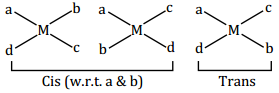
A Planar Complex [Mabcd] gives :-
  1. A Two Optical isomer
  2. B Two geometrical isomer
  3. C Three optical isomer
  4. D Three geometrical isomers
Show answer & explanation

Correct answer: D

Co-Ordination Compounds – NEET-12027 [Mabcd] gives 3 geometrical isomerism 2 Cis 1 Trans
2
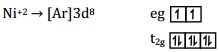
In the complex $\left[ \mathrm { Ni } \left( \mathrm { H } _ { 2 } \mathrm { O } \right) _ { 2 } \left( \mathrm { NH } _ { 3 } \right) _ { 4 } \right] ^ { + 2 }$ the magnetic moment $( \mu )$ of Ni is :-
  1. A Zero
  2. B 2.83 BM
  3. C 1.73 BM
  4. D 3.87 BM
Show answer & explanation

Correct answer: B

[Ni(H₂O)$_{2}$(NH₃)$_{4}$]$^{+2}$
Co-Ordination Compounds – NEET-12013 hence 2 unpaired e⁻ n = 2
μ = $\sqrt{\mathrm{n}(\mathrm{n}+2)}$ = 2.83 BM
3
The coordination number and oxidation number of the central metal ion in the complex $\left[ \mathrm { Pt } ( \mathrm { en } ) _ { 2 } \right] ^ { + 2 }$ is :-
  1. A C.N. = 2, O.N. = +2
  2. B C.N. = 6, O.N. = +4
  3. C C.N. = 4, O.N. = +4
  4. D C.N. = 4, O.N. = +2
Show answer & explanation

Correct answer: D

[Pt(en)$_{2}$]$^{+2}$
x + 20(0) = +2
x = +2 Oxidation state of Pt = +2
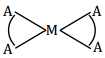
en or Ethylene diamine is a bidentate ligand hence CN = 2 × 2=4
4
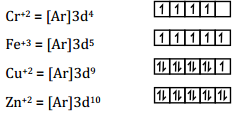
Among the following ions which one is high spin complex.
  1. A $\left[ \mathrm { Cr } \left( \mathrm { NH } _ { 3 } \right) _ { 6 } \right] ^ { 2 + }$
  2. B $\left[ \mathrm { Fe } \left( \mathrm { H } _ { 2 } \mathrm { O } \right) _ { 6 } \right] ^ { 3 + }$
  3. C $\left[ \mathrm { Cu } \left( \mathrm { H } _ { 2 } \mathrm { O } \right) _ { 6 } \right] ^ { 2 + }$
  4. D $\left[ \mathrm { Zn } \left( \mathrm { H } _ { 2 } \mathrm { O } \right) _ { 6 } \right] ^ { 2 + }$
Show answer & explanation

Correct answer: B

High spin complex = Highest no. of unpaired e$^{–}$
Co-Ordination Compounds – NEET-11998 [Fe(H₂O)$_{6}$]$^{+3}$ is high spin complex
5
Which one of these ions absorbs energy from visible spectrum :-
  1. A $\left[ \mathrm { Cu } \left( \mathrm { NH } _ { 3 } \right) _ { 4 } \right] ^ { + }$
  2. B $\left[ \mathrm { Cu } \left( \mathrm { NH } _ { 3 } \right) _ { 4 } \right] ^ { + 2 }$
  3. C $\left[ \mathrm { Zn } \left( \mathrm { H } _ { 2 } \mathrm { O } \right) _ { 6 } \right] ^ { + 2 }$
  4. D $\left[ \mathrm { CdCl } _ { 4 } \right] ^ { - 2 }$
Show answer & explanation

Correct answer: B

If unpaired e⁻ are present than they will absorb the energy.
(1) Cu$^{+}$ → [Ar]3d$^{10}$ Paired
(2) Cu$^{+2}$ → [Ar]3d$^{9}$ Unpaired
(3) Zn$^{+2}$ → [Ar]3d$^{10}$ Paired
(4) Cd$^{+2}$ → [Ar]4d$^{10}$ Paired
(2) [Cu(NH₃)$_{4}$]$^{+2}$
6
Which of the following complex can not exhibit geometrical isomerism :-
  1. A $\left[ \mathrm { Pt } \left( \mathrm { NH } _ { 3 } \right) _ { 2 } \mathrm { Cl } \mathrm { NO } { } _ { 2 } \right]$
  2. B $\left[ \mathrm { Pt } ( \text { gly } ) _ { 2 } \right]$
  3. C $\left[ \mathrm { Cu } ( \mathrm { en } ) _ { 2 } \right] ^ { + 2 }$
  4. D $\left[ \mathrm { Pt } \left( \mathrm { H } _ { 2 } \mathrm { O } \right) \left( \mathrm { NH } _ { 3 } \right) \mathrm { BrCl } \right]$
Show answer & explanation

Correct answer: C

[Cu(en)$_{2}$]$^{+2}$ can not show geometrical isomers
(symmetric bidentate ligand)
Co-Ordination Compounds – NEET-12023
7
Red color of gem stone ruby is due to impurities of :-
  1. A $\mathrm { Al } _ { 2 } \mathrm { O } _ { 3 }$
  2. B $\mathrm { Cr } ^ { + 3 }$
  3. C $\mathrm { Al } ^ { + 3 }$ ions
  4. D All of these
Show answer & explanation

Correct answer: B

Al$^{+3}$ ion is replaced by Cr$^{+3}$ ion impurity which causes the red colour of Ruby.
(3) Cr$^{+3}$
8
The hybridisation in $\left[ \mathrm { Co } \left( \mathrm { C } _ { 2 } \mathrm { O } _ { 4 } \right) _ { 3 } \right] ^ { - 3 }$
  1. A $\mathrm { sp } ^ { 3 } \mathrm {~d} ^ { 2 }$
  2. B $\mathrm { sp } ^ { 3 } \mathrm {~d} ^ { 3 }$
  3. C $\mathrm { dsp } ^ { 3 }$
  4. D $d ^ { 2 } s p ^ { 3 }$
Show answer & explanation

Correct answer: D

[Co(C$_{2}$O$_{4}$)$_{3}$]$^{–3}$ CN = 6
Co$^{+3}$ → [Ar]3d$^{6}$ Ox-WFL → but for
Co$^{+3}$ it act as SFL so pairing will be these
Co-Ordination Compounds – NEET-12010 → Inner d will be used so inner orbital complex
→ d$^{2}$sp$^{3}$
9
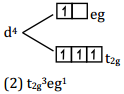
If $\Delta _ { 0 } < \mathrm { P }$, the correct electronic configuration for $\mathrm { d } ^ { 4 }$ system will be :-
  1. A $t _ { 2 g } ^ { 4 } e _ { g } ^ { 0 }$
  2. B $t _ { 2 g } ^ { 3 } e _ { g } ^ { 1 }$
  3. C $t _ { 2 g } ^ { 0 } e _ { g } ^ { 4 }$
  4. D $t _ { 2 g } ^ { 2 } e _ { g } ^ { 2 }$
Show answer & explanation

Correct answer: B

Δ$_{0}$$_{}$ < P than pairing will not happen as energy gap is less.
Co-Ordination Compounds – NEET-12016
10
What is the oxidation number of Fe in $\left[ \mathrm { Fe } \left( \mathrm { H } _ { 2 } \mathrm { O } \right) _ { 5 } ( \mathrm { NO } ) \right] ^ { 2 + }$ ion?
  1. A + 2
  2. B + 3
  3. C + 1
  4. D 0
Show answer & explanation

Correct answer: C

Fe shows +1 oxidation state in brown ring complex as NO transfer e⁻ to convert +1.
[Fe(H₂O)$_{5}$NO]$^{+2}$
Fe = +1
11
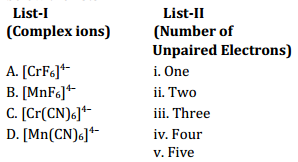
Match List-I (Complex ions) with List-II (Number of Unpaired Electrons) and select the correct answer using the codes given below the lists :-
Co-Ordination Compounds – NEET-12017 Co-Ordination Compounds – NEET-12017


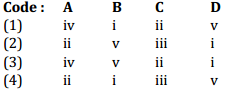
  1. A A - iv, B - i, C - ii, D - v
  2. B A - ii, B - v, C - iii, D - i
  3. C A - iv, B - v, C - ii, D - i
  4. D A - ii, B - i, C - iii, D - v
Show answer & explanation

Correct answer: C

(A) [CrF$_{6}$]$^{–4}$ ⇒ Cr$^{+2}$ = [Ar]3d$^{4}$(WFL) = 4 unpaired e⁻ (iv)
(B) [MnF$_{6}$]$^{–4}$ ⇒ Mn$^{2+}$ = [Ar]3d$^{5}$(WFL) = 5 unpaired e⁻ (v)
(C) [Cr(CN)$_{6}$]$^{–4}$ ⇒ Cr$^{2+}$ = [Ar]3d$^{4}$SFL = 2 unpaired e⁻ (ii)
(D) [Mn(CN)$_{6}$]$^{–4}$ ⇒ Mn$^{+2}$ = [Ar]3d$^{5}$(SFL) = 1unpaired e⁻ (i)
12
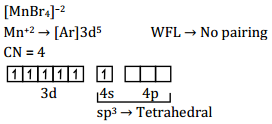
Spin magnetic moment of $\left[ \mathrm { MnBr } _ { 4 } \right] ^ { - 2 }$ is 5.9 BM its geometry would be :-
  1. A Square planar
  2. B Tetrahedral
  3. C Square pyramidal
  4. D Octahedral
Show answer & explanation

Correct answer: B

Co-Ordination Compounds – NEET-12009
13
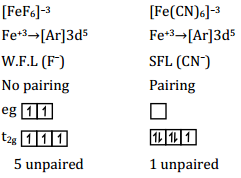
For $\left[ \mathrm { FeF } _ { 6 } \right] ^ { 3 - }$ and $\left[ \mathrm { Fe } ( \mathrm { CN } ) _ { 6 } \right] ^ { 3 - }$ magnetic moment of the fluoride complex is expected to be :-
  1. A The same as the magnetic moment of the cyanide complex
  2. B Larger than the magnetic moment of the cyanide complex because there are more unpaired electrons in the fluoride complex
  3. C Smaller than the magnetic moment of the cyanide complex because there are more unpaired electrons in the fluoride complex
  4. D Larger than the magnetic moment of the cyanide complex because there are fewer unpaired electrons in the fluoride complex
Show answer & explanation

Correct answer: B

Co-Ordination Compounds – NEET-12003 [FeF$_{6}$]$^{–3}$ more magnetic moment than [Fe(CN)$_{6}$]$^{–3}$
14
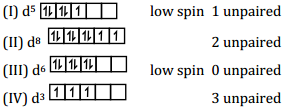
Which of the following system has maximum number of unpaired electrons :-
  1. A $\mathrm { d } ^ { 5 }$ (Octahedral, low spin)
  2. B $\mathrm { d } ^ { 8 }$ (Tetrahedral)
  3. C $\mathrm { d } ^ { 6 }$ (Octahedral, low spin)
  4. D $\mathrm { d } ^ { 3 }$ (Octahedral)
Show answer & explanation

Correct answer: D

Co-Ordination Compounds – NEET-12014

15
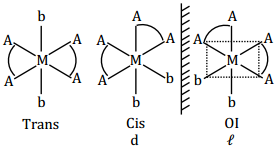
Which of the following octahedral complex have maximum stereoisomers :-
  1. A $\left[ \mathrm { Fe } ( \mathrm { CN } ) _ { 6 } \right] ^ { - 4 }$
  2. B $\left[ \mathrm { Co } ( \mathrm { en } ) ( \mathrm { CN } ) _ { 4 } \right] ^ { - 1 }$
  3. C $\left[ \mathrm { Co } ( \mathrm { en } ) _ { 2 } ( \mathrm { Cl } ) _ { 2 } \right] ^ { + }$
  4. D $\left[ \mathrm { Co } ( \mathrm { en } ) _ { 3 } \right] ^ { + 3 }$
Show answer & explanation

Correct answer: C

[Co(en)$_{2}$Cl₂]$^{+}$ is [M(AA)$_{2}$b$_{2}$]
Type of complex :
Co-Ordination Compounds – NEET-12031 Total stereoisomer = 3
16
A square planar complex is cis platin $\left[ \mathrm { Pt } \left( \mathrm { NH } _ { 3 } \right) _ { 2 } \mathrm { Cl } _ { 2 } \right]$ shows :
  1. A Geometrical isomerism
  2. B Optical isomerism
  3. C Linkage isomerism
  4. D Ionisation isomerism
Show answer & explanation

Correct answer: A

[Pt(NH$_{3}$)$_{2}$Cl$_{2}$] cis platin square planer complex only shows geometrical isomerism.
17
Which is incorrect regarding Werner theory :-
  1. A Co-ordination compounds metals show two types of valancy.
  2. B Primary valency is satisfied by negative ions.
  3. C Secondary valency is satisfied by only neutral molecules.
  4. D Secondary valency is responsible for geometry of complex.
Show answer & explanation

Correct answer: C

Secondary valency can be satisfied by neutral cation anion which acts as ligands.
18
Which complex is diamagnetic?
  1. A $\left[ \mathrm { MnO } _ { 4 } \right] ^ { - }$
  2. B $\left[ \mathrm { Co } \left( \mathrm { NH } _ { 3 } \right) _ { 6 } \right] ^ { + 2 }$
  3. C $\left[ \mathrm { Fe } ( \mathrm { CN } ) _ { 6 } \right] ^ { - 3 }$
  4. D $\left[ \mathrm { Cr } \left( \mathrm { H } _ { 2 } \mathrm { O } \right) _ { 6 } \right] ^ { + 3 }$
Show answer & explanation

Correct answer: A

[MnO$_{4}$]$^{–}$ ion Mn$^{+7}$
Mn = [Ar]3d$^{5}$4s$^{2}$
Mn$^{+7}$ = [Ar] Zero unpaired e⁻ so diamagnetic
19
Which of the following has least conductivity in aqueous solution.
  1. A $\mathrm { CoCl } _ { 3 } \cdot 4 \mathrm { NH } _ { 3 }$
  2. B $\mathrm { CoCl } _ { 3 } \cdot 3 \mathrm { NH } _ { 3 }$
  3. C $\mathrm { CoCl } _ { 3 } \cdot 5 \mathrm { NH } _ { 3 }$
  4. D $\mathrm { CoCl } _ { 3 } \cdot 6 \mathrm { NH } _ { 3 }$
Show answer & explanation

Correct answer: B

COCl$_{3}$.3NH₃ CO$^{+3}$ CN = 6
Hence [CO(NH₃)$_{3}$Cl$_{3}$] is a neutral complex hence least ion and least conductivity in aq. Solution.
20
Hexafluoroferrate(III) ion is an outer orbital complex. The number of unpaired electrons are
  1. A 1
  2. B 5
  3. C 4
  4. D 3
Show answer & explanation

Correct answer: B

[FeF$_{6}$]$^{–3}$$^{}$ O.S. of Fe = +3 hence Fe$^{+3}$→[Ar]3d$^{5}$ and F$^{–}$ is a W.F.L. so CFSE is low, no pairing so t$_{2g}$$^{3}$ e$_{g}$$^{2}$
hence 5 unpaired e$^{–}$

Attempt this as a timed test

Reading answers is not the same as sitting the paper. Attempt it timed and you get your score, per-question timing, and the mistakes tracked for revision.

Start free

More Co-Ordination Compounds tests

All Co-Ordination Compounds tests →