Organic Compounds Containing Halogens — DPP 1

20 NEET questions from Organic Compounds Containing Halogens, with answers and explanations. Attempt it as a timed test to get scoring, accuracy breakdown and mistake tracking.

Attempt this test free 20 questions · 30 minutes · +80 marks
1
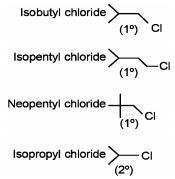
Which of the following is a secondary alkyl halide?
  1. A Isobutyl chloride
  2. B Isopentyl chloride
  3. C Neopentyl chloride
  4. D Isopropyl chloride
Show answer & explanation

Correct answer: D

Organic Compounds Containing Halogens – NEET-14967
2
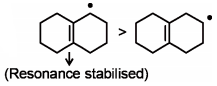
Which is most stable radical?
  1. A $\dot { \mathrm { C } } \mathrm { H } _ { 3 }$
  2. B $\mathrm { CH } _ { 2 } = \mathrm { CH } - \dot { \mathrm { C } } \mathrm { H } _ { 2 }$
  3. C $\mathrm { CH } _ { 3 } - \dot { \mathrm { C } } \mathrm { H } _ { 2 }$
  4. D
Show answer & explanation

Correct answer: B

Organic Compounds Containing Halogens – NEET-15073 Because of resonance allylic radicals are stable.
3
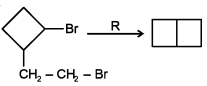
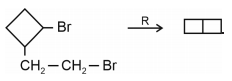
Organic Compounds Containing Halogens – NEET-15178 The reagent R is
  1. A $\mathrm { NH } _ { 3 }$
  2. B $\mathrm { H } _ { 2 } \mathrm { O }$
  3. C KCN
  4. D Na /ether
Show answer & explanation

Correct answer: D

Organic Compounds Containing Halogens – NEET-15178 The Reagent R would be Na/Dry ether this is actually Wurtz reaction and occurs via free radical mechanism.
4
$\mathrm { C } _ { 6 } \mathrm { H } _ { 5 } \mathrm {~N} _ { 2 } \mathrm { Cl } \xrightarrow { \mathrm { Cu } _ { 2 } \mathrm { Cl } _ { 2 } / \mathrm { HCl } }$, this reaction is named as
  1. A Sandmeyer
  2. B Swarts
  3. C Wurtz-Fittig
  4. D Finkelstein
Show answer & explanation

Correct answer: A

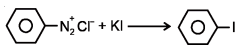
Organic Compounds Containing Halogens – NEET-15139 This is Sandmeyer reaction.
5
Which can not act as an ambident nucleophile?
  1. A $\mathrm { CN } ^ { - }$
  2. B $\mathrm { NO } _ { 2 } ^ { - }$
  3. C $\mathrm { SCN } ^ { - }$
  4. D $\mathrm { OH } ^ { - }$
Show answer & explanation

Correct answer: D

$\left.\begin{array}{l}\mathrm{CN}^{-} \\ \mathrm{NO}_{2}^{-} \\ \mathrm{SCN}^{-}\end{array}\right\} \Rightarrow$ These are ambident nucleophile as they two donar site.
whereas $\overline{\mathrm{O}} \mathrm{H}$ has only single site i.e., oxygen atom to donate electron pair.
6
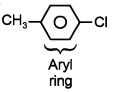
Which of the following may be classified as an aryl halide?
  1. A
  2. B
  3. C
  4. D
Show answer & explanation

Correct answer: C

The Halide which is in direct linked with AryI nucleus called Aryl halide.
Organic Compounds Containing Halogens – NEET-14976
7
Which is most reactive nucleophile in polar protic solvent?
  1. A $\mathrm { F } ^ { - }$
  2. B $\mathrm { Cl } ^ { - }$
  3. C $\mathrm { Br } ^ { - }$
  4. D $\mathrm { I } ^ { - }$
Show answer & explanation

Correct answer: D

$\frac{\mathrm{I}^{-}>\mathrm{Br}^{-}>\mathrm{Cl}^{-}>\mathrm{F}^{-}}{\text {Nucleophilicity }}$ (Polar protic medium)
8
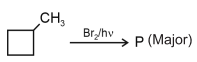
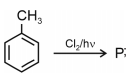
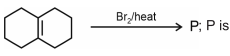
Product (P) is
Organic Compounds Containing Halogens – NEET-15055
  1. A
  2. B
  3. C
  4. D
Show answer & explanation

Correct answer: C

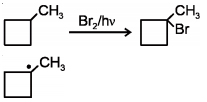
Organic Compounds Containing Halogens – NEET-15055 The reaction occur via free radical pathway and $3^{\circ}$ free radical is most stable.
9
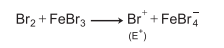
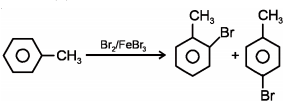
$\mathrm { C } _ { 6 } \mathrm { H } _ { 5 } \mathrm { CH } _ { 3 } \xrightarrow { \mathrm { Br } _ { 2 } / \mathrm { FeBr } _ { 3 } }$, the reaction is called
  1. A Nucleophilic substitution
  2. B Free radical addition
  3. C Electrophilic substitution
  4. D Free radical substitution
Show answer & explanation

Correct answer: C

Organic Compounds Containing Halogens – NEET-15132 Organic Compounds Containing Halogens – NEET-15132 This is electrophilic aromatic substitution.
10
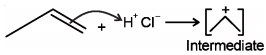
The intermediate during the addition of HCl to propene in presence of peroxide is
  1. A
  2. B
  3. C
  4. D
Show answer & explanation

Correct answer: B

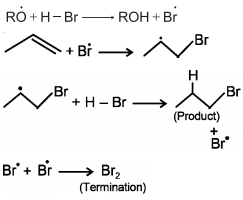
Organic Compounds Containing Halogens – NEET-15013Among all Hx only HBr gives free radical reaction be $\mathrm{CO}_{3}$ with HBr overall process is exothermic. Remaining Hx (HCl, HF, HI) give ionic reaction.
11
Organic Compounds Containing Halogens – NEET-15014
  1. A
  2. B
  3. C
  4. D
Show answer & explanation

Correct answer: B

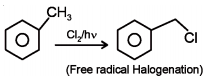
This is an example of free radical Halogenation Hence, allylic radical which is most stable will react with Br .
Hence, the product is
Organic Compounds Containing Halogens – NEET-15014 Stability order :
Organic Compounds Containing Halogens – NEET-15014


12
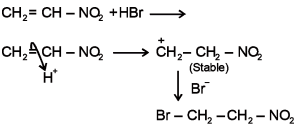
$\mathrm { CH } _ { 2 } = \mathrm { CH } - \mathrm { NO } _ { 2 } + \mathrm { HBr } \longrightarrow \mathrm { P }$; The major product ' P ' is
  1. A
  2. B
  3. C
  4. D $\mathrm { CH } _ { 2 } = \mathrm { CH } - \mathrm { Br }$
Show answer & explanation

Correct answer: A

Organic Compounds Containing Halogens – NEET-15012
13
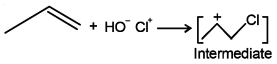
The addition of propene with HOCl proceeds via the addition of
  1. A $\mathrm { H } ^ { + }$in the first step
  2. B $\mathrm { Cl } ^ { + }$in the first step
  3. C $\mathrm { OH } ^ { - }$in the first step
  4. D Either $\mathrm { H } ^ { + }$or $\mathrm { OH } ^ { - }$in first step
Show answer & explanation

Correct answer: B

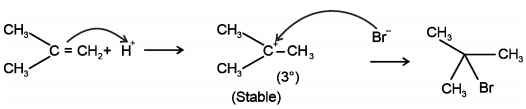
Organic Compounds Containing Halogens – NEET-15015 HOCl Breaks as : $\mathrm{HOCl} \longrightarrow \mathrm{HO}^{-}+\mathrm{Cl}^{+}$
And alkene follows electrophilic addition reaction, So at first $\mathrm{Cl}^{+}$attack.
Here, in a first step the electrophill $\left(\mathrm{Cl}^{+}\right)$will attack over the $\Pi-\mathrm{e}^{-}$cloud of alkene leading to electrophillic addition to alkene.
14
Which of the following is correct for the reaction?
$\mathrm { CH } _ { 3 } - \mathrm { CH } = \mathrm { CH } _ { 2 } \xrightarrow [ \text { Peroxide } ] { \mathrm { HBr } } \text { ? }$
  1. A Electrophilic substitution
  2. B Anti-Markovnikov's addition
  3. C Nucleophilic substitution
  4. D Markovnikov's addition
Show answer & explanation

Correct answer: B

$\mathrm{CH}_{3}-\mathrm{CH}=\mathrm{CH}_{2} \xrightarrow[\text { Peroxide }]{\mathrm{HBr}}$
Mechanism $\mathrm{R}-\mathrm{O}-\mathrm{O}-\mathrm{R} \xrightarrow{\mathrm{hv}} 2 \mathrm{RO}$
Organic Compounds Containing Halogens – NEET-15037 Hence, the above product formed reflects Anti-markovnikov's reaction.
15
Which is most reactive nucleophile in polar aprotic solvent?
  1. A $\mathrm { F } ^ { - }$
  2. B $\mathrm { Cl } ^ { - }$
  3. C $\mathrm { Br } ^ { - }$
  4. D $\mathrm { I } ^ { - }$
Show answer & explanation

Correct answer: A

$\frac{\mathrm{F}^{-}>\mathrm{Cl}^{-}>\mathrm{Br}^{-}>\mathrm{I}^{-}}{\text {Nucleophilicity }}$ (Polar aprotic medium)
16
The IUPAC name of the compound $\mathrm { CH } _ { 3 } - \mathrm { CH } = \mathrm { CH } - \mathrm { CH } _ { 2 } - \mathrm { Br }$ is
  1. A 4-Bromobut-2-ene
  2. B 1-Bromobut-2-ene
  3. C 3-Bromobut-2-ene
  4. D Allyl bromide
Show answer & explanation

Correct answer: B

$\stackrel{4}{\mathrm{CH}}_{3}-\stackrel{3}{\mathrm{CH}} =\stackrel{2}{\mathrm{CH}} -\stackrel{1}{\mathrm{CH}} _{2}-\mathrm{Br}$
IUPAC → 1 - Bromobut-2-ene
17
The addition of HBr is easiest with
  1. A $\mathrm { CH } _ { 2 } = \mathrm { CH } - \mathrm { Cl }$
  2. B $\mathrm { Cl } - \mathrm { CH } = \mathrm { CH } - \mathrm { Cl }$
  3. C $\mathrm { CH } _ { 3 } - \mathrm { CH } = \mathrm { CH } _ { 2 }$
  4. D $\left( \mathrm { CH } _ { 3 } \right) _ { 2 } \mathrm { C } = \mathrm { CH } _ { 2 }$
Show answer & explanation

Correct answer: D

The reaction of alkine with HBr is basically a kind of electrophilic addition to alkenes in this reaction, a very first step is a formation of intermediate carbocation which is rate determining step (slow step), followed by nucleophilic attack.
Organic Compounds Containing Halogens – NEET-14980
18
Organic Compounds Containing Halogens – NEET-15047 Product (P) is
  1. A
  2. B
  3. C
  4. D
Show answer & explanation

Correct answer: C

Organic Compounds Containing Halogens – NEET-15047
19
Which of the following halogen exchange reaction will occur in acetone?
  1. A $\mathrm { R } - \mathrm { I } + \mathrm { NaCl } \rightarrow$
  2. B $\mathrm { R } - \mathrm { F } + \mathrm { KCl } \rightarrow$
  3. C $\mathrm { R } - \mathrm { Cl } + \mathrm { NaI } \rightarrow$
  4. D $\mathrm { R } - \mathrm { F } + \mathrm { AgBr } \rightarrow$
Show answer & explanation

Correct answer: C

$\mathrm{R}-\mathrm{Cl}+\mathrm{NaI} \rightarrow \mathrm{R}-\mathrm{I}+\mathrm{NaCl}$
This reaction will occur in acetone because of two reasons:
(i) The reactant NaI is more soluble in acetone.
(ii) Secondly, the formed product NaCl will precipitate out
20
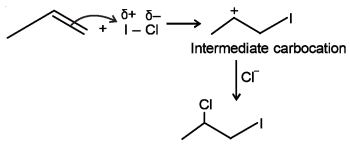
$\mathrm { CH } _ { 3 } - \mathrm { CH } = \mathrm { CH } _ { 2 } \xrightarrow { \mathrm { Cl } - \mathrm { I } } P , P$ is
  1. A
  2. B
  3. C
  4. D
Show answer & explanation

Correct answer: B

Organic Compounds Containing Halogens – NEET-15017

Attempt this as a timed test

Reading answers is not the same as sitting the paper. Attempt it timed and you get your score, per-question timing, and the mistakes tracked for revision.

Start free

More Organic Compounds Containing Halogens tests

All Organic Compounds Containing Halogens tests →