1
Which among the following is Darzen's method of preparation of alkyl chloride?
- A $\mathrm{CH}_{3} \mathrm{CH}_{2} \mathrm{OH} \xrightarrow{\mathrm{PCl}_{5}} \mathrm{CH}_{3} \mathrm{CH}_{2} \mathrm{Cl}$
- B $\mathrm{CH}_{3} \mathrm{CH}_{2} \mathrm{OH} \xrightarrow[\mathrm{ZnCl}_{2}]{\mathrm{HCl}} \mathrm{CH}_{3} \mathrm{CH}_{2} \mathrm{Cl}$
- C $\mathrm{CH}_{3} \mathrm{CH}_{2} \mathrm{OH} \xrightarrow{\mathrm{PCl}_{3}} \mathrm{CH}_{3} \mathrm{CH}_{2} \mathrm{Cl}$
- D $\mathrm{CH}_{3} \mathrm{CH}_{2} \mathrm{OH} \xrightarrow{\mathrm{SOCl}_{2}} \mathrm{CH}_{3} \mathrm{CH}_{2} \mathrm{Cl}$
Show answer & explanation
Correct answer: D
$\mathrm{R}-\mathrm{OH} \xrightarrow[\text { (Darzen's method) }]{\mathrm{SOCl}_{2}} \mathrm{RCl}+\mathrm{SO}_{2}+\mathrm{HCl}$
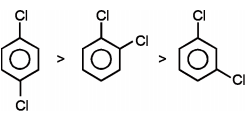 This is because of more symmetrical structure and tight crystal packing.
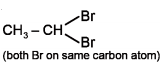
 has highest boiling point.
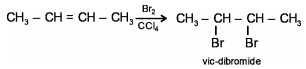
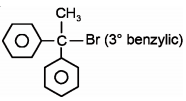 This is most reactive for S$_{N}$1 reaction amongst the choices given.
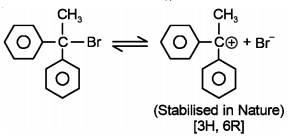 Here, 3 Hyperconjugating and 6 Resonating structures are plausible to stabilizers this carbocation.
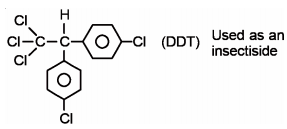
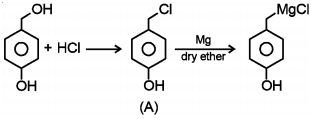
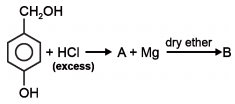 What is B?
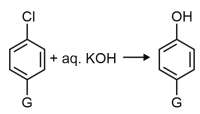 For which of the following G , above reaction will be the fastest?
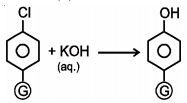 As the reaction proceed the SNAr mechanism.

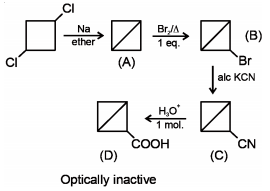
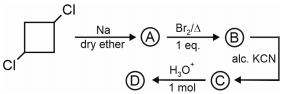 Product (D) in the reaction is